
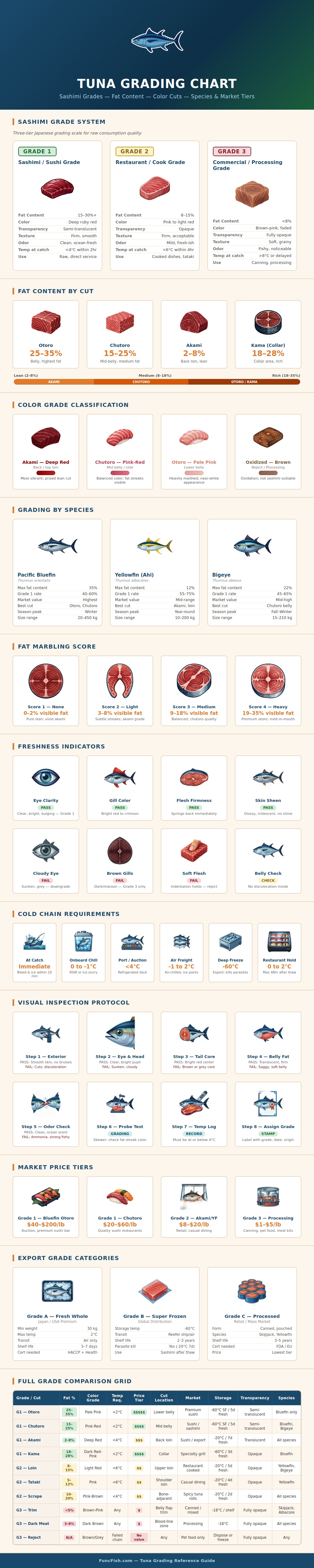
There’s this thing called “tuna”. Most people think tuna is just tuna. That’s wrong. Grading tuna, and understanding how it works, will make you a better eater. But more importantly, it saves you money: not everything labeled tuna are going to be good. Some things is going to suck ass and cost you money. What can you do about it? Know what to look for.
According to the chart above, there are basically three levels of tuna quality based off how each fish is treated after it’s out of the water. Time tops the list here. A fish has only ten minutes to be bled and moved into cold temperatures before enzymes in its belly begin to break down fat. As the fat degrades, the fish lose flavor and becomes mushy.
How to Choose Good Tuna
Grade 1 fish are rushed out, placed in ice, and kept below freezing nearly immediately. This maintains their fresh scent, which is mark of high-quality sashimi. It also keep them from warming up and losing their freshness. Grade 3 fish never make it to this stage; instead, they’re left to rot and eventually wind up as feed for pets or canned tuna. It’s the difference between art and industrial processing; and it all lies in space between Grade 1 and Grade 3.
But that’s where the good stuff lies: Fat. There is a reason why a tuna isn’t all the same. Because it insulates its organs, the fat are stored in the belly. From there, the meat get progressively firmer and leaner to the rear end. The fattiest cut of sushi is the lowest part of the belly, otoro, which can reach upwards of thirty-five percent fat. That means it’s essentially just fat that melts on the palate wrapped around muscle fiber.
Next up, the loin (near the spine), akami, are firm, deep red, and lean. For some, this is their favorite sashimi, since it doesn’t weigh them down like otoro does. Others are after the rich taste, chasing after otoro. Again, no one is wrong here. It simply depends what you’re after: Are you in it for the texture? Or are you after the intensity?
Another way to tell if your tuna is fresh (or oxidized) is color. The tuna meat should be vibrant, not dull. Akami should be deep ruby red, while the Chutoro in the middle of the belly will have more fat and therefore appear pinker. Otoro is all about fat, so it appears nearly white or pale. And if you notice any brownish hues? Walk away. When the fish has been sitting out for too long or kept at an improper temperature, that’s called oxidation, and it indicates that the myoglobin in the tuna meat have reacted with oxygen and gone dull. While this is something a good sushi chef can cut around, it often ends up costing the kitchen some money.
Even more important is that species matters. Bluefin tuna is known for its ability to store excess belly fat in the winter months. This is why bluefin is so good for sashimi, it’s full of fat! The other two tuna types (Yellowfin & Bigeye) also makes great fish, but they do not store as much fat internally. Their meat is much leaner, which means it will stand up well to the heat of a grill/sear instead of going soft. Don’t try to use thin slices of yellowfin for bluefin otoro, there’s just no fat there to help carry the flavor/mouthfeel.
If you’ve ever wondered what to look for in freshness, here goes. First, the eyes: They need to be bright and bulging, not cloudy and sunken. Next, the gills should be bright red, never brown or maroon. If they’re the latter, that means the fish has been sitting in cold storage too long. Finally, press down on the fish with your finger. A good piece of tuna will spring right back at you. If the meat is mushy or soft, that means it’s breaking down. It’s a small detail, but it tells you everything about how the fish was handled before it got to your plate.
All of this adds up to price. Strict handling and limited supply are why premium otoro comes at its price point. As much as it’s about the fish, it’s about the cold chain. When purchasing tuna, look for openness in both handling and origin. A restaurant that doesn’t know where their tuna originated (and even worse, how it was handled) likely doesn’t have any idea themselves. Seek out vibrance, smell for cleanliness, and lastly, know that not all of the fattiest cuts is the best cuts. They’re the ones that was treated with respect from the second it came out of the water to when it arrived on your plate.
You should of looked for quality.