Vertical Jig Weight by Current Calculator
Estimate a vertical jig weight from depth, tide speed, braid diameter, jig profile, boat drift, and target line angle so the lure fishes near the strike zone instead of sweeping away.
📌Vertical jigging presets
⚙Current, depth, and jig settings
Use depth to the jigging zone, not just charted bottom, when fish are suspended.
Use the current where the line fishes; surface tide can be different from bottom flow.
Diameter drives line drag more than listed breaking strain. Override the PE preset here.
Under 20 degrees is crisp vertical jigging; 30 degrees is still fishable for many drifts.
Vertical jig weight estimate
Calculation breakdown
📊Braid drag and jig profile data
PE 1.0 Finesse
PE 1.5 Allround
PE 3 Offshore
Wide Flutter
🌊Current and depth starting table
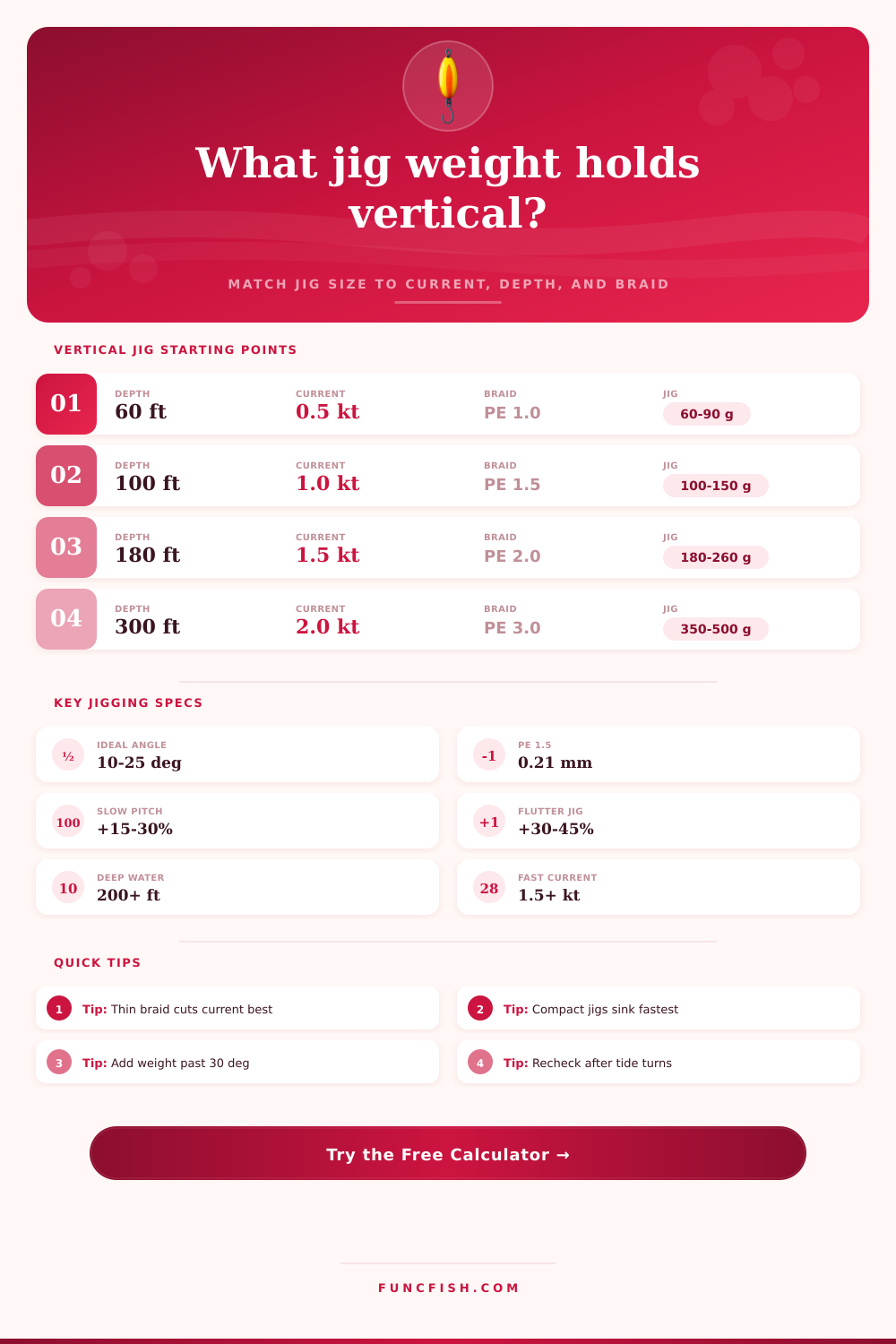
| Depth band | Light current, 0.3-0.6 kt | Moderate current, 0.7-1.2 kt | Strong current, 1.3-1.8 kt | Fast tide, 1.9-2.5 kt |
|---|---|---|---|---|
| 40-80 ft / 12-24 m | 40-80 g / 1.5-3 oz | 80-130 g / 3-4.5 oz | 130-200 g / 4.5-7 oz | 200-300 g / 7-10.5 oz |
| 80-140 ft / 24-43 m | 80-130 g / 3-4.5 oz | 130-220 g / 4.5-8 oz | 220-330 g / 8-12 oz | 330-450 g / 12-16 oz |
| 140-220 ft / 43-67 m | 130-220 g / 4.5-8 oz | 220-330 g / 8-12 oz | 330-500 g / 12-18 oz | 500-650 g / 18-23 oz |
| 220-350 ft / 67-107 m | 220-350 g / 8-12 oz | 350-520 g / 12-18 oz | 520-750 g / 18-26 oz | 750-1000 g / 26-35 oz |
🧵Braid diameter reference
| Braid class | Typical diameter | Common breaking range | Current drag behavior | Vertical jigging use |
|---|---|---|---|---|
| PE 0.8 | 0.15 mm / 0.006 in | 14-18 lb / 6-8 kg | Very low belly | Finesse reefs, light walleye, small jigs |
| PE 1.5 | 0.21 mm / 0.008 in | 25-35 lb / 11-16 kg | Balanced control | Snapper, rockfish, striped bass, general offshore |
| PE 2.5 | 0.27 mm / 0.011 in | 40-50 lb / 18-23 kg | Needs more lead | Cod grounds, grouper ledges, medium amberjack |
| PE 4.0 | 0.34 mm / 0.013 in | 65-80 lb / 29-36 kg | High belly in tide | Tuna, big amberjack, deep structure with locked drag |
🎣Jig profile comparison
| Profile | Hydrodynamic load | Sink character | Weight adjustment | Best use |
|---|---|---|---|---|
| Compact tungsten or dense lead | Low, 0.80-0.90 | Fast, straight drop | Can fish lighter | Deep marks, hard tide, quick bottom reset |
| Slim knife or rear-weighted jig | Moderate, 0.95-1.05 | Fast with short dart | Baseline weight | Speed jigging and pelagic targets |
| Slow pitch flat-side jig | High, 1.20-1.35 | Broad fall and kick | Add 15-30% | Rockfish, snapper, bottom species that eat on fall |
| Flutter, bucktail, inchiku, kabura | Very high, 1.35-1.65 | Slow glide or parachute | Add 30-60% | Shallow rips, baited vertical work, short drifts |
⚖Gear and species comparison grid
| Species or fishery | Useful braid | Rod jig rating | Common vertical jig range | Angle priority |
|---|---|---|---|---|
| Walleye, zander, light river current | 8-15 lb / PE 0.6-1.0 | 1/2-2 oz / 15-60 g | 20-80 g / 3/4-3 oz | Keep under 15 deg for bottom ticks |
| Snapper, sea bass, nearshore reef | 20-35 lb / PE 1.0-1.5 | 60-180 g / 2-6 oz | 60-200 g / 2-7 oz | 20-25 deg is usually workable |
| Rockfish, cod, pollock, ling | 30-50 lb / PE 1.5-2.5 | 150-400 g / 5-14 oz | 180-500 g / 6-18 oz | Bottom contact matters more than flutter |
| Amberjack, grouper, tuna, deep wrecks | 50-80 lb / PE 3.0-5.0 | 250-800 g / 9-28 oz | 250-900 g / 9-32 oz | Use heavier jigs to reduce structure sweep |
💡Calculation notes
Line drag tip: If two setups use the same jig but one runs thicker or rougher braid, the thicker line needs more weight because current pushes the entire line column, not only the lure.
Tide change tip: Recalculate when the tide builds, drops, or reverses. A jig that is perfect at 0.8 kt can become too light once the same drift reaches 1.4 kt.
“Your bait’s not going to go anywhere unless you move it forward with your rod tip. That’s why it gets frustrating. Your rod tip isn’t moving, yet your lure won’t go exactly where you want it to. The water grab your line and sends your jig out ten feet from the structure where fish sits. Instead of feeling your jig tick bottom, you’re feeling drag on your reel and know you aren’t presenting the right way to conditions in the water.
“That’s never really about depth; that’s about staying vertical after you make your descent. A lot of guys pick their jigs solely by depth. They don’t consider the speed of current at whatever depth they’re going to be fishing. Current will keep you honest. Depth gets you down, but current will push you sideways if you don’t have enough weight to stay vertical. Otherwise, you’re not vertical jigging anymore and your technique is less effective.”
Why Jigs Need the Right Weight
You don’t have to guess what conversion or coefficient applies to your conditions; the calculator does that work for you. Breaking strength isn’t as big a deal as braid diameter when it comes to drag, because how much water gets caught on the line as it falls has everything to do with its surface texture. Even if pound test is higher, if line is rough, it might not actualy create as much friction in the water column than a slicker line with a lower pound test. And over a hundred feet, that can add up.
You’re able to plug-in your true line diameter into the tool so you get a weight recommendation that’s fighting the actual current, instead of an average guess. Lateral resistance is also related to jig profile. Because a compact piece of tungsten cut through the water with little resistance, a knife sinks fast and straight. On the other hand, a wide flutter spoon or a dressed bucktail jig have some lift, so it will act more like a parachute that can be pushed off course in a moderate flow. To offset its own lift in current you must adds additional weight. As table indicates, you’ll have to go up several sizes for wide profile lures to get them to hang at the same angle as a slim one.
Ideally, you want the line to be as close to truly vertical as possible. Anything over thirty degrees typically mean that the lure is too far off structure or the fish are seeing it from an unflattering perspective. Once you enter some values into the calculator, it will predict the likely angle and give you some idea of what your set-up should of look like prior to launching the cast. For instance, if the calculator tell you that with your given tide you’ll have a thirty-five degree bow out, you know you’re going to need a heavier jig or thinner line. Better to adjust your equipment on the dock than fumble around for an hour with your head bowed out at 45 degrees.
The tide isn’t a fixed thing and what was an easy drift can double up on you within half an hour. When it turns again, make sure to recalculate; a jig that stayed in steady contact at zero-point-five knots could bounce along the bottom at one-and-a-half. To combat this, the calculator has a cushion feature. This allows you to account for extra weight when you are working against pulsing current or fishing in an area with heavy structure that require absolute control.
The whole vertical jig thing is all about positioning and control. Once you choose the proper weight, you can feel everything with your fingertips. You can feel it hitting bottom, being pushed by a fish, or hanging in the strike zone. That’s what separates an empty drift from a full livewell, getting the connection back.