Water Color to Feeding Depth Calculator
Estimate the depth band where fish are most likely to feed by combining water color, visibility, light, season, cover, bait contrast, and species behavior.
📌Scenario presets
⚙Water and feeding inputs
Feeding-depth forecast
Full breakdown
📋Water color reference grid
Gin Clear
Clear Green
Stained
Muddy
📊Reference tables
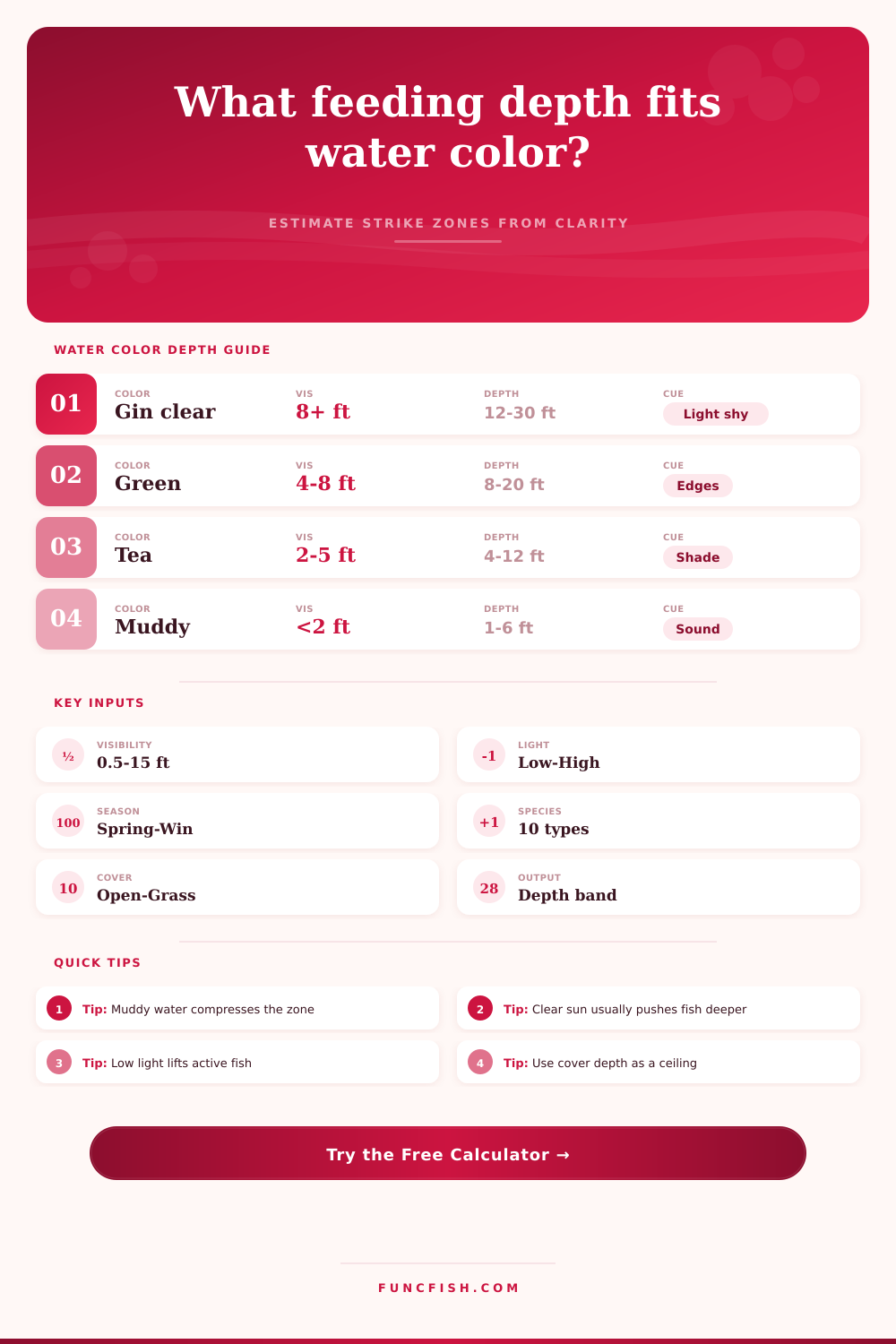
| Water color | Typical visibility | Starting feed zone | Best signal |
|---|---|---|---|
| Gin clear blue | 8-20 ft / 2.4-6.1 m | 12-30 ft / 3.7-9.1 m | Low light, long casts |
| Clear green | 5-10 ft / 1.5-3.0 m | 8-22 ft / 2.4-6.7 m | Breaks and weed edges |
| Light stained | 3-6 ft / 0.9-1.8 m | 5-16 ft / 1.5-4.9 m | Contrast and shade |
| Tea stained | 2-5 ft / 0.6-1.5 m | 4-12 ft / 1.2-3.7 m | Dark edges and wood |
| Algae green | 1.5-4 ft / 0.5-1.2 m | 3-10 ft / 0.9-3.0 m | Oxygen edges |
| Muddy brown | 0.5-2 ft / 0.2-0.6 m | 1-6 ft / 0.3-1.8 m | Sound and contact |
| Species | Clear water bias | Stained water bias | Prime depth behavior |
|---|---|---|---|
| Largemouth bass | Weed edge 8-18 ft | Cover 2-10 ft | Uses shade and ambush cover |
| Smallmouth bass | Rock 12-28 ft | Rock 6-16 ft | Roams deeper with sun |
| Walleye | Breaks 15-35 ft | Edges 6-18 ft | Favors dim bands |
| Trout | Thermal band 8-30 ft | Current 2-10 ft | Tracks oxygen and light |
| Crappie | Brush 8-20 ft | Brush 3-12 ft | Suspends near vertical cover |
| Catfish | Channel edge 6-20 ft | Bank seam 1-8 ft | Feeds shallow in low visibility |
| Northern pike | Grass 5-15 ft | Grass 2-8 ft | Uses sight and ambush lanes |
| Redfish | Clear flats 1-5 ft | Mud edges 1-4 ft | Often stays shallow near tide |
| Light or season | Depth shift | Visibility effect | Use when |
|---|---|---|---|
| Dawn / dusk | Lift 10-25% | Low glare | Fish slide shallower to feed |
| Bright sun | Drop 15-35% | High glare | Clear water and sparse cover |
| Overcast | Lift 5-15% | Even light | Stained water or wind chop |
| Summer warm | Split shallow/deep | Thermal stress | Check oxygen edges |
| Winter cold | Compress 10-20% | Slow pursuit | Use slower horizontal moves |
| Bait visibility | Best water color | Depth role | Species match |
|---|---|---|---|
| Natural subtle | Gin clear / clear green | Keeps pressured fish honest | Trout, smallmouth, pike |
| Flash / metal | Clear green / light stained | Extends sight window | Walleye, striped bass |
| Dark silhouette | Tea / tannic / night | Shows against the surface | Bass, catfish, crappie |
| Chartreuse / white | Stained / algae / brackish | Holds contrast in color | Bass, redfish, crappie |
| Vibration / scent | Muddy / silt gray | Lets fish find bait close | Catfish, redfish, bass |
💡Practical checks
Tip: Treat the calculated range as a starting lane. If bites come at the top or bottom of the band, recalculate with the nearest real visibility reading.
Tip: In muddy water, cover and contact matter more than exact depth. Keep the bait within the lure visibility window shown above.
It’s often panic time when you’re standing on a dock staring down at muddy brown water or clear green water. Where in the heck are the fish? I’ll cast a few times to an area that looked good but didn’t have any fish.
This isn’t always because of your technique; it’s most likely because of your depth. If the fish is feeding deeper than what you are fishing, they don’t give a hoot about your lure. They’re eating. You’re not.
How to Find Fish at the Right Depth
The calculator above does the math for you. It makes those vague observations mean something with a concrete target zone. Even without the tool, understanding how this works will help you become a better angler.
Feeding depth depends on water clarity, the farther they can see, the deeper they’ll go Sunlight penetrates further in clear water so visibility is high. Trout, smallmouth bass and other species doesn’t like feeling exposed. They will pull up and seek shelter under cover or along deep channels to ambush prey safely.
Muddy water blocks out the light so the visual horizon is reduced. Because their predators can’t see them, they don’t have to hide as much. So they feed aggressively in shallow water instead.
Depending upon what you enter for visibility, the tool adjust the range to reflect that. For example, if you’ve got two feet of visibility in muddy river water, the result points you toward the bank seam. Or, if you’re seeing eight feet in a clear lake, it pushes you toward those deep breaklines. It’s just to keep the fish safe and comfortabley.
The system also has a dial for light conditions. Clear water and bright sunlight put pressure on fish. They get pushed deeper, or into shade lines of weeds and dock edges. On overcast days, light is diffused and fish can roam shallow with less worry. That matters a lot for the calculation.
You might find yourself with a deep number on a bright sunny summer day in clear water. Throw in some thick clouds and move to the same body of water and target rises up.
Even season plays a role. Fish are always looking for warm water and shallow water when spawning. No matter how clear it is. Come high summer, they may divide their time between shallow oxygen laden weed bed and thermal refuge out deep.
Considering all these opposing factors gives us a better idea of where the fish should be without guessing what is driving them on a particular day.
Another wrinkle comes from species behavior. For instance, we all know walleyes hunt in stained water or low light. Often they will be a little closer to structure than bass will in those same conditions. In addition, catfish have less vision so their depth will be more related to current seams and areas with good food availability as opposed to light penetration. You can see from the table on the page where each species leans one way or the other in terms of position based off water color.
While a largemouth in stained water might stay near cover in four feet of water, a walleye in that same water might hover off the bottom at about six feet. Knowing this helps avoid your time being wasted trying to target the incorrect vertical area.
Also, you have to take into account bait visibility. A natural but more subtle color works well in clear water when pressured fish are hesitant to spook on something obvious. But in muddy or stained water where they can’t really see the bait well, something with vibration or higher contrast becomes key. The calculator factors that in as well with its effective strike window.
If the fish can’t see what you’re throwing, then the depth range shrinks because it has to get very close to feel it out. That’s why we say to match the output to the tackle you’re using. You won’t necessarily go down and pick a depth and go for it. You’ll want to make sure your presentation fits the look of the environment.
All of these tools give you a place to start, but they don’t guarantee anything. Water’s messy, real water. The wind blows, it chops up the surface and changes how light goes through. It rained yesterday and the turbidity shot through the roof in an instant. Treat this calculated range as a starting place. Adjust just a little by what you see and feel if you’re not getting bit.
Begin with the math, but let the water speak for itself at the end of the day. Figuring out the depth makes it a good day instead of a frustrating day. You should of used the tool more often.