Weedless Hook Gap Calculator
Estimate whether a weedless hook leaves enough bite gap after soft-plastic compression, skin-hooking depth, wire bulk, cover drag, and hookset force.
🎣Rig presets
📏Hook and bait measurements
Weedless hook gap results
Calculation breakdown
🧰Gear and species comparison grid
Stick Worm
Creature Bait
Swimbait
Soft Toad
Flipping Craw
Weedless Wacky
Pike Slug
Inshore Paddle
📊Hook gap reference by soft-plastic profile
| Plastic profile | Typical body height | Good gap ratio | Common hook range | Rigging note |
|---|---|---|---|---|
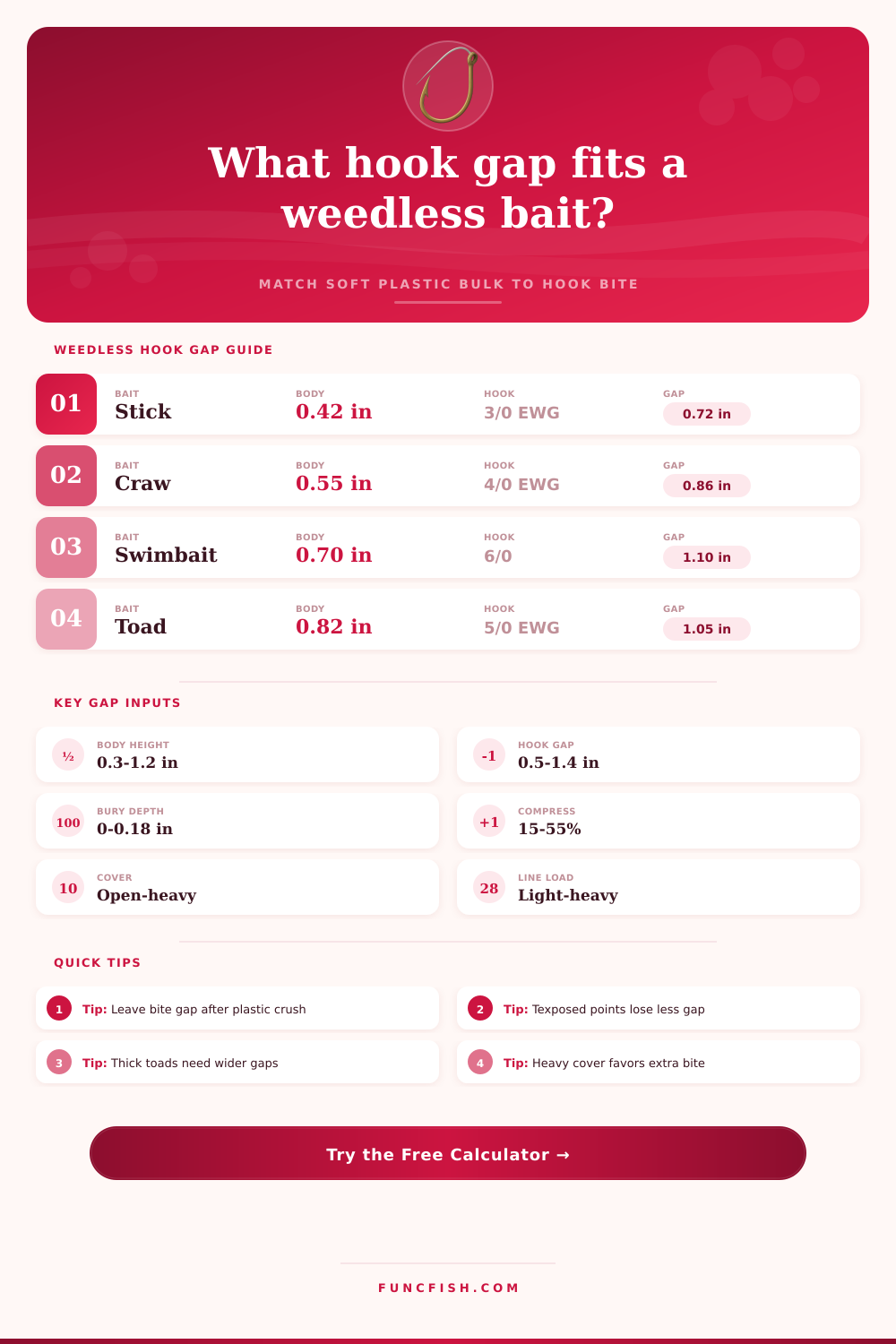
| Thin stick worm | 0.32-0.46 in / 8-12 mm | 1.45-1.75x | 2/0 to 4/0 EWG | Texpose lightly; too much bury costs bite. |
| Bulky creature bait | 0.50-0.72 in / 13-18 mm | 1.55-1.90x | 4/0 to 6/0 EWG | Extra-wide bend helps clear ribs and appendages. |
| Craw or beaver body | 0.45-0.65 in / 11-17 mm | 1.45-1.80x | 3/0 to 5/0 straight or EWG | Straight shanks penetrate well but need true alignment. |
| Paddle-tail swimbait | 0.55-0.90 in / 14-23 mm | 1.45-1.75x | 4/0 to 8/0 belly hook | Keel weight and screw lock add rigging loss. |
| Soft toad or frog | 0.70-1.05 in / 18-27 mm | 1.35-1.65x | 4/0 to 6/0 EWG or double | Soft hollow sections compress, but legs can block roll. |
| Fluke or jerk shad | 0.38-0.62 in / 10-16 mm | 1.45-1.80x | 3/0 to 5/0 offset | Keep the bait straight so the point tracks centerline. |
🪝Hook style clearance factors
| Hook style | Gap behavior | Typical wire | Best use | Clearance caution |
|---|---|---|---|---|
| Extra-wide-gap offset | High belly clearance | 0.040-0.060 in | Stick worms, creatures, toads | Point can lay flat if bait is too thick. |
| Round-bend offset | Deep bite with less belly room | 0.035-0.052 in | Thin worms and flukes | Bulky ribs can fill the opening. |
| Straight-shank flipping | Fast point path | 0.045-0.065 in | Craws, beavers, punch rigs | Snell kick helps but bury depth matters. |
| Weighted belly screw-lock | Keel weight adds rigging loss | 0.050-0.075 in | Swimbaits and weedless paddles | Undersized gaps wedge against tall bodies. |
| Twist-lock / CPS style | Holds nose straight | 0.045-0.068 in | Flukes, tubes, saltwater plastics | Screw lock does not fix a filled gap. |
| Weedless wacky guard | Open point with guard drag | 0.028-0.045 in | Wacky worms near brush or grass | Guard stiffness needs extra hookset load. |
🐟Target fish bite-clearance table
| Target | Minimum bite clearance | Typical hookset load | Preferred rig | Gap note |
|---|---|---|---|---|
| Largemouth bass | 0.16-0.26 in / 4-7 mm | 5-10 lb at bait | EWG, straight-shank, toad hook | Heavy cover rewards extra raw gap. |
| Smallmouth bass | 0.13-0.22 in / 3-6 mm | 3-7 lb at bait | Offset worm, finesse EWG | Do not oversize so much that bait action dies. |
| Pike or musky | 0.26-0.38 in / 7-10 mm | 8-16 lb at bait | Large swimbait or slug hook | Use wider gaps and strong wire. |
| Redfish or speckled trout | 0.18-0.30 in / 5-8 mm | 4-9 lb at bait | Weighted belly or twist-lock | Saltwater plastics often need longer shanks. |
| Snook or juvenile tarpon | 0.22-0.34 in / 6-9 mm | 7-14 lb at bait | Heavy belly hook, strong offset | Harder mouths need both gap and load. |
| Panfish or crappie | 0.08-0.14 in / 2-4 mm | 1-3 lb at bait | Small guard hook | Thin wire helps penetration on light line. |
🔍Diagnosis table for missed fish
| Symptom | Likely gap issue | Measurement to check | Adjustment | Why it works |
|---|---|---|---|---|
| Point barely shows after hookset | Plastic fills the bend | Compressed body height | Move up one hook gap size | More opening remains after the bait crushes. |
| Fish skin-hooked outside mouth | Clearance is marginal | Usable bite gap score | Texpose shallower or widen gap | The point has a cleaner path through plastic. |
| Bait rolls during retrieve | Hook too wide or off-center | Gap-to-width ratio | Re-rig centerline or shorten shank | Centered mass keeps the hook upright. |
| Good bites but no penetration | Hookset load is low | Load at bait and rod-line type | Use thinner wire or less bury depth | Less force is needed to free the point. |
| Snags increase after upsizing | Too much exposed point path | Skin-hook depth | Add slight texpose depth | Small bury depth protects without filling the gap. |
| Swimbait tears nose or twists | Gap and screw lock not aligned | Belly height and hook throat | Use longer screw-lock belly hook | The point exits at the thickest body line. |
Measurement tip: Close the bait around the hook with your fingers and look at the point path. If the point must travel through a full wall of plastic before it sees open air, the calculator will usually show a low usable bite gap.
Rigging tip: A bigger hook is not always better. If the gap score is high but the bait rolls, shorten the shank or use a hook style with the same gap and a better centerline exit.
Ever set the hook and feel the fish slam it? You yanked as hard as possible, but you felt it go slack. You reel up and see a seemingly good looking hook that came away empty handed. The fish are missing.
Most of us pick a hook size based off the length of bait rather than actual physics of the bite. The fact is the thickness of most baits mean they have no room for the hook to get from under the body up through the lip and into the fish. Everyone do it sooner or later. But the gap is what makes it work or not.
Why Fish Miss the Hook
When you set the hook, soft plastics compress. We has all experienced this. Most guides will tell you they don’t think about it until it results in a lost fish, but it is a physical reality we can’t avoid. When you bury a Texas-rigged stick worm into the head, the plastic squishes together as it’s compressed under pressure. That half inch of body height suddenly become a quarter inch (or less) in that instant of impact.
The calculator above perform this math for you. It calculates how much of your bait’s body will be “effective,” which is the amount of its height that will actualy make contact. This matters, because if you’re relying on raw gap measurements alone, without considering the crush factor, you’re essentially fishing with a hook that’s too small for the job.
So imagine a soft salted creature bait versus a firm floating fluke. The fluke maintains form when pressed against your point, giving it more of its inherent width to block path of the point. In contrast, the salted creature becomes soft under pressure and helps it enter if the gap was made for that squished body. That’s what I mean by density. Generic rules such as a four-zero on a medium bait don’t work well because they ignore this factor. A denser swimbait require more raw gap due to its non-compressible nature. A softer bait could of get away with a tighter bend if rigged right.
Your location can determine what gets in the way of a hook. A sharp, exposed hookpoint is needed for punching through heavy cover such as matted grass and milfoil to get fish out of the weeds. This increased exposure come at a cost. By wrapping plastic over the hook bend, or burying its shank, you’re making rig more weedless but decreasing the clearance for the hook to deflect a side swipe bite. Many bass will attack the bait from odd angles turning it in their jaws. So if your hook isn’t buried deep enough to remain snag free, it may simply slide down the fish’s jaw as he turns with it.
Here’s where wire size quietly but importantly becomes part of this equation again. You might think that thicker wire resist bending at the point when setting hooks. That’s actualy a disadvantage much more time. Thinner wire flexes just enough to give your hookpoint a smooth entry into soft tissue, whether it be fish or bait mouth. This means there is a higher chance of deflection against hard cartilage or bone with thick wire. The tool takes this into account and sets the effective clearance according to size of shank material you choose.
How does it perform in the water? That depends on the rigging style. Baits rigged with an extra wide gap hook are specially made to have as much distance from point to shank as possible. This allows them to open back up after being compressed, accommodating bulky baits like crawfish imitators. A straight shank flipping hook sacrifice some belly clearance but has a quicker, more direct line of sight for the point when going through brush piles. A finesse wacky hook will not penetrate because the point won’t be able to come through the mass of plastic before the bait hits the cover; the geometry just doesn’t work.
Many anglers ignore mechanical fit because they get hung up on the details of color and scent in their lures. You can paint one on that catches ’em but if the hook can’t grab hold of the fish mouth, they won’t be caught. Take less than a minute to check yours out on dry land. Pinch the bait tightly around the hook eye and watch where the point sits. Look at where the point is positioned. If the entire hook point are covered by rubber, it’s time to go up a size or back off on how much you bury.
Missed strikes becomes catches when your gap is correct. Biology + mechanics = getting ‘em in the boat. You are not merely touching an obstruction but clearing it by measuring twice to rig once and then letting physics take over on the big bite.