
You’re on that muddy bank of some European river, hammering your heart against your ribs. The fight has already lasted twenty minutes. Your rod’s in great danger, bending like a bowstring, but you finally get the monster to the mat and look her over. She appears huge. But since you don’t have any scales, you have no idea exactly how large she might be.
And that’s when most anglers lose confidence because of that guesswork. Knowing how much an inch equals change everything. Unlike a bass or a trout, the wels catfish doesn’t mature by growing linearly. As it ages, its body shape undergoes drastic changes. So while one fish is 50 inches long and another is 100 inches long, they follows entirely different sets of mathematical formulas regarding weight and girth.
How to Estimate the Weight of Wels Catfish
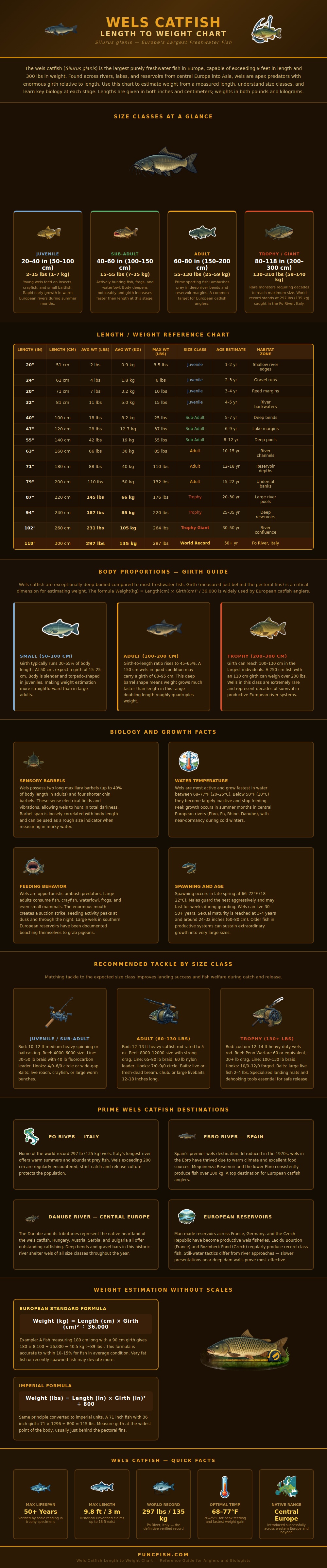
This gets broken down in the chart above which shows clear divisions of each size class: starting with juveniles hovering around twenty to forty inches. Younger fish are still torpedo shaped and relatively slender. They still eat small baitfish and insects, but rapidly increase their growth rate in warm summer water. Because they are not as thick than older fish, you can predict their weight.
Sub-adults ranging from forty to sixty inches begin to change there shape. The body begins to deepen substantially. This is where the weight begin to accelerate more quickly then the length. On average a fifty-five inch sub-adult will weigh forty-two pounds. That’s substantially more girth than a twenty-four inch juvenile. And you can’t just scale up their weight as you would if it were one of the smaller fish. The thickness increases, which adds bulk that pure length measurements completely ignore.
That’s why girth is such an important component to the common estimation formula used throughout Europe. The formula essentially uses the fish’s length times the girth squared, divided by some sort of constant factor. Why? Because girth determines the amount of volume present in a fish which plays a bigger role in weight than does surface area. A one-hundred-and-eighty centimeter fish with a girth of ninety centimeters will weigh about forty kilograms according to equation. This takes into account their barrel-like bodies that most mature adults possess. Those who fail to consider girth tend to underestimate trophy fish by dozens of pounds.
The deeper the belly, the heavier the catch. This is a basic principle, but it makes all the difference. It helps you determine if you caught a respectable adult or if you actualy battled a giant.
It’s interesting to understand how this growth occurs biologically. Wels catfish are ambushing predators who use their sense of smell through sensory barbels that can picks up on electrical fields even in dark water. Feeding aggressively at twilight, they will eat everything from small waterfowl to crayfish. Below a 50 degree Fahrenheit temperature, they slow way down metabolically. So during those warm summer months in river fisheries such as the Ebro in Spain or the Po in Italy, they grow most. In these more southerly bodies of water, the water retains heat longer. This lengthens the feeding period and gives them time to pack on pounds year after year.
Decades-old specimens exist. These giants continue to grow slowly over time as they quietly dominate food chain in deep reservoirs.
Match your gear to potential size of the fish you’re going after. For juveniles, braided line in the thirty-to-fifty-pound range works well with a medium-heavy spinning rod. Go into the adult zone at six feet or more, and you want a rod that’s built for throwing five ounces; heavy duty stuff. And reels need strong drags that holds eighty pounds or better. Use circle hooks… They help avoid gut-hooked fish (very important for catch-and-release welfare). Handling the fish when wet requires both power and sensitivity. If you respect the species, good dehooking tools and landing mats is a necessity rather than an accessory.
It prepares you both physically and mentally. If you’re feeling the first bite, you’ll want to know whether you are dealing with a 20-pound sub-adult or a 200-pound trophy lurking in a river bend. That makes all of the difference in what you use for tackle and how you approach the battle. Old monsters crush slowly while young ones go crazy in circles. Identifying which one is on the line early reduces stress on both the animal and your gear.
The bottom line: pursuing wels catfish is more than half science, but it’s also half art; half patience. Because these fish continue to grow steadily throughout their extended lives (some living over fifty years), anglers need to understand how these animals develops to catch them. Wels will make you wait for a memory that is just as brief as the experience itself. If you’re looking for a 40 pound sub-adult on a gravel run or hoping for a potential world-record giant in an Italian reservoir, knowing their development means no more guesswork, it’s strategy. No longer do you waste your time; instead, you get down to the business of fishing. That is the real reward even more than the trophy itself.