Zander Weight Calculator
Estimate zander weight from measured length, widest girth, body depth, river or reservoir habitat, condition, maturity class, forage pattern, confidence, and unit system.
📌Named zander presets
⚙Zander measurements and profile
Model: this field estimator blends a length-girth fish formula with a body-depth cross-check, then adjusts for zander habitat, maturity, condition, forage, and measurement confidence.
Zander weight estimate
Enter measurements and calculate to see the estimate.
Calculation breakdown
📊Zander profile cards
River Adult
Reservoir Feeder
Pre-Spawn Female
Photo Estimate
🔀Zander, walleye, and perch comparison grid
📘Zander reference tables
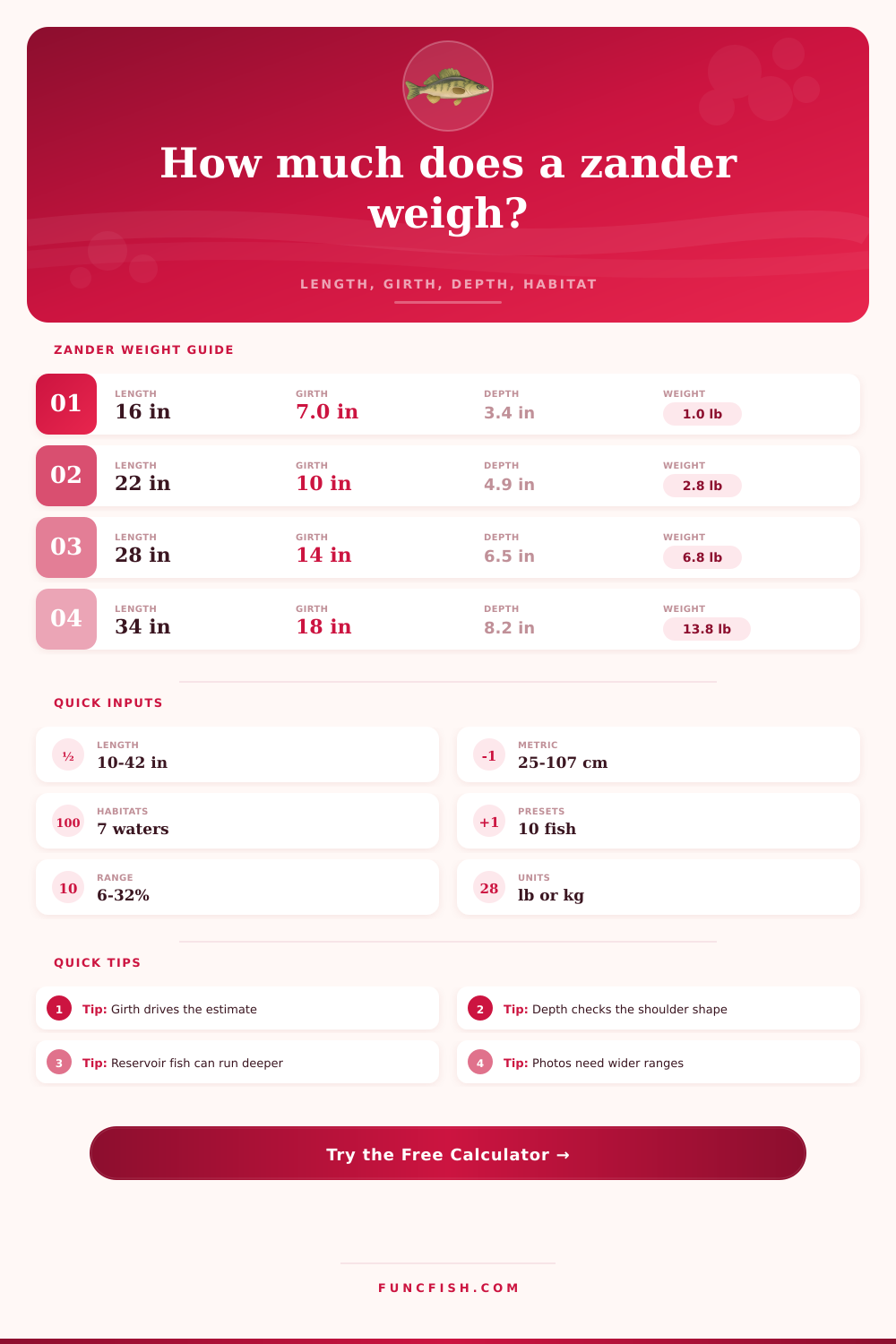
| Total length | Typical girth | Typical depth | Estimated weight |
|---|---|---|---|
| 14 in / 36 cm | 6.0-6.8 in / 15-17 cm | 2.9-3.3 in / 7-8 cm | 0.6-0.9 lb / 0.27-0.41 kg |
| 18 in / 46 cm | 7.7-8.8 in / 20-22 cm | 3.7-4.2 in / 9-11 cm | 1.3-1.8 lb / 0.59-0.82 kg |
| 22 in / 56 cm | 9.8-11.2 in / 25-28 cm | 4.6-5.2 in / 12-13 cm | 2.6-3.7 lb / 1.18-1.68 kg |
| 26 in / 66 cm | 12.0-13.8 in / 30-35 cm | 5.6-6.4 in / 14-16 cm | 4.6-6.2 lb / 2.09-2.81 kg |
| 30 in / 76 cm | 14.5-16.8 in / 37-43 cm | 6.7-7.7 in / 17-20 cm | 8.0-11.3 lb / 3.63-5.13 kg |
| 34 in / 86 cm | 16.8-19.0 in / 43-48 cm | 7.8-8.8 in / 20-22 cm | 12.0-16.5 lb / 5.44-7.48 kg |
| Habitat option | Expected body | Calculator effect | Best measurement priority |
|---|---|---|---|
| Slow river glide | Long balanced adult body | Baseline river zander | Length and girth together |
| Main current edge | Slightly leaner runner | Small trim, wider range | Girth and condition |
| Canal lock or navigation | Compact feeding fish | Neutral to slightly full | Depth cross-check |
| Open reservoir basin | Deep pelagic feeder | Fuller profile allowed | Girth and depth |
| Reservoir shallow prey bay | Heavy bait-fed shoulders | Fullness boost | Condition and forage |
| Deep natural lake | Long deep-water body | Stable deep profile | Length accuracy |
| Turbid lowland water | Variable river-reservoir body | Wider confidence band | All three dimensions |
| Maturity class | Length clue | Fullness effect | Range effect |
|---|---|---|---|
| Juvenile zander | Under 14 in / 36 cm | Slender, low girth ratio | Moderate range |
| Subadult feeding fish | 14-20 in / 36-51 cm | Fast-growing body | Standard range |
| Adult zander | 20-28 in / 51-71 cm | Balanced zander profile | Standard range |
| Large mature specimen | Over 28 in / 71 cm | Shoulders deepen | Slightly wider range |
| Pre-spawn heavy adult | Seasonal heavy body | Weight boost | Wider range |
| Post-spawn lean adult | Recently spent fish | Weight trim | Wider range |
| Forage and confidence | Input meaning | Estimate change | When to use it |
|---|---|---|---|
| Bleak, roach, small silver fish | Baseline prey mix | Neutral fullness | Most rivers and reservoirs |
| Smelt or pelagic baitfish | Open-water rich forage | Fullness boost | Deep lakes and basins |
| Sparse forage or winter reserve | Lower energy condition | Weight trim | Cold or low-prey periods |
| Measured all dimensions | Tape length, girth, depth | Narrowest band | Best logbook estimate |
| Photo-based estimate | Approximate shape | Profile blend and wide band | When no girth tape exists |
| Memory estimate | Lowest measurement certainty | Widest band | Old catch notes or reports |
💡Measurement tips
For zander, a girth that is high but a depth that is low usually means the estimate should stay conservative. The calculator compares both shape signals before applying condition and forage modifiers.
Reservoir zander can carry deeper shoulders when pelagic forage is strong, while current-edge river fish often run longer and leaner. Match the habitat before using confidence range as your final guide.
This calculator is a measurement estimator only. It does not evaluate harvest rules, seasons, or regulations.
Weight estimation for zander requires taking several differents measurements of the fish. Because zander have a long and muscular bodies, there body is not compact like carp. Therefore, the length of the zander are not a measurement that can be used to determine the weight of that zander.
In order to determine the weight of an zander, you must measure the length, girth, and depth of the zander. The length of the zander provides an indication of the scale of the weight of the zander, but the girth and depth measurement provide the mass of the zander. The girth measurement is important in that the weight of the zander is relate to the square of the girth measurement.
How to estimate the weight of a zander
Additionally, the depth measurement of the zander is used as a means of cross-checking the weight estimation for accuracy; if the weight calculation based off the girth and depth measurements do not agree with one another, the calculator will create a blend of the two weight estimations to ensure that the weight isnt incorrect due to only one of the two measurements. The habitat settings for the zander is important in weight estimation calculations. For instance, zander that live in main currents within rivers are leaner than zander that live in open reservoir basins.
Additionally, the maturity and condition of the zander will impact it weight. For example, females that have reached maturity may have extra weight before spawning; however, that same female zander will lose that extra weight after spawning. The forage patterns for zander will also impact its weight; zander that live in areas with many smelt will have different body composition than zander that live in areas with sparse forage opportunities.
The reference tables on the calculator shows the typical proportions for zander of each size from each habitat. These reference tables are not rules that must be adhered to with each zander. However, if the girth measurement for the zander is outside of the range shown in the reference tables, the calculator will still determine the weight of the zander.
However, the condition index and shape score for the zander will indicate that its girth measurement is outside of the normal parameters for zanders of that size in that habitat. It is common for people to believe that length and girth are the measurements that is required to determine the weight of the zander. However, the length and girth measurements will differ between zander based upon there life history.
For instance, a zander that live in a deep lake may have different measurements than a zander that lives in a canal. Additionally, the confidence in each measurement will change the weight estimation. For instance, if you measure the girth and depth of the zander with a tape measure, the confidence in those measurements is high.
However, if someone took those measurements from a photograph of the zander, there would be less confidence in the accuracy of those measurements. The calculator allows for people to compare the weights of zander that were caught during different seasons, or from different bodies of water. The calculator makes it easy for individuals to compare the weights of their zander catches over time.
However, no calculator will be able to account for every individual zander that is caught; it is possible that some zander will have weights outside of the calculated parameters due to factors like surviving the winter or finding food sources that are outside of the normal forage area. However, the calculator will determine the most likely weight of the zander that is being measure, and show how certain the calculations are in regard to that determined weight.