Whip Length to Depth Calculator
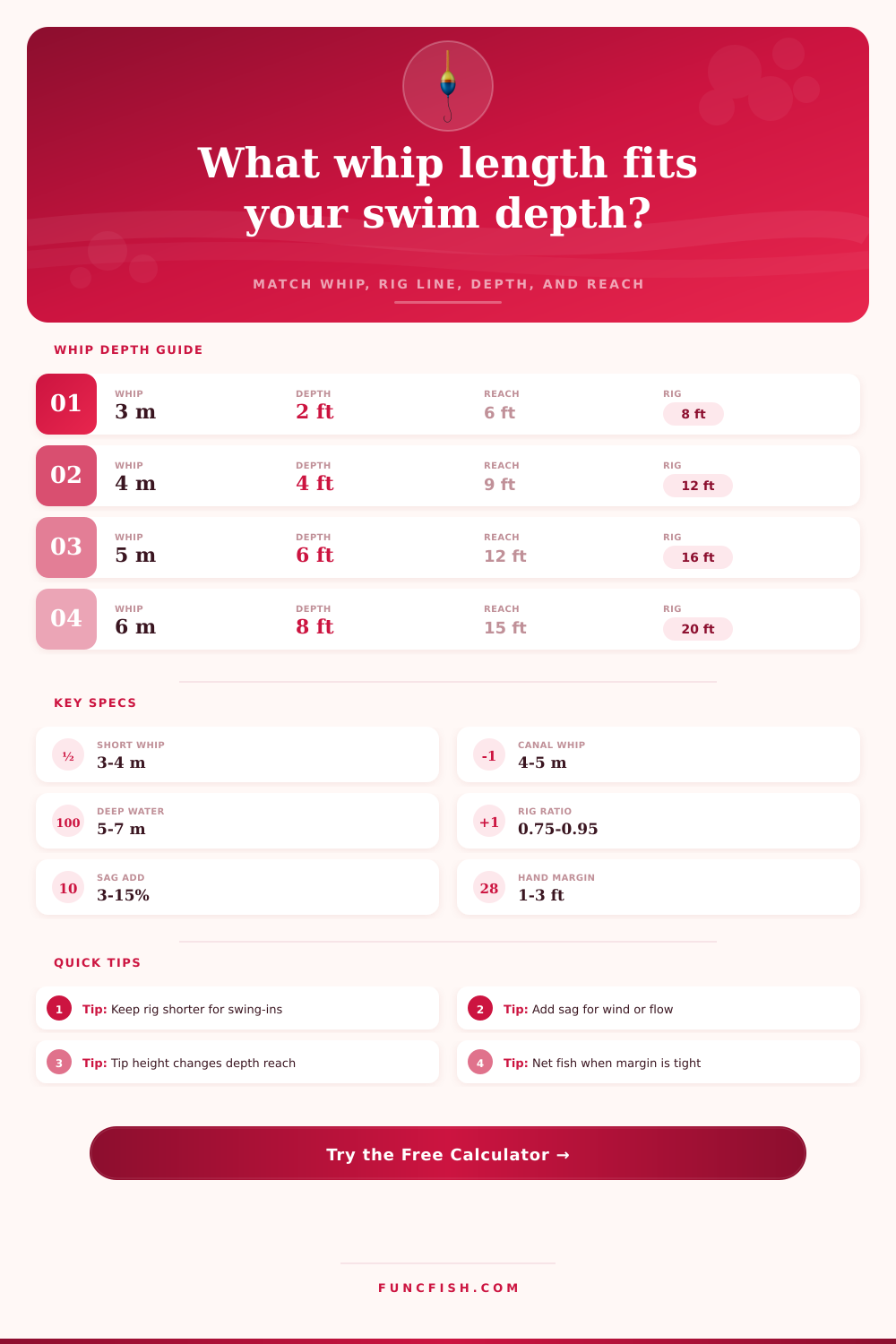
Match a fixed-line whip to swim depth, bank reach, tip height, rig sag, and landing clearance so the hook can reach depth without leaving a line too long to control.
📌Scenario presets
⚙Whip, depth, and rig inputs
Whip length to depth results
Full calculation breakdown
🎣Whip and rig equipment grid
3 m Speed Whip
4 m Canal Whip
5 m Match Whip
6 m Power Whip
📏Whip length, depth, and rig ratio table
| Whip length | Common swim depth | Practical reach | Rig line ratio | Landing note |
|---|---|---|---|---|
| 2.5-3 m / 8-10 ft | 1-3 ft / 0.3-0.9 m | 5-7 ft / 1.5-2.1 m | 0.72-0.84 of whip | Best for short swing-to-hand rigs and tiny fish. |
| 3.5-4 m / 11.5-13 ft | 2-5 ft / 0.6-1.5 m | 7-10 ft / 2.1-3.0 m | 0.80-0.88 of whip | Classic canal and pond length with manageable line. |
| 4.5-5 m / 15-16.5 ft | 4-7 ft / 1.2-2.1 m | 10-13 ft / 3.0-4.0 m | 0.84-0.92 of whip | Good for deeper shelves when a net is ready. |
| 5.5-6 m / 18-20 ft | 6-9 ft / 1.8-2.7 m | 12-16 ft / 3.7-4.9 m | 0.86-0.94 of whip | Use more landing reserve for bream or carp. |
| 7 m / 23 ft and longer | 8-12 ft / 2.4-3.7 m | 15-20 ft / 4.6-6.1 m | 0.88-0.95 of whip | Closer to short pole work; line control matters most. |
🌊Water condition adjustment table
| Condition | Sag or bow allowance | Depth impact | Rig choice | Calculator setting |
|---|---|---|---|---|
| Still, sheltered canal | 2-5 percent | Minimal bow; direct depth reading | Shorter lash, fine float | Tight or normal margin |
| Open lake ripple | 5-9 percent | Tip lift and float drift add line need | Slightly longer rig, stable float | Normal margin |
| Wind across the whip | 8-14 percent | Line bow reduces effective depth control | Heavier float, extra reserve | Windy margin |
| Small river glide | 8-16 percent | Hold-back raises the float and hook path | Longer lash, bulk shot lower | Windy or beginner margin |
| Deep shelf or margin | 6-12 percent | More vertical drop consumes rig length | Net fish, keep hand reserve | Normal to windy margin |
🐟Species and whip handling comparison
Bleak and dace
0.5-2 ozShort rigs, shallow depth, and very small landing reserve suit speed fishing with 2.5-4 m whips.
Roach and perch
2-12 ozCanal depths of 2-5 ft usually fit a 3.5-5 m whip with a rig around 80-90 percent of whip length.
Skimmers and bream
8 oz-3 lbDeeper rigs need more vertical line; use a landing net reserve rather than a full-length swing-in.
Small carp and F1
1-5 lbChoose a stronger whip type, larger margin, and shorter usable line ratio to keep control at the bank.
🧮Line ratio and construction reference
| Whip construction | Usable line ratio | Flex allowance | Best line class | Depth matching note |
|---|---|---|---|---|
| Ultra-light speed whip | 0.76-0.84 | Low to moderate | 0.07-0.10 mm / 1-2 lb | Fast shallow work; avoid rigs close to full whip length. |
| Light carbon match whip | 0.80-0.88 | Moderate | 0.08-0.12 mm / 1.5-3 lb | Best all-round choice for roach, dace, and small perch. |
| Standard carbon whip | 0.84-0.92 | Moderate | 0.10-0.14 mm / 2-4 lb | Handles typical canal depth while keeping a net margin. |
| Power carbon whip | 0.82-0.90 | Higher | 0.12-0.18 mm / 3-6 lb | Stronger fish need control reserve more than maximum rig length. |
| Fiberglass starter whip | 0.72-0.82 | High | 0.12-0.16 mm / 3-5 lb | Extra flex means a shorter rig fishes more predictably. |
| Travel whip | 0.76-0.86 | Moderate to high | 0.10-0.14 mm / 2-4 lb | Allow more sag for multi-section tip movement. |
💡Calculation tips
Depth tip: For a fixed-line whip, depth is only part of the line demand. A 4 ft swim at 10 ft reach uses more rig line than a 4 ft swim straight under the tip because the tip-to-hook path is diagonal.
Landing tip: If the handling margin is negative, shorten the fishing line, move the float closer, switch to a longer whip, or plan to net the fish rather than swinging it to hand.
Using a four-meter stick to measure the rod makes you think length of whip is just an estimate based off that ruler. If the rod is four meters long, you think line goes down four feet. That’s wrong and leads to losing fish. Because your line didn’t go deep enough you’re standing there on the bank swinging at a roach that ain’t there.
It’s all about geometry. It is not linear distance. What you’re dealing with is managing a triangle. The sides of this triangle are water depth, the distance you cast your bait, and the hypotenuse, which is your fixed line. This is where geometry come into play.
Think in Triangles, Not Straight Lines
But since none of us visualizes any sort of trigonometry when we pack our vans full of rods, calculator does it all for us. We input our whip length, and the calculator subtracts the sag, landing margin, and tip height. This leaves us with how much line we actualy have to work with. Now if that’s less than how far out you need to be in order to cast to the bottom on your desired swim, even the most well-cast rod will fail.
And again the tool make you consider the amount of slack caused by current and wind before you ever set foot on the water. How much higher do you hold your tip? Until it becomes an issue. When fishing shallow, holding your tip up with line helps maintain tension. That’s like lifting point where your rig begins. A few inches might not seem like much but those feet or even a couple can eat up a lot of your line when fished shallow. It reach less depth.
Why does the calculator want to know this? Because if you don’t pay attention to it then you will have rigged your rig too far up off the bottom. This won’t catch the fish skirting above the silt.
You also have to take into account your reserve. Your reserve is the buffer you keep between hitting bottom and landing a fish in the net. If you want to land a two pound bream without pulling it all around on the mud, you’re not going to do it on all of your line. The closer and smaller the fish, the less landing reserve you need. A short whip used for speed fishing can get by with very little reserve because they knows the fish will be small and up close. But as you migrate to heavier skimmers or deep margins, that reserve increases. That’s the separation between snapping the tip and having control over lifting the fish.
There are silent line thieves; sag is another one. This happens when wind blows the line out and current holds it back against the shot’s pull. Both result in a longer path different than your straight line measure from tip to float. That’s why the calculator tacks on an allowance for this depending on conditions. Maybe it is only two percent in a protected canal, but that amount increases greatly in a flowing river glide or ripples on an open lake. If you don’t allow for it, you’ll be short if weather turns.
Stiffness of construction is another factor. Fiberglass is known to bend under pressure, which absorbs line length and reduces your effective reach. That flex diminish your effective reach. Carbon fiber is stiffer and holds its shape providing more consistent depth control. Usable ratios change with material, as you can see in the table on page. Flexing a power whip takes up less joint space and means you have more line relative to the length of the stick. Travel whip require additional space for joint action.
Efficiency matters (not maximum depth). You want enough length to reach the fish and have slack to manage the conditions. However, you don’t want it so long that you lose sensitivity or can’t swings into it. Shorten the rig or close-in on the swim if the calculator indicates a negative margin. Don’t attempt to overcome physics and throw farther-out; that simply increases sag and decreases your control.
You should of known this. The length of your whip isn’t everything; it’s all about matching your whip to the water. Each inch has a certain amount of reach and depth that it buys you. Start thinking in triangles instead of straight lines and your presentation will improve instantly. Landings become cleaner and misses is few and far between. It takes a bit of homework before you head to the bank but math doesn’t lie.