Wire Coated Strip Length Calculator
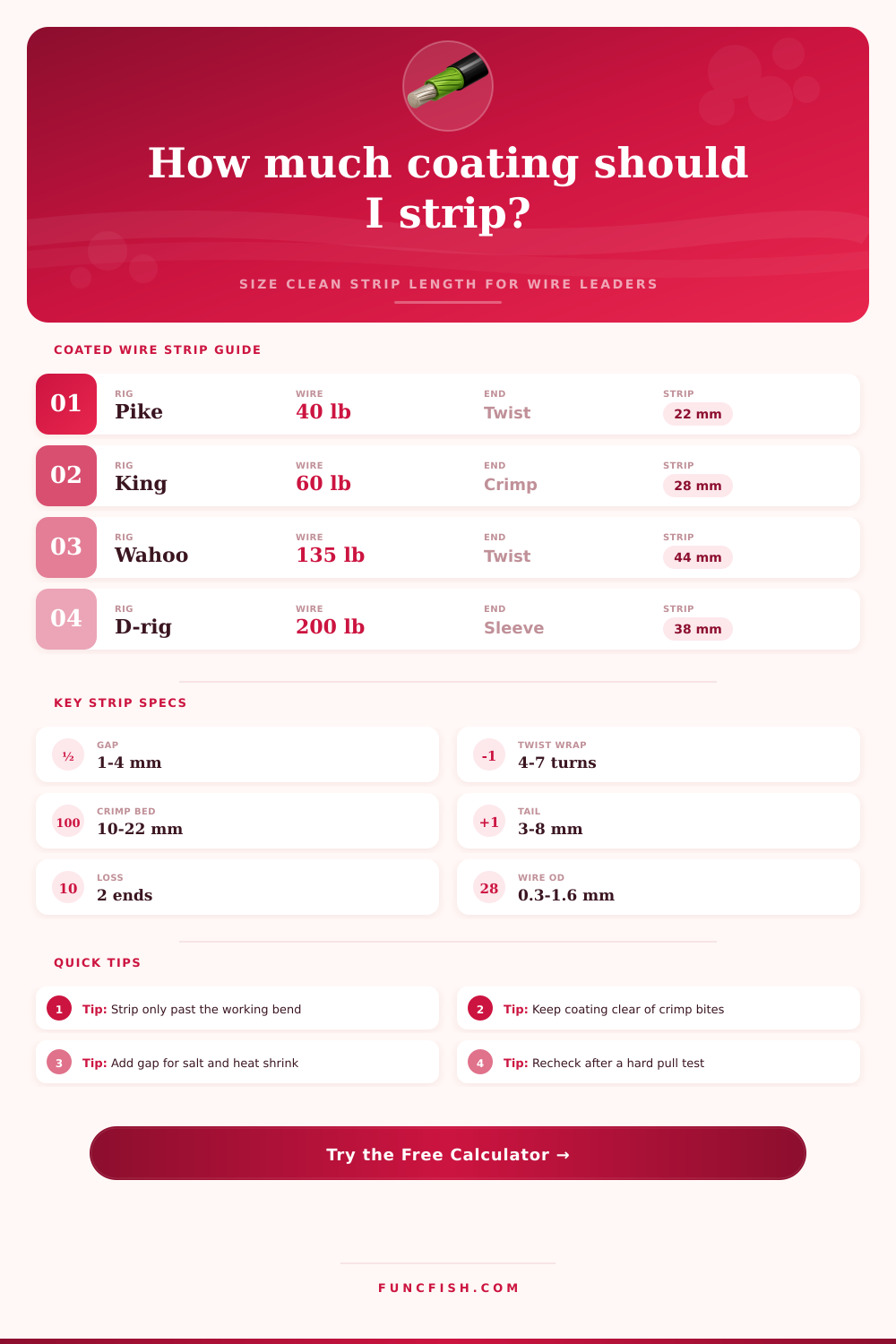
Estimate how much nylon or plastic coating to remove from coated fishing wire before crimping, twisting, looping, or adding heat shrink so bare wire sits where the connection actually works.
📌Coated Wire Strip Presets
⚙Wire, Terminal, and Strip Inputs
Coated Wire Strip Results
Calculation Breakdown
🧵Coated Wire Material Data
1x7 Coated Leader
7x7 Coated Cable
Coated Single Strand
Downrigger Cable
Diameter values are typical fishing leader and cable references; actual coating thickness varies by spool, finish, age, and manufacturer run.
📏Typical Wire Size Reference
| Wire family | Rating examples | Diameter examples | Strip allowance to add | Primary end connection |
|---|---|---|---|---|
| Light nylon-coated 1x7 leader | 10, 20, 40, 60 lb | 0.012, 0.018, 0.024, 0.032 in | 1.0-2.2 mm past the wrap or sleeve | Small crimp, snap, spoon, or stinger hook eye |
| Heavy nylon-coated 1x7 leader | 90, 135, 210 lb | 0.041-0.051 in coated outside diameter | 2.0-3.5 mm past the working bend | Haywire twist, thimble loop, or oval sleeve |
| Coated single-strand stainless | #10 131 lb, #12 180 lb, #14 220 lb, #17 300 lb, #19 400 lb | 0.024, 0.029, 0.033, 0.039, 0.043 in wire diameter | 2.5-4.5 mm due to spring-back and wrap height | Haywire twist, barrel wrap, or rigid loop |
| Flexible coated 7x7 or 49-strand cable | 90, 135, 175, 210 lb | About 0.041-0.063 in coated outside diameter | 1.5-4.0 mm; keep strands fully inside sleeve bed | Double-barrel sleeve, thimble loop, or assist loop |
| Vinyl-coated downrigger cable | 150, 200, 250 lb | About 0.033-0.041 in cable before coating | 3.0-6.0 mm if using terminal sleeve and heat shrink | Terminal sleeve, swivel end, or release clip cable end |
🔧Connection Strip Allowance Table
| Connection | Working bare length basis | Setback target | When to add more strip | Check before fishing |
|---|---|---|---|---|
| Haywire twist with barrel wraps | Eye bend plus 4-7 wraps and 3-8 mm tag | Coating ends behind final barrel wrap | High-speed trolling, stiff single strand, or large eye | Wraps bite wire evenly without coating lumps |
| Single oval sleeve | Sleeve bed, tag, and end clearance | Coating clear of compression bites | Soft coating, salty sleeves, or general crimp pliers | Sleeve compresses bare cable, not plastic jacket |
| Double-barrel sleeve | One clean wire leg per barrel plus tag | Coating stops just outside sleeve mouth | Two-leg loops, thimbles, and larger snap eyes | No plastic mashed into either barrel |
| Figure-eight loop | Two bends, crossover, and tucked tag | Coating outside both bend contact zones | Small hook eyes or short stinger rigs | Loop closes cleanly without cracking coating |
| Heat shrink stop over stripped wire | Terminal bed plus shrink landing zone | Gap hidden under shrink but not under crimp | Downrigger ends, release clips, and spreader booms | Shrink grips coating while crimp grips wire |
🎣Gear and Species Comparison Grid
Pike and Pickerel
20-45 lbShort stinger or spoon leaders usually need modest strip length, small setback, and clean bare wire around the hook eye.
Muskie Casting
60-130 lbRepeated casting and big lure leverage call for extra wrap bed and a coating gap that will not crack under bending.
Kingfish and Wahoo
90-275 lbFast strikes and trolling drag favor longer bare working length, a clear sleeve mouth, and a conservative strip margin.
Bottom Cable Rigs
150-400 lbHalibut, cod, shark, and spreader rigs use heavier cable where the coating should be kept out of sleeve compression.
📊Strip Method Reference
| Method | Best wire type | Allowance effect | Risk to watch | Result check |
|---|---|---|---|---|
| Razor roll cut and peel | Nylon-coated 1x7 and 7x7 leader | Baseline allowance | Nicking outer strands if the blade bites too deep | Coating edge is square and the wire is bright |
| Low heat softening and wipe | Vinyl-coated downrigger cable and thick jacketed wire | Add 10-18 percent for heat-affected coating edge | Overheating strands or leaving melted plastic in sleeve | No smear under crimp bed or twist wraps |
| Rotary wire stripper | Consistent coated cable diameters | Subtract 2-4 percent if repeatable and calibrated | Oval cable can be cut unevenly | Same strip length on every leader end |
| Fine abrasive scrape | Coated single strand and tough black jackets | Add 5-12 percent for feathered coating edge | Scoring wire or leaving coating flakes | Bare wire is smooth before wrapping |
| Factory bare end section | Prepped downrigger or terminal cable kits | Use measured bare length as the limit | Bare section may be shorter than the sleeve bed | Crimp bed does not cross onto coating |
💡Rigging Notes
Strip length check: Mark the recommended length with a fine marker, strip one test end, then lay the sleeve or twist wraps over the bare section before cutting the finished leaders.
Setback check: The coating edge should sit outside the crimp bite or final barrel wrap, but close enough that the finished leader does not gain an unnecessary long bare hinge.
To prevent a faulty connection due to improper strip length, figure out the proper length of wire leader to use. Too long and that nylon jacket remains in the crimp sleeve which essentially becomes a spacer between terminal and steel strands. The terminal will never bite down on metal core and the strength of a big fish pulls the wire free from the sleeve.
Enter your chosen terminal type along with composition of your wire in the calculator above and it’ll solve the equation for you. You will no longer have to guess how far to cut back the coating. Not any old bare wire but the right amount of bare wire. Strip too little and you are going to crimp plastic part instead of steel part. Strip too much and now you’re making a long unsupported piece of bare wire which will be prone to fraying and kinking when casting.
How Much Wire to Strip
They made it calculate exactly how far back to set setback gap. This ensures the coating stops after working section, so all the real holding power stay in steel part.
You should know your wire family because different types of wire reacts differently to being stripped. Halibut downrigger cable can be a thick vinyl-coated cable that needs scraping or even heating to soften it before you can get a clean strip. It strips away cleanly, but you need to leave extra space so melted vinyl doesn’t interfere with the sleeve bite. Pike leaders is commonly 1×7 with a light nylon coating. They strip back easy and cleanly to allow for a nice sharp, square cut, and they lie nicely against small crimp. Not only do you need to account for the coating thickness, but how it react when removed.
On the page, there are also some reference tables detailing what’s considered normal for various types of connections. A haywire twist should of have plenty of bare wire to make multiple tight barrel wraps and then a little leftover to tuck it all back inside. An oval sleeve only needs coating to clear completely around compression zone. These is the starting points that our calculator scales to your desired security level.
If you select a higher stress margin like troll shock or heavy drag, we’ll increase the amount of strip allowance. Because if something gets pulled hard suddenly, it has got to stick and not flex out. The calculator adjust these baseline needs based off your security target.
Next, let’s talk about physics. The hook eye bend dictates how the wire behave during a curve. As the wire wraps around the eye of a tiny little spoon, the inside strands compress and the outside strands stretch out. That deformation can’t be followed by jacket because it will lift or crack off in process. And that’s a problem if the jacket is reaching the bend point. Once you strip down past the bend where you’re actualy working, there is nothing left but flexible steel core being stressed by the bend. It’s all about geometry, and it determine whether the whole rig lives or dies.
Few anglers pay attention to coating’s condition. Fresh, pliable nylon will hold its form and clean up nicely. Stiffened or salt-used coatings may comes loose around edge, chipping or crumbling. That causes debris that could work its way into a twist wrap or crimp bed before it is noticed. Allowing a couple of millimeters of extra wrap allowance protect you if things get messy. Then you have wiggle room to cut off rough-edged ends while leaving the all-important connecting zone intact.
No matter what a tool might say, you have to test it. So use a practice rig and give it a good yank. Where does it slip? Where does it flex? Are there any stress marks in coating around the crimp? You need more clearance.
You want something hidden, strong as hell, yet invisible beneath surface. The leader end has a clean and unimposing appearance, but there is something sturdy and metal-to-metal under the hood at each connection point. The wire blends with the hardware; there’s nothing exposed for the fish to mess with once the fight heats up. Get the stripping correct and all you see is dissapears.