Wire Line Depth Calculator
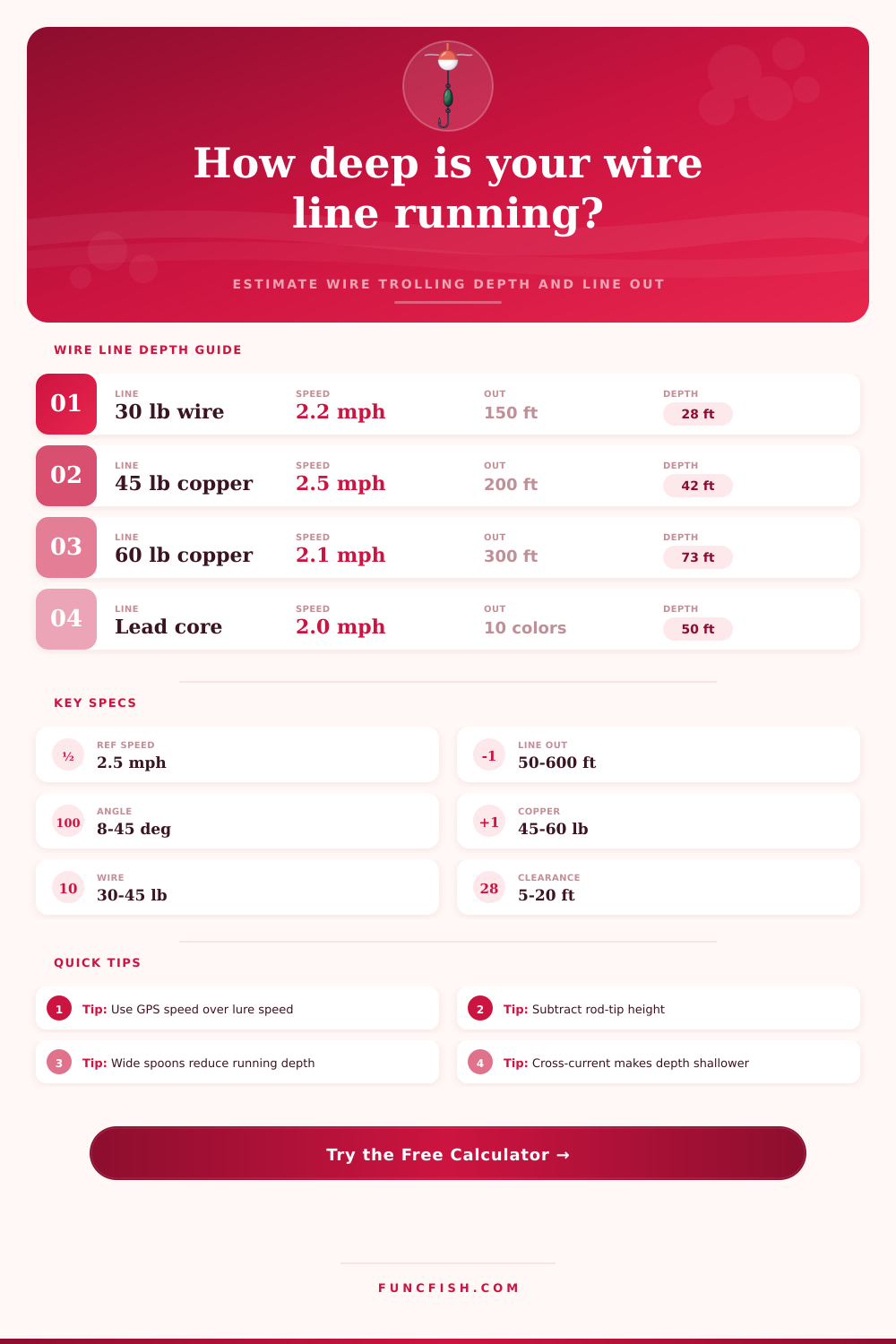
Estimate trolling depth for stainless wire, copper, lead core, and weighted wire using line-out geometry, speed correction, lure drag, current angle, rod-tip height, and target-zone clearance.
📌Scenario presets
⚙Wire line trolling inputs
Wire line depth estimate
Calculation breakdown
🎣Wire line gear comparison grid
Stainless Wire
Copper Line
Lead Core
Weighted Steel
📊Wire and weighted line reference
| Line type | Typical test | Reference drop | Best use | Depth note |
|---|---|---|---|---|
| 30 lb 7-strand stainless | 30 lb / 13.6 kg | 14 ft per 100 ft at 2.5 mph | Stripers, lake trout, salmon | Good with spoons and umbrella rigs |
| 45 lb stainless trolling wire | 45 lb / 20.4 kg | 16 ft per 100 ft at 2.5 mph | Heavier current or larger attractors | More pull, slightly steeper than 30 lb wire |
| 40 lb Monel wire | 40 lb / 18.1 kg | 18 ft per 100 ft at 2.5 mph | Traditional salt and freshwater wire trolling | Dense and smooth, handles long set-backs well |
| 32 lb copper | 32 lb / 14.5 kg | 20 ft per 100 ft at 2.5 mph | Shallower trout and salmon spreads | Faster sink than stainless wire |
| 45 lb copper | 45 lb / 20.4 kg | 22 ft per 100 ft at 2.5 mph | Standard Great Lakes copper segments | Common all-around copper depth baseline |
| 60 lb copper | 60 lb / 27.2 kg | 25 ft per 100 ft at 2.3 mph | Deep salmon, lake trout, and heavy traffic | Steepest copper option in this calculator |
| 18 lb lead core | 18 lb / 8.2 kg | 5 ft per color at 2.0 mph | Walleye, kokanee, shallow trout | One color is about 30 ft of line |
| 19-strand weighted steel | 35-45 lb / 15.9-20.4 kg | 21 ft per 100 ft at 2.4 mph | Copper-style depth with easier handling | Good on multi-rod freshwater spreads |
🐟Common species depth targets
| Species or program | Typical target band | Common wire setup | Speed window | Clearance target |
|---|---|---|---|---|
| Great Lakes king salmon | 35-90 ft / 10.7-27.4 m | 45 lb copper or weighted steel | 2.2-2.8 mph / 3.5-4.5 km/h | Stay above marks or thermocline |
| Lake trout on bottom | 55-120 ft / 16.8-36.6 m | Stainless wire with spoon or flasher | 1.7-2.3 mph / 2.7-3.7 km/h | 5-15 ft above bottom |
| Striped bass wire line | 18-55 ft / 5.5-16.8 m | 30 lb wire with spoon, tube, or umbrella | 2.0-3.0 mph / 3.2-4.8 km/h | 10 ft around structure |
| Walleye lead core | 12-35 ft / 3.7-10.7 m | 18 lb lead core plus crankbait | 1.5-2.2 mph / 2.4-3.5 km/h | Track over weeds or contour |
| Kokanee copper | 15-45 ft / 4.6-13.7 m | Light copper with dodger | 1.1-1.8 mph / 1.8-2.9 km/h | Fish above the school |
| Coastal king mackerel | 20-70 ft / 6.1-21.3 m | Wire, planer, or weighted rig | 4.0-7.0 mph / 6.4-11.3 km/h | Match bait depth first |
⚖Speed, lure drag, and current adjustments
| Adjustment | Calculator factor | What it means | Depth effect |
|---|---|---|---|
| Low-drag spoon | 1.05 depth factor | Slim spoon, fly, or bait with little lift | Runs slightly deeper than baseline |
| Medium plug | 1.00 depth factor | Neutral pull from stickbait or trolling fly | Uses baseline reference curve |
| Flasher or dodger | 0.90 depth factor | Extra drag lifts the wire line | Runs about 10% shallower |
| Diving plug | 0.96 plus bill depth | Bill adds some dive but also pull | Small net depth gain |
| Planer or keel rig | 1.18 depth factor | Added directional weight ahead of lure | Runs deeper and steeper |
| Cross-current sweep | 0.92 current factor | Wire bows sideways instead of down | Runs shallower than line-out suggests |
| Against current | 0.88 speed factor | Lure speed is higher than boat speed | Runs higher in the water column |
| With current | 1.08 speed factor | Lure speed is lower than boat speed | Runs a little deeper |
📏Line-out and angle reference
| Line out | Shallow angle 10° | Moderate angle 18° | Steep angle 28° | Field note |
|---|---|---|---|---|
| 100 ft / 30 m | 17 ft / 5 m | 31 ft / 9 m | 47 ft / 14 m | Short copper or wire segment |
| 150 ft / 46 m | 26 ft / 8 m | 46 ft / 14 m | 70 ft / 21 m | Common striper wire range |
| 200 ft / 61 m | 35 ft / 11 m | 62 ft / 19 m | 94 ft / 29 m | Standard copper starting point |
| 300 ft / 91 m | 52 ft / 16 m | 93 ft / 28 m | 141 ft / 43 m | Deep salmon or trout line |
| 450 ft / 137 m | 78 ft / 24 m | 139 ft / 42 m | 211 ft / 64 m | Long copper needs open spread room |
🧭Gear and species matching
Salmon Copper Spread
150-450 ft45 lb copper or weighted steel, spoon to flasher drag, 2.2-2.8 mph, usually fished above marks rather than hard bottom.
Striper Wire Rod
100-250 ft30 lb stainless with tube, spoon, or umbrella. Watch current sweep because sideways belly reduces true depth quickly.
Lake Trout Bottom Line
200-400 ftStainless wire or heavy copper with low-drag spoon. Use bottom buffer to keep the presentation just above structure.
Walleye Lead Core
3-10 colorsLead core changes in 30 ft color steps, so small speed changes can matter more than one extra rod length of line.
💡Depth calculation notes
Depth note: Wire line charts are estimates because lure pull, turns, fleas, current, and rod position change the catenary curve. Recheck the calculator after changing speed, lure style, or attractor size.
Spread note: If two wire lines cross in turns, compare their calculated angle and running depth. A steeper, deeper inside line should usually carry less line out than a high outside line.
With wire line trolling there’s an added element of frustration that makes it unique, you’re watching the sonar and seeing your lure run forty feet over top of bait band. Your line is paying out three-hundred feet of copper but the geometry isn’t working the way you expect it to. Water pushes back against boat speed. The line curves and drags along.
This is why we discuss wire line depth calculations. It close the loop between where lure is sitting in the water column and how much line you’ve got out. Lead core, copper, and stainless steel are sinking lines so they needs those variables considered along with lure drag and trolling speed. The calculator above will do that for you if you put in the variables. But you also need to understand what all that means.
How to Calculate Wire Line Depth
Stainless steel and copper tend to sink while monofilament backing tends to remain fairly neutral. How much line you have deployed determine how much depth each foot of line is producing in the water. The more line out the deeper the fish get but again, only until it starts to pull straighter. The steeper the angle the deeper per foot out but there is a limit to that.
“People often forget that their GPS speed isn’t necessarily the same as lure speed. If you’re fishing against current, your boat could be going two and a half miles per hour but the lure is hardly even moving in the water.” The slower you go, the deeper the lure sits. In slow water, the lure’s forward movement lift it up before gravity can pull it down again, giving it more time to sit deeper. Conversely, running with current will make the lure move faster through the water, which raises your presentation and flattens out your line. Focus on speed of the lure, not just the speed of the boat. This forces you to consider what the fish really feel. It is not what your dash reads.
A slender metal spoon doesn’t present much drag either, which is another variable in the equation. The weight of all that wire will pull it down to where it naturaly fishes. However, if you put a big planer board or diving plug on the same line, the line lift and pulls the rig up with it. On this page they list out drag factors for various lures. They show you how deep or shallow your rig will be based off solely upon what’s on the business end of your outfit. A spoon may get you 10-percent shallower then a flasher does, and while that may not seem like much, when you’re targeting an exact thermocline edge it can make a world of difference.
Also consider height of your rods. That four feet of line from the top of the water to the end of your rod isn’t contributing to your depth under the water. If you don’t take it into account, you’ll always be running shallower than you believe. The higher your rods is (either outriggers lifting the line up or just high rods), the more this happens. Take away height of the line for a clean baseline on how far down the lure begins its dive.
Current also adds another factor. Because you are trolling in a current, your line sag to one side instead of going directly downward, which means it will run shallower than calculated if stationary. The current factor accounts for this fact and shows that gravity battles against lateral forces as well. A small amount makes a big difference when you have a long setback spreads.
For lead core, stainless steel, or copper, think about how much resistance you want to pull against and how fast you want it to sink. Stainless sinks slower with less resistance slowing your boat if you has several rods going. Copper will sink faster and slow your boat down more to since it resists the water. Line-out requirements is greater for equivalent depths using stainless. The trade offs are well shown in the gear comparison section. Pick the right line based off target depth/speed window and let the geometry work the rest out.
You don’t want to run too high, and you also don’t want to be running so low that you’re dragging the bottom. You must do this all while keeping presentation in the strike zone and hitting the mark on the screen. Experience tells you whether they’re really eating it, but the depth estimate puts you relatively close. Use that estimated depth as a starting point and modify based off what the boat is doing and what you see on the sonar. If you pay attention to the feel of it through the rod, the line will let you know exactly what it wants to do. When you combine good math with this sort of feel, a seemingly random cast becomes a well placed strike. Watch the angles. Keep the line tight. Trust the numbers, and they’ll point you in the right direction before the current runs you off course.