
The drag screams, the rod doubles over, and you’re fighting a strong fish, but what kind of fish? A deep-water giant that needs all your strength to manage? Or just another small school tuna that’ll give up shortly? This is where understanding duration help you understand amount. It transforms a wild fight into a strategic one.
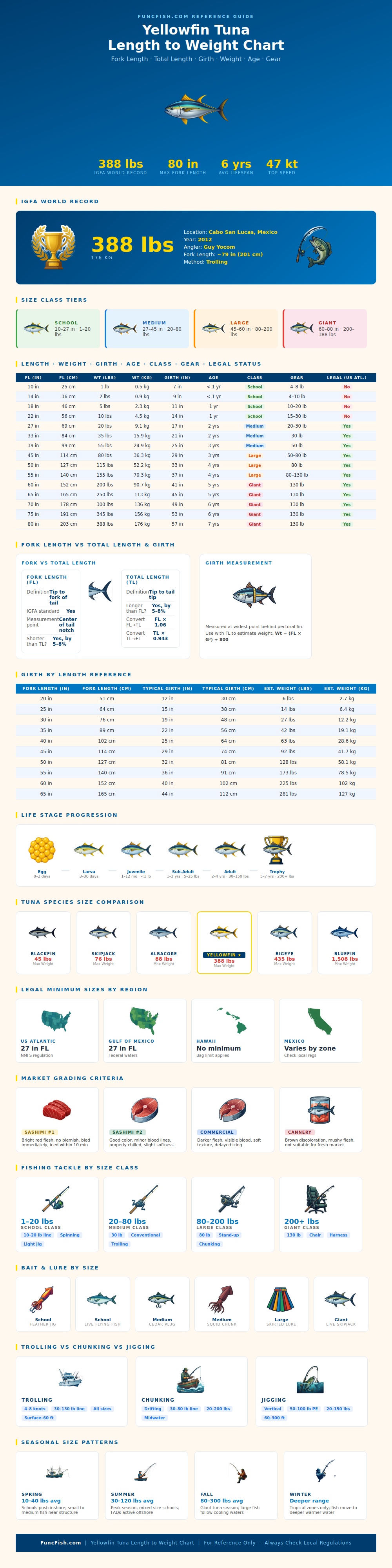
Yellowfin tuna don’t grow in a straight line. When they are ten-inches long, they’re just over a pound. They’re light and easy to manage. Double their size to twenty-inches and now they’re about a six-pounder. Triple their size and you’ve got a near-thirty-pounder on your hands at thirty inches. That’s an exponential graph we fail to grasp. We think a bigger fish will be a little bit heavier, but we could of been more wrong. A 60-inch yellowfin could be two-hundred pounds.
How Big Are Yellowfin Tuna?
What does that do? That changes the way you play with the fish. You won’t go after a ten-pound fish the same way you’d go after a two-hundred-pound fish. Size matter because the smaller the fish, the greater your margin of error.
Next, think about the tackle you have onboard. Are you fishing for smaller school sized tuna? Light spinning gear might be fine. They fight like crazy, but if you play them right, they won’t tear through thin lines. But when you go after medium or large class territory, those won’t work and heavier conventional reels and lines in the fifty to one hundred thirty pound ranges is needed. The extra strength are required to pull the fish up and also keep it from pulling off into a reef, piece of debris or cutting your line. That gives you some insurance against failure.
Another issue that many people run into is measuring the fish correctly. To get total length most anglers will start at the snout and go all the way down to end of the fish’s tail. The real rule used in the sport fishing world is called fork length. It only take your measurement from the snout to the middle of the notch on the tail. Even though it doesn’t sound like much, it does add up especially when comparing records. Also, if you use one method different than the other, your fish may look bigger than they actualy are.
Knowing how big it is in the water gives you an idea whether to keep fighting it or not. If you notice the drag is working hard and the girth is thick before the fish come out of the water, you probably got yourself a good fish.
You’ll also want to consider seasonal size. Spring finds schools moving inshore with lots of smaller fish. Summer offers mixed bags. You will find a bit of everything, from teenager to adult fish around floats and other floating objects. Fall typically has the giants coming out as the water cools and the feeding get better. Winter tends to be deeper or down in the tropics. Understanding the seasons gives you an idea of what to expect before you even put boat in the water. Sure, maybe it’s not a trophy in April, but maybe it will provide a few for dinner.
You can understand the Yellowfin Tuna’s growth curve because the yellowfin doesn’t grow at a steady rate. There are times when it just grows up fast and other times when it levels off. Knowing where your fish fits on that curve helps you make the proper tackle, bait, and be cautious as necessary. The battle will go smoother and be even safer if you know the number behind the muscle.
You’ll know how much fish there really is under the surface the next time the rod goes down, whether you’re going for a personal best, or just filling out the cooler. That translates into a predictable, yet still impressive, contest instead of a chaotic battle.