
It’s three o’clock in the morning. You’re standing on boat. Below you, the ocean is black. The moonlight lights up everything around you, painting a path over the waves. But there are no squid.
You’ve got a tackle box filled with colorful lures. When you shine them under cabin lights, they’re beautiful. But when they dissapears into the dark water, you realize that’s the heart of yo-zuri fishing. It’s not enough to have good equipment; you also need to know how squid sees color underwater, how it reacts with light, and how depth change all this.
How to Pick the Right Lure Color
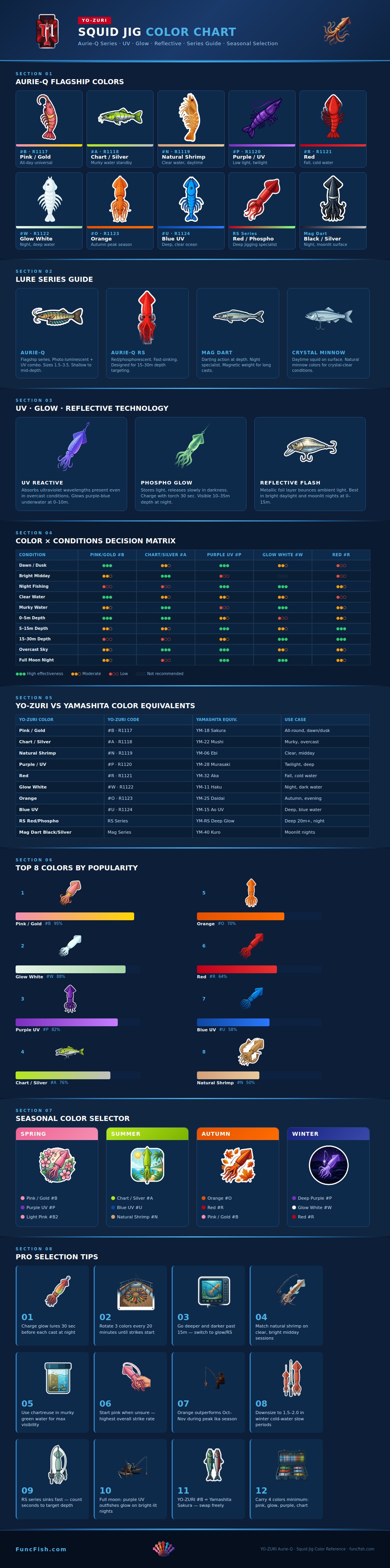
Most people think of choosing lures like it’s a trip to the grocery store. Whatever looks pretty goes in the basket. Big mistake. In the deep sea, your best communication tool is color. Send the wrong message and nobody bites. That’s where this visual guide simplifies the process.
Here it breaks down what color to use based off certain environmental factors like depth, time of day, and water clarity. Why? These are not broad statements that make you think “that makes sense” and move on. Instead it gives you exact matches. You’ll notice that at the very top of their list is an all-day go-to: gold and pink. Why? That’s what it looks like out there, but it doesn’t scream “I’m fake.”
Once the sun goes down later in the day, that lure falls off the boat. Then it’s UV reactive shades, or purple. Shades that suck up light waves we can’t detect with our eyes but they detects with theirs. Knowing this makes a huge difference when loading your boat up with baits.
These colors aren’t simply paint jobs. The chart breaks down reflective foil, phosphorescent glow and UV reactive material. Those all has distinct applications. Phosphorescent materials hold onto light and slowly give it off. That’s great for fishing at night in deep water where there’s no ambient light around. Charge them under a torch and cast out. They glow by themselves.
Then you have reflective finishes that show available light. They is good for both bright days and moonlit nights. At least there is some kind of light to play with. This is not a random choice, but rather one that either reflects what is already there or adds more light to the situation.
But there’s another element here: depth. The deeper you go, the faster light diminishes. The first color to filter out is, indeed, red. That’s why red lures are used more often for fall fishing in cold water then for activity at the surface. Below about fifteen metres, it’s time to move to glow or even deep jigging series according to the chart. They will stay visible in low light.
And that makes sense; squid are visual hunters. Contrast matter. A darker blob against a paler backdrop becomes visible. Too good a match and well, you’re waving around a piece of blank line. Your color scheme should follow seasonal changes as well. Lighter, more naturaly-looking colors is often best during spring and early summer months. These resemble the shrimp common in warmer, clearer waters.
As fall approaches, the cooler temperatures and deeper runs favor those redder and orangish colors. They contrast better with the fading light that accompanies shorter days. For winter, you have to start from scratch again. Water’s cold, the action’s slow, and you’ll frequently want to downsize your lure along with darker, more penetrating colors. Beauty doesn’t matter now. It’s all about survival and efficiency.
In addition, on an even more practical level, if you’re used to fishing with other brands, keep in mind there’s a match as well. A lot of anglers has found that similar color codes will convert from manufacturer to manufacturer. One popular line has pink gold and another has a sakura finish. Why does this matter? It minimizes the learning curve for people who like to try different lures but don’t want to start from scratch every time they buy a new one. You simply learn what each of these finishes means and go from there. No need to reinvent the wheel.
So what do you start out with? If you don’t know where to start, throw three colors. Use pink for all around. Use purple for low light. Use glow for deep or nighttime. Then rotate through every 20 minutes till you get bit. It is a pretty easy plan that takes the guesswork right out of it.
Fishing is about making up for variables you have no control over. Color of your lure isn’t one of those. Get good at that and you’ll waste fewer hours looking down at an empty rod tip. Instead, you will spend more hours watching your reel spinning. Now you’re seeing that surface in the moonlight as a playground not a blank canvas.
You could of used better colors.