Zip Slider Distance Calculator
Calculate the stop-to-slider distance, usable free run, trace clearance, rig angle, and minimum stop load for zip slider, fish-finder, and running lead rigs.
📌Zip slider presets
⚙Slider distance inputs
Zip slider setup results
Calculation breakdown
🛠Slider hardware reference
Plastic Zip Slider
Metal Zip Slider
Fish-Finder Slide
Pulley Bead
📐Distance behavior grid
Short Stop
0.8-1.1xUseful near rough ground when fast indication matters more than a long free run.
Balanced Stop
1.2-1.7xMost surf and river running rigs clear the hook trace without excessive slack.
Long Run
1.8-2.4xBetter for cautious bites, surf sweep, or heavy bait that needs room to settle.
Boat Tide
1.0-1.6xVertical angle changes quickly, so travel is kept controlled around the lead.
📊Recommended zip slider distances
| Rig use | Typical stop distance | Trace length | Lead range | Distance note |
|---|---|---|---|---|
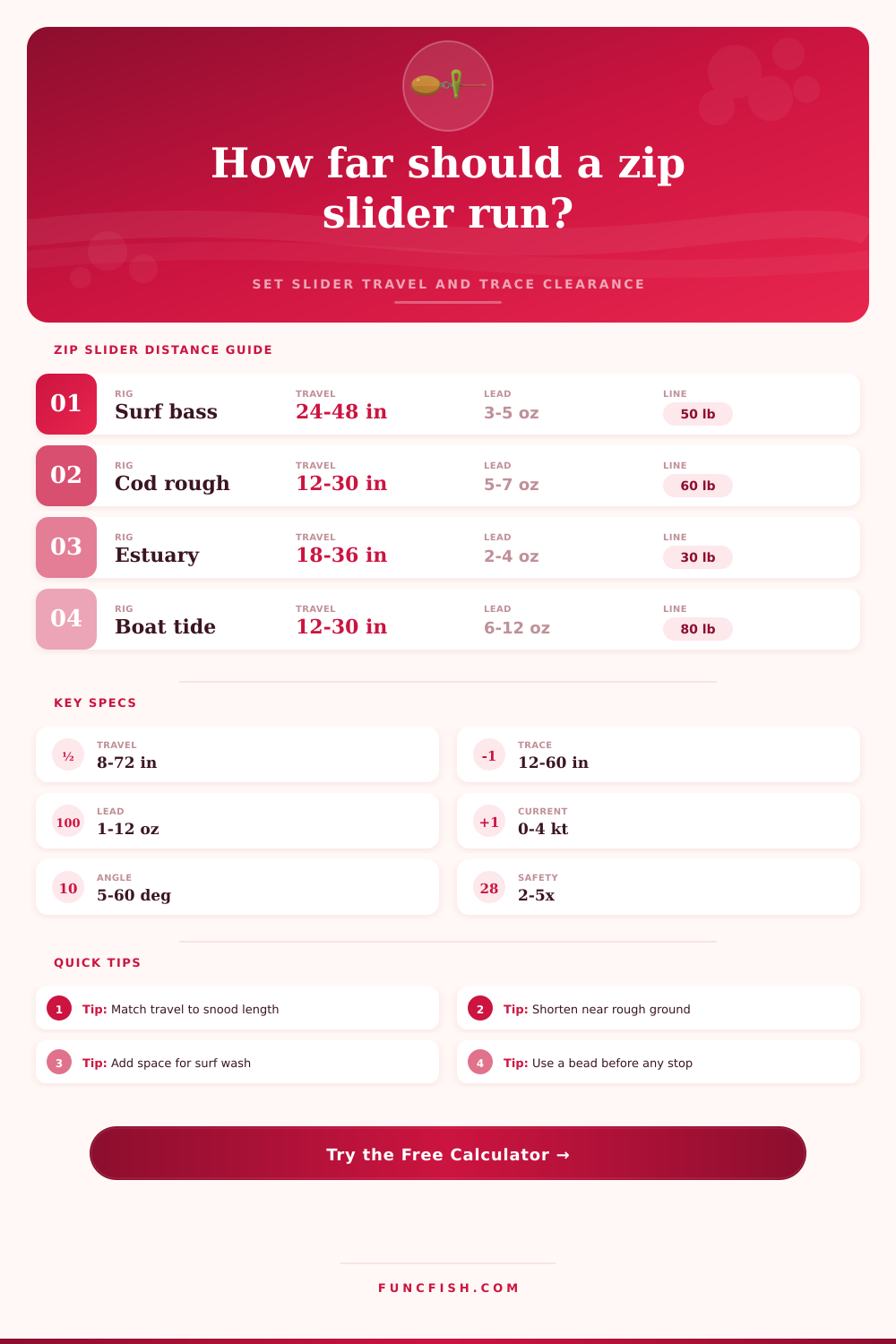
| Surf bass fish-finder | 24-48 in / 61-122 cm | 24-42 in / 61-107 cm | 3-5 oz / 85-142 g | Leave enough run for wave surge and pickup. |
| Estuary flatfish | 18-36 in / 46-91 cm | 18-36 in / 46-91 cm | 2-4 oz / 57-113 g | Moderate travel keeps baits pinned near bottom. |
| Cod rough ground | 12-30 in / 30-76 cm | 18-30 in / 46-76 cm | 5-7 oz / 142-198 g | Shorten distance where the lead can wedge. |
| Ray or hound slider | 30-72 in / 76-183 cm | 36-60 in / 91-152 cm | 5-8 oz / 142-227 g | Longer run helps big fish move before resistance. |
| Boat tide runner | 12-30 in / 30-76 cm | 18-48 in / 46-122 cm | 6-12 oz / 170-340 g | Control travel because the lead sits nearly below the rod. |
📘Line and leader matching table
| Line class | Typical diameter | Slider drag effect | Stop method | Best use |
|---|---|---|---|---|
| 15 lb mono | 0.37 mm | Medium | rubber stop plus bead | light estuary and freshwater runners |
| 30 lb shock leader | 0.55 mm | Medium-high | stop knot with hard bead | light surf and river leads |
| 50 lb shock leader | 0.70 mm | High | large bead or crimp stop | standard surf casting with 4-5 oz leads |
| 60 lb mono leader | 0.80 mm | High | crimp stop plus bead stack | rough ground and heavy surf rigs |
| 30-50 lb braid | 0.28-0.36 mm | Low in water, sharp on stops | stop knot backed by bead | boat, kayak, and low-stretch bite indication |
🐟Species and rig response table
| Target | Clearance ratio | Free-run bias | Impulse allowance | Calculator cue |
|---|---|---|---|---|
| Surf bass or redfish | 1.55x | longer | 4.8 lb | Use balanced or drop-back mode in rolling surf. |
| Flounder or flatfish | 1.25x | moderate | 1.6 lb | Keep travel tidy so the bait stays near the lead track. |
| Cod or huss | 1.05x | short | 5.5 lb | Reduce distance in rough ground to limit snagging. |
| Ray, skate, or hound | 1.85x | long | 7.5 lb | Long snoods need matching slider room and strong stops. |
| Carp or tench | 1.45x | longer | 3.0 lb | Free-running setups usually prefer extra travel. |
💡Zip slider calculation tips
Clearance tip: If the stop distance is less than the trace length, the hook trace can fold back around the lead during the cast or first pull. Add distance, shorten the trace, or choose a shorter indication mode only when rough ground demands it.
Stop tip: A zip slider should hit a bead or purpose-made stop, not a bare knot. Braid and heavy leads concentrate load, so the stop load estimate is a hardware check as much as a distance result.
This calculator models rig geometry, slider body length, water movement, line drag, and stop load. Tune the final distance after watching bite indication and whether the slider still runs freely.
When you set the hook on a bass and the line breaks at the slider stop, that’s one of those frustrations angler face. It’s ounces and millimeters that make all the diffrence in the world. How far do you let the zip slider move from your rod until it collides with the bead? That makes a huge difference. Not enough room can cause a shock to the line and spook the fish. Too much room will be like not being there at all because you never moved your rod tip and missed the bite.
Physics formulas won’t get it, but knowing what’s going to happen on bottom will. The key to all of this is trace clearance. How far away should your lead be from the hook trace? It should be far enough so that when a fish pulls, it doesn’t immediatly pull into the lead. When they do, if there’s less stop distance than hook link, then as soon as it tugs on the line it will fold it right back up onto the lead. And now we has a weak spot under maximum tension.
How to Set Your Slider Stop Correctly
Once you enter the cast length and water depth, the calculator crunches the numbers for you. Guesswork on how much mainline is sagging isn’t necessary. Instead, it translates these conditions into an actual stop location where you can keep your bait moving but have confidence your connection remains strong.
The key here is water depth. When you’re working shallower waters within an estuary, the geometry of the angle between the lead and your rod tip are steep. Because the line rides tight against the water column, the slider doesn’t have much distance to cover before encountering resistance. If you’re targeting aggressive feeding flounder up close to the surface, you may be able to get away with eighteen inches of free run. But drop the same rig down to twenty feet of surf and suddenly we’re talking about a different ballgame. The line droops under its own weight and your lead sink lower, translating to a wider arc.
Here’s where that slack allowance input comes into play. If you don’t take into account the drooping of mainline, the fish will pull itself out of reach before the tension shows on your rod. But then there’s the issue of bottom makeup. If I’m fishing a clean sand bottom, a big fish can take off and still have plenty of time for a free run as the lead just slides along. But that’s an invitation for trouble if you’re trying that on hard, rough rock covered in heavy kelp. That lead’s going to catch. The slider’s going to jam up into whatever stopped it, and now you’ve got a bunch of your expensive tackle attached to the reef. Shorten that stopping distance a lot in such conditions. Sacrifice some of the free run so you’ll be able to feel the bite before the rig stops. It is a compromise, but at least your stuff doesn’t get hung on rocks.
It becomes even more complex with line choice. Braided line cuts through water so well that it has very little drag. That means the slider slides freely, often too much. You’ll feel super sensitive to tiny bites. This isn’t bad, but it is not good if you have zero control over where the slider lands. On the other side, monofilament stretches and memorizes giving less shock load transfer. Using large amounts of lead weight and braided line can result in some nasty bolt-offs that is nothing short of catastrophic. The tool takes into account how tight your safety factor is and helps you ensure your knot or bead size can handle the stop load. If the tool says the stop load is higher then the rating of your hardware, all the clever rig tying tricks won’t save you from losing the connection.
The presets for different species are useful starting points because they reflect common behaviors. For example, reds and surf bass readily grab baits on the surge and often take decisively in rolling waves. A balanced setup with some give but not too much is a good approach. But rays and skates tends to be slow and deliberate, needing more line and distance to glide free of the bait without noticing it. These bottom feeders knows any quick tautness means trouble. So you let ‘em meander till they’re headed back into the beach, and then it’s time. There is a good reason it works.
So where do we draw the line? It’s all about judging the risk. How far will I go to increase my chance of feeling bites compared to the risk of breaking off because of bottom hazards or a weak line? The numbers act as a sign, but the ultimate fine tuning comes from looking at your rod tip. Pay close attention to the line movement on the initial couple of bites. If the indicator dances and fails to settle down, chances are there is too much slack. On the other hand, if it violently lurches and instantly falls mute, then you’ve limited its run too much. Before each cast, move the bead up or down an inch or two. Oftentimes that one adjustment should of been the difference between an empty chair and a full cooler.