🎣 Fly Fishing Tippet Calculator
Match tippet size to fly size, leader length, and target species — imperial & metric
| Tippet Size | Diameter (in / mm) | Break Strength (lb / kg) | Recommended Fly Sizes | Best For |
|---|---|---|---|---|
| 0X | 0.011" / 0.28mm | 15.5 lb / 7.0 kg | #2 – #4 | Large streamers, pike, bass |
| 1X | 0.010" / 0.25mm | 13.5 lb / 6.1 kg | #4 – #6 | Big streamers, salmon |
| 2X | 0.009" / 0.23mm | 11.5 lb / 5.2 kg | #6 – #8 | Woolly buggers, bass poppers |
| 3X | 0.008" / 0.20mm | 8.5 lb / 3.9 kg | #8 – #12 | Nymphs, wet flies, small streamers |
| 4X | 0.007" / 0.18mm | 6.0 lb / 2.7 kg | #12 – #16 | Standard nymphs, dry flies |
| 5X | 0.006" / 0.15mm | 5.0 lb / 2.3 kg | #14 – #20 | Dry flies, standard trout |
| 6X | 0.005" / 0.13mm | 3.5 lb / 1.6 kg | #18 – #24 | Small dry flies, delicate presentations |
| 7X | 0.004" / 0.10mm | 2.5 lb / 1.1 kg | #22 – #26 | Midges, micro-dries, spring creeks |
| 8X | 0.003" / 0.076mm | 1.75 lb / 0.8 kg | #26 – #28 | Ultra-fine midges, technical fishing |
| Species | Typical Weight | Recommended Tippet | Min Break Strength | Water Clarity Adjust |
|---|---|---|---|---|
| Brown Trout | 0.5–5 lb (0.2–2.3 kg) | 4X–6X | 3.5 lb / 1.6 kg | –1X in clear water |
| Rainbow Trout | 0.5–8 lb (0.2–3.6 kg) | 4X–5X | 5.0 lb / 2.3 kg | –1X in clear water |
| Brook Trout | 0.25–2 lb (0.1–0.9 kg) | 5X–6X | 3.5 lb / 1.6 kg | –1X in clear water |
| Cutthroat Trout | 0.5–5 lb (0.2–2.3 kg) | 4X–5X | 5.0 lb / 2.3 kg | Standard |
| Grayling | 0.25–2 lb (0.1–0.9 kg) | 5X–7X | 2.5 lb / 1.1 kg | –1X in clear |
| Largemouth Bass | 1–10 lb (0.5–4.5 kg) | 0X–2X | 11.5 lb / 5.2 kg | +1X in murky |
| Atlantic Salmon | 5–25 lb (2.3–11.3 kg) | 1X–3X | 8.5 lb / 3.9 kg | Standard |
| Northern Pike | 3–20 lb (1.4–9 kg) | 0X + wire | 15.5 lb / 7.0 kg | +1X in murky |
| Carp | 5–30 lb (2.3–13.6 kg) | 2X–4X | 6.0 lb / 2.7 kg | –1X in clear |
| Material | Stretch | Refractive Index | Abrasion Resist. | Best Use |
|---|---|---|---|---|
| Nylon Monofilament | 25–30% | 1.53 | Good | General trout, dry flies |
| Fluorocarbon | 15–20% | 1.42 (near water) | Excellent | Nymphs, clear water, subsurface |
| Copolymer | 20–25% | 1.49 | Very Good | All-around, good knot strength |
| Braided w/ Mono Tip | <5% | N/A | Excellent | High-sensitivity nymphing |
| Euro Nymph Nylon | 25–35% | 1.52 | Good | Czech/Polish nymphing |
| Saltwater Mono | 20–25% | 1.53 | Excellent | Saltwater, pike, heavy fish |
| Hard Monofilament | 10–15% | 1.54 | Very Good | Leader butts, bite tippets |
| Bi-Color Indicator | 25–30% | 1.52 | Good | Strike detection in nymphing |
The Tippet in Fly Fishing, it is that thin string that binds your leader to the fly. It forms the last part in your whole gear, placed exactly at the working end of everything. Without that bit you simply would attach the fly directly to the leader, which is not the best solution.
Think of the Tippet as the real helper of your leader, because it helps to bear the weight during you cast and fight with fish.
What is a Tippet and How to Choose It
If the leader comes from the store as one single bit, it naturally gets thinner from the thick store. The heavy part starts strong and big, later slowly shrinks to thinner form during it goes on, and ends with that soft Tippet section. Hang it to your fly line, attach fly and ready, you can start fishing.
But here is what actually happens in practice. Flies often break or get lost in the water, just as parts of the string or Tippet fall in the river. That simply belongs to the game.
Exactly because of that people sell Tippet on separate rolls. You attach new bit to the thin end of your leader, later bind to it your fly. If the fly comes loose or simply disappears, another fly uses the same Tippet section.
When you use up that part until the end, you cut it away and lay new. Like this your leader does not shrink with every change of fly.
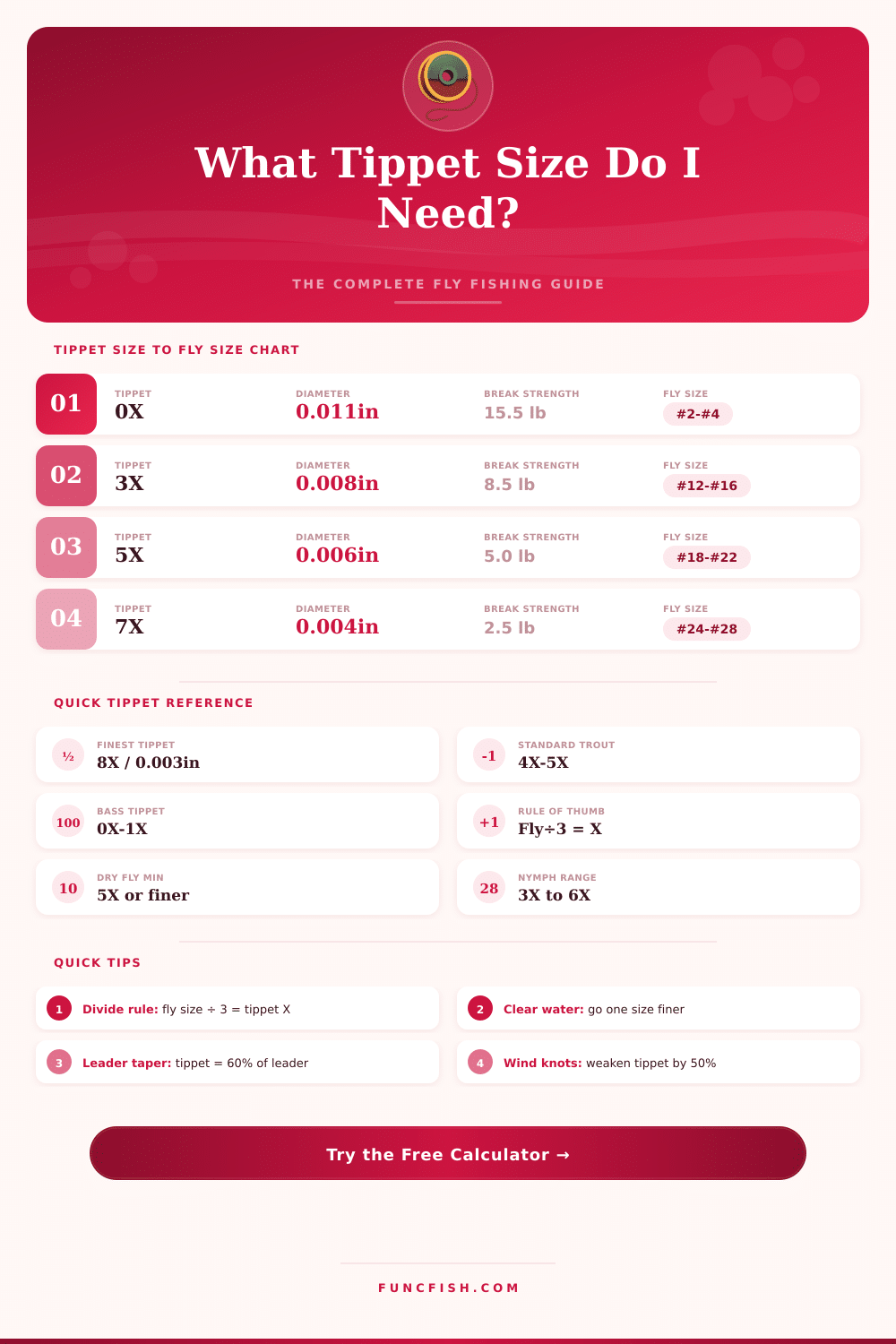
Tippet usually is surprisingly thin. The system for measuring it uses a scale with “X”, where higher numbers point to thinner material. 6X Tippet is much thinner then 3X. In the strong side, 2X Tippet lasts around 10 pounds before break.
8X Tippet? It gives in less than 2 pounds. Most anglers for trout choose 5X as their main pick.
The main reason for using Tippet is to avoid the heavy fly line and leader scaring the fish. In clear brooks with trout that has real importance. It is also key when you chase bonefish, snook or stripers in shallow flats.
Here is a simple rule that works for choosing the right size. Divide the size of your fly by three, or sometimes four, and that gives you the wanted X-rating. A fly of size 16 fits well with 5X Tippet.
Middle sizes as 4X and 5X work for small streamers and nymphs, although they can seem a bit weak when you cast bigger and heavy streamers. For bigger flies you do not need very thin Tippet.
Tippet you find in two main types: nylon monofilament and fluorocarbon. Some fluorocarbon versions reach higher weight tests, but seem slightly thinner, so they are less visible underwater while fishing. Interesting fact: “Tippet” is an old word from the time when Fly Fishing anglers themselves made leaders by binding various thicknesses of monofilament, and thethinnest part received that name.
Tippet usually involves almost a third of the whole length of your leader. For a standard nine-foot leader that is around three feet. Something thin as 6X breaks quite quickly, especially after fighting with fish or if the knot is not perfect.