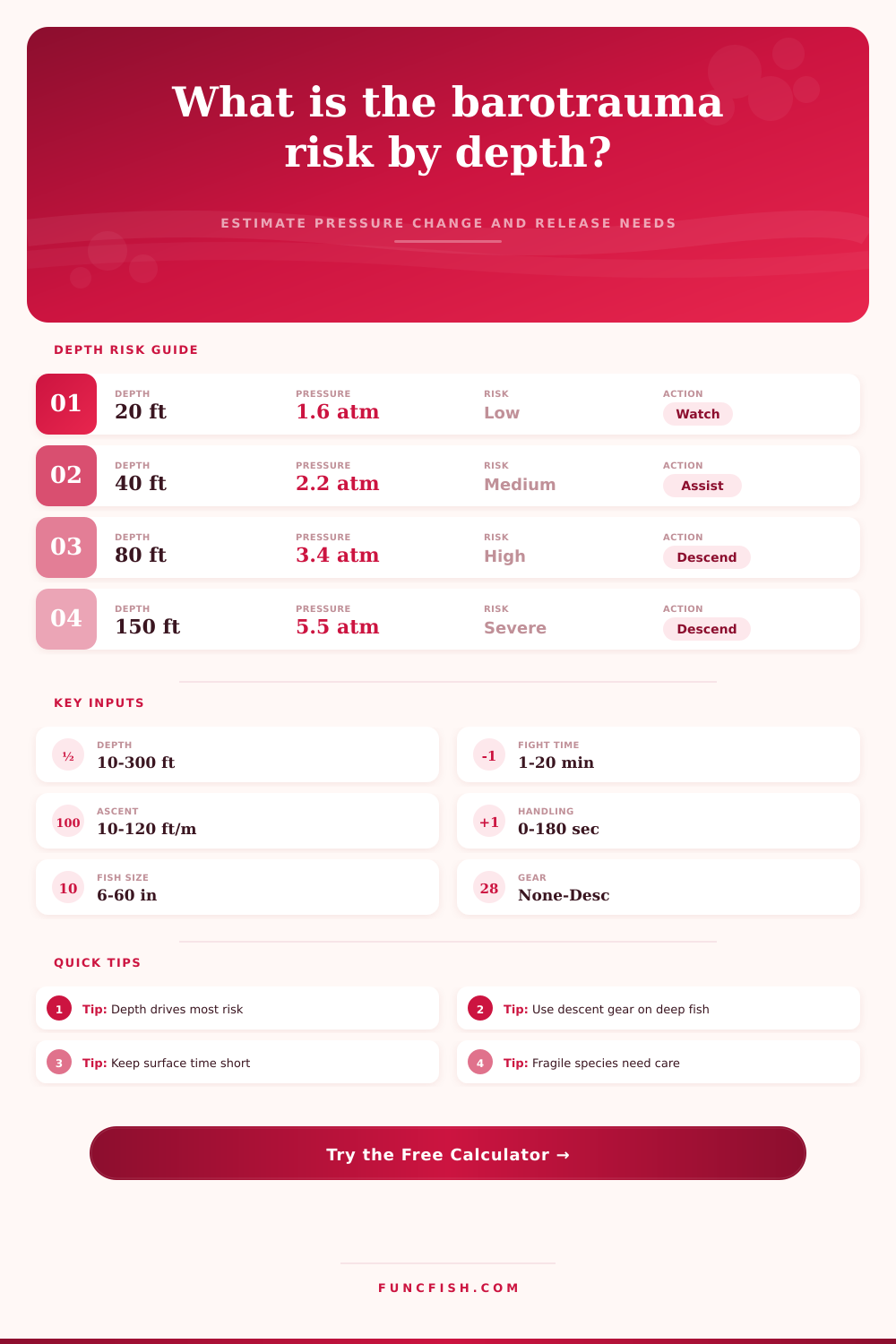
Barotrauma Risk by Depth Calculator
Estimate pressure change, gas expansion, risk score, and release depth for fish brought up from depth during catch and release.
📌Scenario presets
⚙Barotrauma inputs
This calculator estimates relative barotrauma pressure risk for release planning. It does not replace local best-practice guidance, fishery rules, or species-specific handling protocols.
Barotrauma risk estimate
Full breakdown
📋Species and release gear grid
Black bass
Walleye
Rockfish
Snapper
Grouper
Lake trout
Cod
Descending clip
📊Reference tables
| Capture depth | Absolute pressure | Surface expansion | Typical risk cue |
|---|---|---|---|
| 15 ft / 4.6 m | 1.45 atm | 1.45x | Usually low, watch behavior |
| 30 ft / 9.1 m | 1.91 atm | 1.91x | Moderate for sensitive species |
| 60 ft / 18.3 m | 2.82 atm | 2.82x | High enough for release aid |
| 100 ft / 30.5 m | 4.03 atm | 4.03x | High risk without descent |
| 150 ft / 45.7 m | 5.55 atm | 5.55x | Severe pressure change |
| 250 ft / 76.2 m | 8.58 atm | 8.58x | Extreme release challenge |
| Species group | Risk flag depth | Susceptibility factor | Release emphasis |
|---|---|---|---|
| Black bass | 25 ft / 7.6 m | 0.88 | Short handling, descend if floating |
| Walleye | 30 ft / 9.1 m | 1.08 | Gentle handling and quick return |
| Crappie | 25 ft / 7.6 m | 1.16 | Reduce surface time for schools |
| Rockfish | 60 ft / 18.3 m | 1.30 | Descending device priority |
| Snapper | 50 ft / 15.2 m | 1.24 | Return deep, avoid delay |
| Grouper | 60 ft / 18.3 m | 1.22 | Heavy descending aid |
| Halibut | 80 ft / 24.4 m | 0.80 | Control fatigue and hook injury |
| Cod | 80 ft / 24.4 m | 0.95 | Recompress deeper fish |
| Release method | Risk reduction used | Best depth range | Calculator assumption |
|---|---|---|---|
| No release aid | 0% | 0-25 ft / 0-7.6 m | No recompression help |
| Quick low handling | 8% | 0-35 ft / 0-10.7 m | Less air exposure stress |
| Venting tool | 18% | 30-80 ft / 9.1-24.4 m | Symptom relief, no depth return |
| Descending clip | 32% | 30-150 ft / 9.1-45.7 m | Controlled recompression |
| Weighted crate | 40% | 40-200 ft / 12.2-61.0 m | Holds fish until it swims down |
| Recompression cage | 46% | 60-250 ft / 18.3-76.2 m | Longer controlled descent |
| Deep-drop release | 52% | 80-300 ft / 24.4-91.4 m | Max planned return depth |
| Visible condition | Symptom factor | Handling target | Priority cue |
|---|---|---|---|
| Normal orientation | 0.00 | Under 45 sec | Watch swim-down |
| Bloated belly | 0.12 | Under 30 sec | Prepare release aid |
| Bulging eyes | 0.18 | Under 25 sec | Descend promptly |
| Stomach everted | 0.22 | Under 20 sec | Deep return preferred |
| Unable to submerge | 0.30 | Under 15 sec | Immediate descent |
| Exhausted / slow kicks | 0.20 | Under 20 sec | Limit extra handling |
💡Practical checks
Tip: When the suggested descent depth is greater than the planned release depth, treat the difference as a gear or handling gap rather than a precise biological threshold.
Tip: The fastest improvement is usually shorter surface time plus recompression gear for fish brought up from moderate or deep water.
Barotrauma happen when you pull up a trophy walleye from forty feet deep and, when you get her to the surface, she has bulging eyes and a swollen belly. She looks alive, yet she’s in trouble. As the fish comes closer to the surface, the water pressure dramaticly changes with each foot of ascent. To put it simply, the gas contained within the fish’s swim bladder start expanding like a bag of chips does in the back seat on a long trip. When expansion get excessive, the fish can’t regulate its own buoyancy and it might die from stress before recovery even begin.
Knowing how it works will make your catch-and-release survival rate increase. There are other factors that influence the risk, like species biology, ascent speed, and how long you handle the fish once it’s aboard. The source doesn’t mention anything about how a fish is oriented or if it’s swimming upside down. But overall, single biggest factor is depth.
Why Barotrauma Happens and How to Help Fish Survive
That’s because, at 30 or so feet, water exerts one atmosphere of pressure and that number doubles about every 33 feet. In other words, a fish caught at 60 feet will experience almost three times the pressure it would feel at the surface. Therefore, gas in its swim bladder wants to increase by a factor of three; its volume triples. As you’ll note in the reference table, this causes risk levels to change rapidly with depth… The deeper you go, the faster the risk escalates. And this isn’t a linear problem either, meaning each foot doesn’t counts equally. Going deeper really ramps things up.
The result depend heavily on species biology. Some fish possess a physostomous bladder, which connects them to their guts and allows them to rapidly increase or decrease their buoyancy by gulping or burping air into the gut. Other species possesses a physoclistous bladder, which is closed off from the gut and has slow rates of gas reabsorption via special tissues. These variations are accounted for in the tool’s susceptibility factors assigned to species groups.
For example, a bass caught in shallow water would likely make a quick ascent without much suffering while a rockfish snagged at the bottom of a deep kelp forest would be far less fortunate, facing potentially fatal injuries inside its body. That’s the reason you can’t just rely on generic advice out in the field. The other thing you have control over is ascent rate.
Pulling a fish too quickly from depth doesn’t gives its swim bladder a chance to compensate. Even a relatively gentle fight lasting just four minutes will cause metabolic stress which stops the fish’s ability to handle pressure change. This contributes to the math as does the actual gas expansion. Slowing your retrieve down a bit if you’re fishing deep structure or drifting over a reef make a measurable difference by letting the fish start to compensate before reaching the low pressure areas closer to the surface.
Once you have the fish in the boat, your handling time becomes critical. Oxygen deprivation and thermal shock from being out of the water also add stress to the pressure trauma each second the fish is exposed. Handling time and fish condition are two of the inputs that help estimate the total toll on the animal. Instead of carefully examining the fish, if the fish is bloated, unable to go under water, or otherwise damaged, it should of been immediately recompressed. Although venting tools will remove excessive gas, this does not cure deep-water barotrauma.
For those fish caught deep, descending devices that attach to the lower jaw and return the fish to its capture depth are much more effective. Returning the fish to an environment where their physiology can work normal allows them to recover. The results suggest how deep they recommend releasing them to neutralize the pressure change. For example, if the tool says you should go way deeper then what you intended to release them, then it’s warning you that there’s a very good chance they won’t survive being released at the surface.
And this isn’t guesswork: Catch-and-release mortalities are monitored by fisheries management agencies, and barotrauma is one of the major causes for post-release death on deep water species. The right gear helps match biological reality with conservation goals. Know the conditions in which you’re fishing; Pressure comes from depth; how we respond makes all the difference. The best insurance policy is a respectful quick release using the proper tool for both depth and species. A tragic event becomes a sustainable catch. The fish swims off and the water remains healthy for the next angler. You feel the fish go limp, but this time it slips away to where it should be: deep.