Braid Carrier Count Diameter Calculator
Estimate finished braided fishing line diameter from carrier count, bundle size, braid angle, packing efficiency, coating build, and caliper tension.
📌Scenario presets
⚙Braid construction inputs
Braid diameter estimate
Results update after calculation.
Calculation breakdown
🧵Carrier construction reference
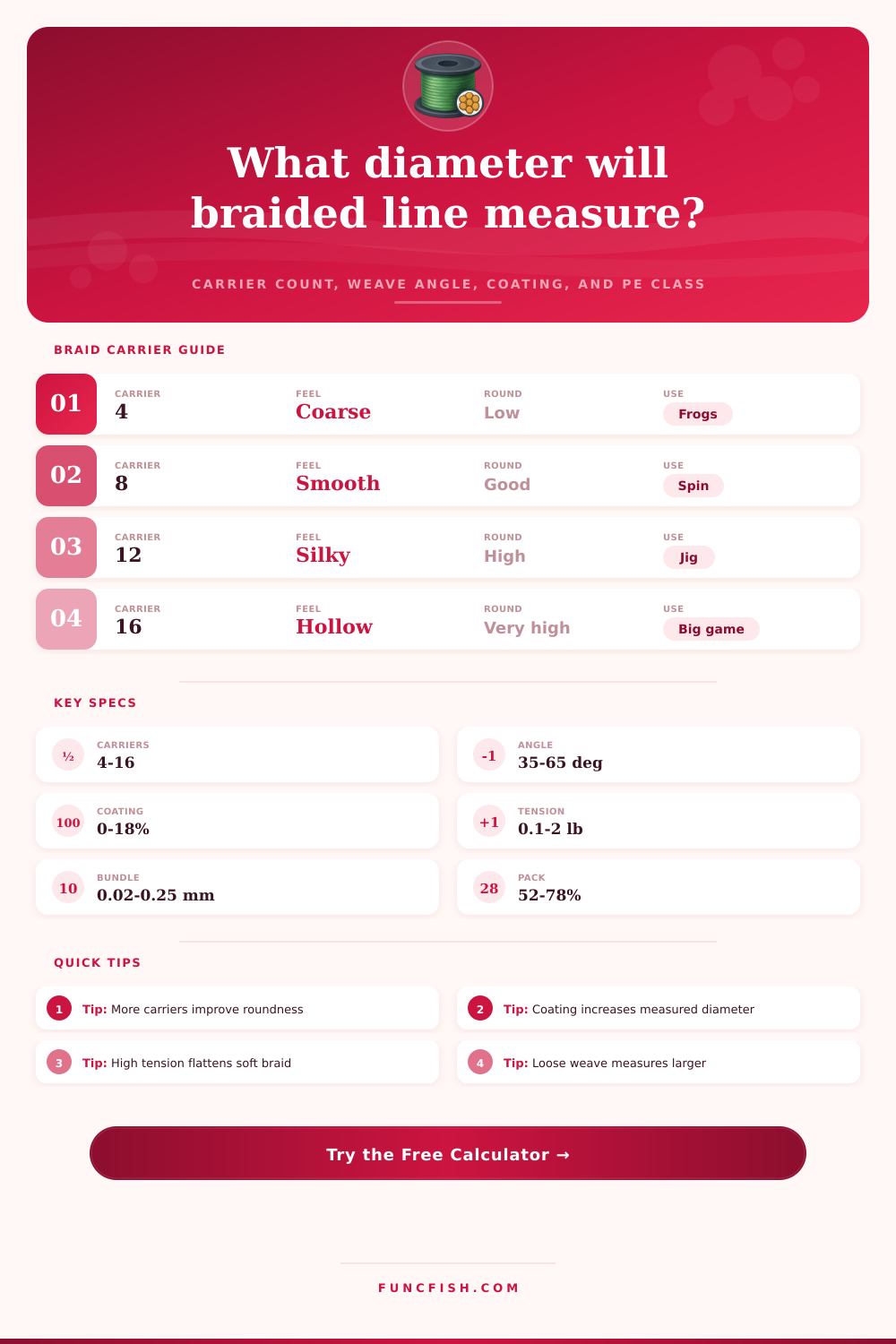
4 Carrier
8 Carrier
12 Carrier
16 Carrier
📊Carrier comparison grid
4 carrier casting
Best biteLower carrier count creates a tougher, more textured line for vegetation, cover, and short power casts.
8 carrier spinning
BalancedMost all-around braid diameters land here because the line is smoother without becoming too compressible.
12 carrier jigging
RoundMore carriers improve roundness and guide noise, useful for deep jigging and diameter-sensitive vertical work.
16 carrier hollow
SpliceVery high counts can be round but compressible, so measured diameter depends heavily on caliper pressure.
📘Reference tables
| Carrier count | Typical construction | Packing range | Diameter behavior | Best fishing use |
|---|---|---|---|---|
| 4 carrier | Four larger bundles | 55-64% | Coarser, can measure oval | Frogs, cover, catfish, surf shock leaders |
| 6 carrier | Transitional braid | 58-66% | Smoother than 4, still textured | Budget casting, inshore utility |
| 8 carrier | Common round braid | 62-72% | Stable diameter and good casting | Bass, walleye, trout, kayak inshore |
| 9 carrier | Eight around one core | 64-73% | Round center-supported profile | Long casting, controlled spinning line |
| 12 carrier | Fine multi-carrier weave | 66-75% | High roundness with lower guide noise | Vertical jigging, finesse saltwater |
| 16 carrier | High-count or hollow core | 60-76% | Round but pressure-sensitive | Big-game splicing and heavy trolling |
| PE class | Approx diameter | Light braid strength | Heavy braid strength | Common use |
|---|---|---|---|---|
| PE 0.4 | 0.10 mm / 0.004 in | 6 lb / 2.7 kg | 10 lb / 4.5 kg | Trout, panfish, light finesse |
| PE 0.8 | 0.15 mm / 0.006 in | 10 lb / 4.5 kg | 16 lb / 7.3 kg | Finesse bass and walleye |
| PE 1.2 | 0.18 mm / 0.007 in | 15 lb / 6.8 kg | 25 lb / 11.3 kg | General spinning and casting |
| PE 2.0 | 0.23 mm / 0.009 in | 25 lb / 11.3 kg | 40 lb / 18.1 kg | Inshore, jigs, heavier bass |
| PE 4.0 | 0.33 mm / 0.013 in | 50 lb / 22.7 kg | 80 lb / 36.3 kg | Frogs, surf, light offshore |
| PE 8.0 | 0.47 mm / 0.019 in | 90 lb / 40.8 kg | 130 lb / 59.0 kg | Offshore jigging and trolling |
| Species or technique | Typical braid | Carrier preference | Diameter target | Measurement note |
|---|---|---|---|---|
| Trout ultralight | 4-8 lb / 1.8-3.6 kg | 8 carrier | 0.07-0.12 mm | Light tension prevents false flattening |
| Bass spinning | 10-20 lb / 4.5-9.1 kg | 8 or 9 carrier | 0.12-0.18 mm | Coating build matters on new spools |
| Frog fishing | 40-65 lb / 18-29 kg | 4 or 8 carrier | 0.28-0.40 mm | Coarse braids may read oval |
| Walleye jigging | 8-15 lb / 3.6-6.8 kg | 8 or 12 carrier | 0.10-0.16 mm | Tight weave improves vertical feedback |
| Surf casting | 20-50 lb / 9.1-22.7 kg | 8 carrier | 0.20-0.36 mm | Shock leader knots need actual diameter |
| Hollow-core tuna | 80-200 lb / 36-91 kg | 12 or 16 carrier | 0.45-0.85 mm | Compressible wall can under-read |
| Adjustment | Low value | High value | Diameter effect | Use in calculator |
|---|---|---|---|---|
| Braid angle | 35° open lay | 65° dense lay | Open lay reads larger; dense lay compacts | Angle factor changes area by lay geometry |
| Coating build | 0% | 18% | Adds surface thickness and stiffness | Area grows by selected coating percent |
| Pick count | 12 per inch | 70 per inch | Higher picks reduce flat spots | Roundness score and ovality factor |
| Caliper tension | 0.1 lb / 45 g | 2 lb / 907 g | Soft lines flatten more under pressure | Flattening factor lowers measured diameter |
| Wet state | Dry | Aged wet | Can swell coating or relax braid | Wet multiplier modifies final diameter |
💡Measurement tips
Braid is flexible, so a hard squeeze can report a smaller number than the line actually occupies on a spool or through a guide. Compare lines at the same measuring tension.
An 8-carrier braid can be thinner than a 4-carrier braid only if bundle size, coating, and packing are also smaller. Carrier count mostly changes shape, texture, and roundness.
The calculator estimates geometric diameter from braid construction. Published line diameters can vary because brands use different test methods, coatings, and rounding conventions.
In tackling stores you see this all the time. A braid labeled with a certain strength might have a diameter that feels suspiciously small for what it claims to hold, and you’re scratching your head wondering what’s going on. That’s because braided fishing line isn’t monofilament. It’s a woven thing with some pretty serious air pockets and texture that will change based off measurement. The calculator takes care of all the math for you after you input bundle size and carrier count. Which saves you from making guesses about why a four-carrier braid feels bulkier then an eight-carrier one at the same pound test.
So where did all this carrier talk come from? Well, you should know carrier count define the shape of the line rather than its raw thickness. In this case, four carriers means fewer but thicker strands woven together to create a coarse texture. It is good for skipping frogs through reeds as it doesn’t catch like a bulkier line would. But it’s also rougher so it may show larger on a caliper than a finer line that are smoother. To achieve that same silky round line with less water absorbency go to a twelve or sixteen carrier construction that gives you a heavier feeling line that glides through your guides quietly.
How to Measure Braided Fishing Line Correctly
And many folks think more carriers = bigger diameter. That is false. More carriers simply pack together better for a different feel and give you smaller diameter. The actual physics of the line depends on its bundle diameter, which is thickness of each individual strand before they are braided together. If measured well enough, then the tool will consider weave angle geometry, and be able to precisely tell you what diameter the finished line will be.
The tighter the weave angle is, the more compact the line since there’s less air in it and it has a smaller overall profile. Conversely, the looser the lay, the bigger the spaces between the fibers. This makes the overall line diameter bigger but it still uses as much material. You’d think a loosely woven line would be weaker. Well, makers often like it for casting distance where the openness helps the line come off the spool and uncoil smoothly. Every cast involve a tradeoff between smooth airflow and saving space.
The second complication with coating is that it increases the measured size but doesn’t increase the strength. So a heavier fluorocarbon coating may contribute ten or fifteen percent to the area. What does this do? Well, it give you a hefty feel and leaves a small interior for sensitivity. This is great if you are fishing rocky areas and want abrasion resistance. However, keep in mind that it will take up more space on your spool than uncoated line. You’ll feed it into the inputs telling the system the coating percentage. The outcome helps in determining whether you get added protection or if that added bulk negatively impacts your casting distance.
The last variable to trip up most anglers is caliper tension, which depends on how hard you pinch the measuring tool. Braided line is compressible particularly the higher carrying varieties which has a hollow center. Squeeze it loosely and you’ll read larger. Squeeze it firmly and you’ll get a smaller number. That’s what accounts for the difference in diameter reported by various brands of same strength class. As the chart on the page illustrates, tension affects readings different with various constructions. It also demonstrates that the actual number isn’t as important as being consistent with your measurements.
Knowing your actual diameter helps you select guides and knots. If you’re using a thinner diameter than the advertised size, you might have trouble getting tight guides. On the other hand, if you think you are using a thin line but it is actualy thicker than listed, those guides will shred your line. These factors make an unclear spec more useful when developing a rod. The idea here is to use what you know about the variables to help you choose the right tackle more effectivey. You should of used this info before buying new furnitures.