Casting Angle to Structure Calculator
Estimate the cast angle, compensated landing distance, closest pass, and snag-risk window for docks, grass, rocks, timber, bridges, and other fish-holding structure.
📌Structure casting presets
⚙Casting geometry inputs
Angle and clearance results
Formula breakdown
🎣Lure profile data
Weightless Plastic
Finesse Jig
Spinnerbait
Casting Spoon
🐟Gear and species comparison grid
Bass around docks
Medium-heavy rod, 12-17 lb line, 2-5 ft clearance, and 6-12 ft lead for controlled skips beside posts.
Crappie in brush
Light rod, 4-8 lb line, 3-6 ft clearance, and gentle angles that keep the jig above outer limbs.
Redfish by mangroves
Medium rod, 10-20 lb braid, 2-4 ft clearance, and extra lead when current sweeps under roots.
Pike on reeds
Medium-heavy rod, 30-50 lb braid, 1-4 ft clearance, and a shallow line that tracks along the wall.
📊Reference tables
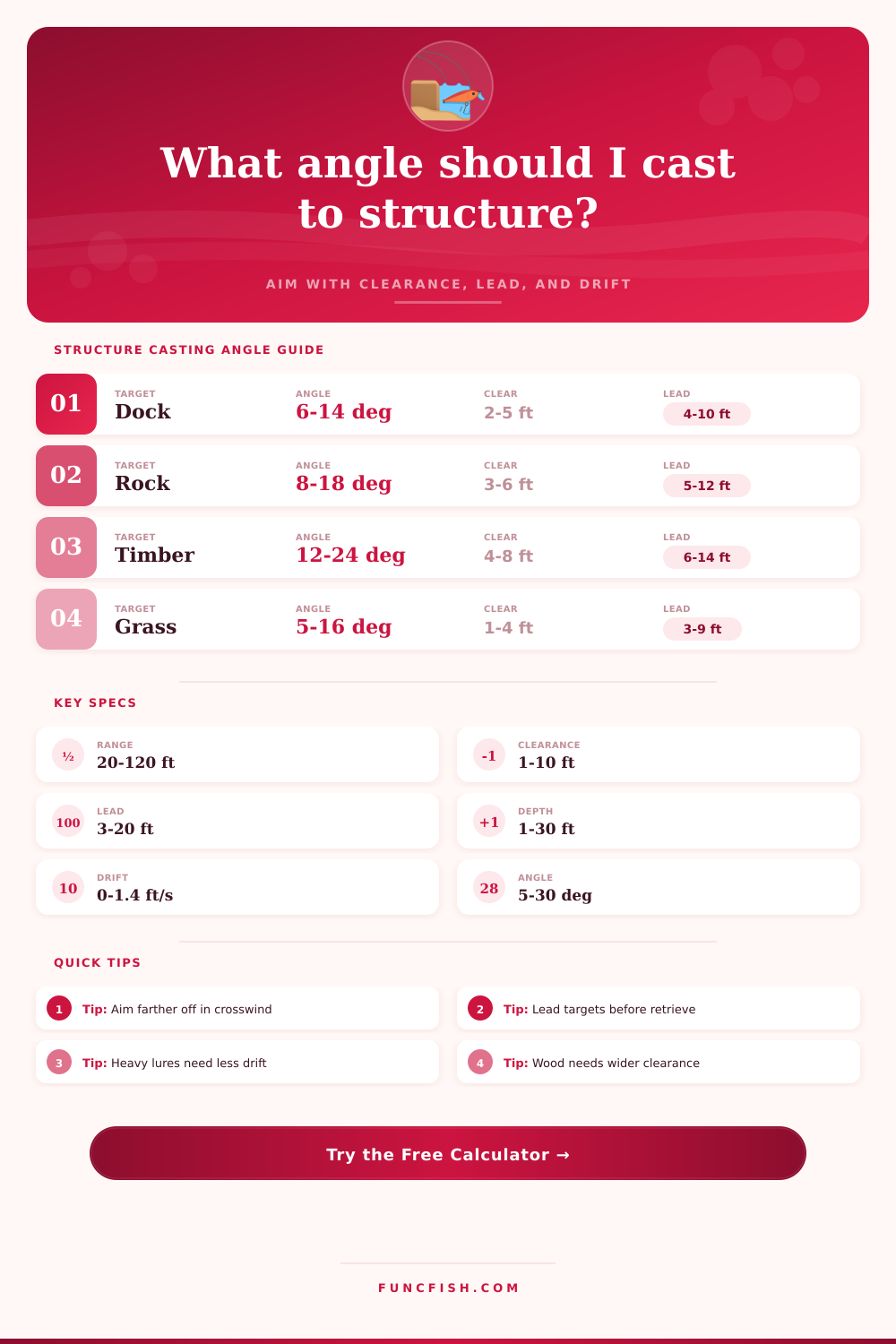
| Structure | Starting angle | Clearance range | Lead beyond target |
|---|---|---|---|
| Dock posts | 6-14° | 2-5 ft / 0.6-1.5 m | 4-10 ft / 1.2-3.0 m |
| Laydown timber | 12-24° | 4-8 ft / 1.2-2.4 m | 6-14 ft / 1.8-4.3 m |
| Boulder point | 8-18° | 3-6 ft / 0.9-1.8 m | 5-12 ft / 1.5-3.7 m |
| Weedline wall | 5-16° | 1-4 ft / 0.3-1.2 m | 3-9 ft / 0.9-2.7 m |
| Wind or current | Model speed | Best compensation | When to widen angle |
|---|---|---|---|
| Calm or sheltered | 0.00 ft/s / 0.00 m/s | Use geometry only | Only for heavy cover or poor accuracy |
| Light push toward cover | 0.35 ft/s / 0.11 m/s | Add lateral aim room | Soft plastics and floats |
| Medium push toward cover | 0.80 ft/s / 0.24 m/s | Add angle and reduce hang time | Deep water or slow-sinking lures |
| Along the face | 0.55 ft/s / 0.17 m/s | Shift lead distance | Bridge, riprap, and grass edges |
| Lure profile | Sink estimate | Drift response | Angle behavior |
|---|---|---|---|
| Weightless plastic | 0.8 ft/s / 0.24 m/s | High | Needs more open-water aim |
| Finesse jig | 1.9 ft/s / 0.58 m/s | Medium-low | Holds a tighter target lane |
| Crankbait | 1.1 ft/s / 0.34 m/s | Medium | Works on shallow parallel angles |
| Casting spoon | 2.6 ft/s / 0.79 m/s | Low | Needs more lead than lateral room |
| Species | Typical structure | Usual clearance | Gear note |
|---|---|---|---|
| Largemouth bass | Docks, timber, grass | 2-6 ft / 0.6-1.8 m | Medium-heavy rod, abrasion-aware line |
| Smallmouth bass | Rock, points, current breaks | 3-7 ft / 0.9-2.1 m | Medium rod, fluorocarbon leader |
| Redfish | Mangrove roots, oyster edges | 2-5 ft / 0.6-1.5 m | Braid plus leader for cover |
| Crappie | Brush piles and standing timber | 3-6 ft / 0.9-1.8 m | Light line, slower fall rate |
💡Angle planning tips
Clearance tip: Treat the calculated closest pass as the lure path, not the line path. Bowed line, rod angle, and a fish turning into cover can all require an extra foot or two of room.
Lead tip: If the result shows a good angle but a short retrieve lane, keep the same clearance and add lead beyond the structure so the lure starts working before it reaches the strike zone.
For many anglers, there’s something especially frustrating when you know that fish are present but can’t make an accurate enough cast around the structure without fouling up. On a dock, you can see them through the hole, or along that weed edge, but your casts seem to always go past it more too much or fall into center of it. Managing your geometry on the water, as I call it, often makes the difference between a good day and a bad day. It is not some abstract notion of power or accuracy, but controlling your forward range versus your left and right range. Lateral distance.
Enter the calculator, which take out the guesswork on setting the starting angle prior to lifting rod. But few people understand that the inputs determines the trajectory once the bait enters the water. The type of structure such as rock or timber determine the amount of space required between your bait and an instant snag. Your choice of lure profile make a huge difference in how much you have to compensate for the wind. Light baits gets pushed all over the place, while heavier ones hold their lane very well. However, other factors like sink rate and depth next to structure also comes into play.
How to Use Casting Angles to Catch More Fish
Wind also plays a big role in a cast: both at launch and when the lure drifts through the air and on the water’s surface until it sinks. Even a mild breeze that blows a soft plastic a few feet off target, with a reach into some overhead cover, can transform a neat presentation into a twisted pile of branches and line. The tool takes this into account. It recommends an increased angle if the wind drives the lure toward the danger zone, or a lessened one if it tends to blow the offering away from the threat. This helps make sure you present the bait up-close without putting yourself too far outside the safety zone. It helps you find that sweet spot where being close enough gets a little safer.
When reading the result you’ll want to take into account more than just the degree number. The distance result will tell you where to cast to get the lead past your desired strike zone. That lead is essential as it seldom happens when a fish hits a lure on the very first second it crosses the strike zone. They have to see something, so begin your retrieve well before the bait passes by the structure and maintain a retrieve through it. Zero lead means you are landing directly on your target. This could of cost you precious presentation time by forcing you to battle the fear of snags instead of generating strikes.
The other element of this metric is the closest pass, which illustrates the tightest part of the lures journey compared to the danger zone. You should also consider species behavior as it relates to how close you can get. For instance, largemouth bass hold tight to dock posts where you can go really tight with little clearance. Smallmouth on rock points prefer to stay just outside of snags and rough areas. Crappie around brush piles is picky about tension and want enough clearance to let their lure move naturaly without ripping it through the outer limbs.
All these subtleties have been baked into the presets, but knowing why will allow you to tinker when things don’t go as planned on the water. These figures are more of a baseline than a mathematical constant. Fish behavior, light conditions and clarity levels can vary from day-to-day and influence what angles works best beyond simple geometry. For example, even if your line-up is theoretically “perfect”, casting into their strike zone could spook a school of fish by putting your shadow on the water, much like how sunlight glinting off the surface makes them skittish.
The idea with all this is to remove some of the uncontrollable variables so we can spend less time fretting over our math and fighting with equipment and instead reading the water and responding to bites. The more you practice and hone in on casting angles, the better you’ll get at it. But a solid reference point will also help speed up the learning process a lot. You can ditch the muscle memory that might let you down under pressure and instead use a logical approach to tackling tricky cover.
First, learn the tool and how it should look on your favorite target. Then go cast it around and tweak those numbers based off real-world casts. When you stop guessing and start designing, it becomes much easier to go from knowing where the fish are to actualy catching them. On the water, precision is everything. A couple degrees off the mark can be the difference between filling up the boat or coming home with an empty cooler.