Cork Float Shot Capacity Calculator
Estimate how much split shot a cork float can carry by modeling displaced water, cork density, exposed sight tip, reserve buoyancy, hook load, bait load, water type, and current drag.
📌Cork float presets
⚙Float balance inputs
Leave at 0 to use the selected water condition. Add manual reserve when a live bait pulls hard, waves slap the float, or you want more sight tip.
Cork float shot capacity results
Calculation breakdown
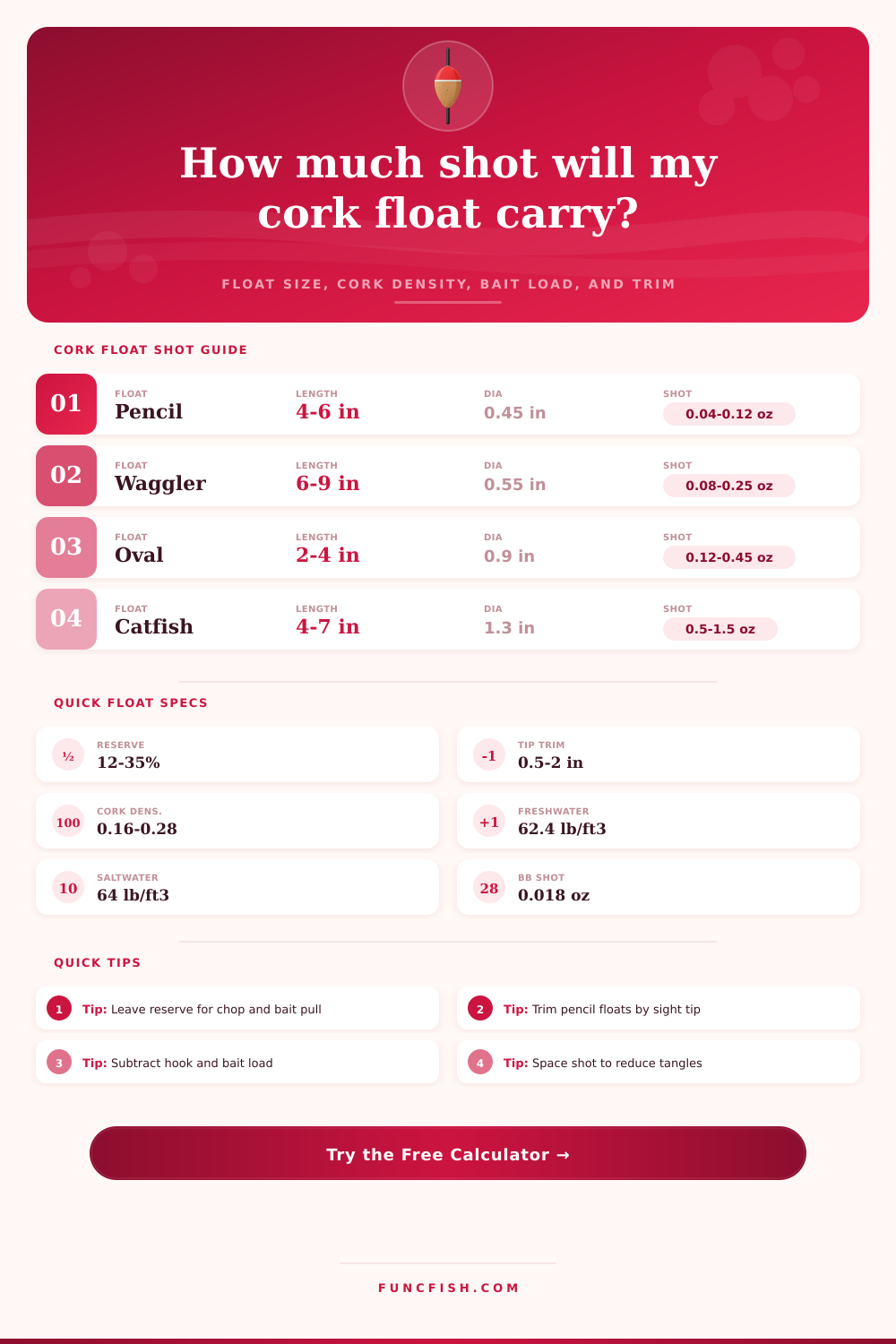
📊Float profile comparison grid
Pencil cork
Waggler cork
Oval cork
Popping cork
📏Split shot reference table
| Shot size | Approx weight | Metric weight | Typical float use | Trim note |
|---|---|---|---|---|
| Size 8 | 0.004 oz | 0.11 g | Ice, micro panfish, tiny corks | Fine final trim |
| Size 6 | 0.006 oz | 0.17 g | Bluegill, brook trout, small creeks | Stacks cleanly |
| Size 4 | 0.010 oz | 0.28 g | Crappie, trout, pencil corks | Good sensitivity |
| Size 1 | 0.014 oz | 0.40 g | General slip cork rigs | Easy to count |
| BB | 0.018 oz | 0.51 g | Common fixed or slip float load | Balanced all-rounder |
| 3/0 | 0.028 oz | 0.79 g | River floats and deeper rigs | Use fewer pieces |
| 7 shot | 0.057 oz | 1.62 g | Big bait, catfish, inshore corks | Bulk placement |
| Bulk pack | 0.100 oz | 2.84 g | Oversize corks and fast current | Add small trim shot last |
🐟Species and cork balance table
| Target | Typical cork | Shot style | Reserve range | Balance goal |
|---|---|---|---|---|
| Bluegill and perch | 3-5 in pencil or ice cork | Small string shot | 12-18% | Very light bite visibility |
| Crappie | 5-7 in slip cork | One bulk plus trim shot | 15-22% | Minnow can move naturally |
| Trout | 6-9 in waggler | Buttoned shot string | 15-25% | Stable drift and fast bite read |
| Walleye | 6-8 in oval or slip cork | Bulk shot near swivel | 20-28% | Hold leech or minnow near depth |
| Steelhead | 8-10 in river cork | Tapered shot line | 25-35% | Prevent dunking in current seams |
| Catfish | 5-7 in cigar or large cork | Heavy bulk shot | 28-40% | Support cut bait and waves |
🧮Trim and reserve reference table
| Condition | Reserve to leave | Visible tip | Shot placement | When to adjust |
|---|---|---|---|---|
| Calm pond or ice hole | 10-15% | 0.4-0.8 in | Compact and close to hook | Float rides too high on shy bites |
| Light ripple | 15-22% | 0.8-1.2 in | One main shot plus trim shot | Tip bobs under wavelets |
| Moderate chop | 22-30% | 1.2-1.8 in | More weight near swivel | Rig drifts faster than bait |
| River current | 28-38% | 1.5-2.5 in | Taper shot down leader | Float leans hard or dives |
| Active live bait | 25-40% | 1.2-2.2 in | Bulk shot above leader | Bait keeps pulling cork down |
⚖Cork material density table
| Material grade | Specific gravity | Lift effect | Best match | Practical note |
|---|---|---|---|---|
| Premium light cork or balsa | 0.16-0.20 | More lift | Small sensitive floats | Needs durable finish |
| Standard fishing cork | 0.22-0.26 | Normal lift | All-around slip corks | Good default estimate |
| Dense painted cork | 0.28-0.35 | Less lift | Short sturdy floats | Paint adds small mass |
| Cork-coated foam core | 0.10-0.16 | High lift | Oversize bait floats | Can ride high if overestimated |
| Waterlogged old cork | 0.36-0.50 | Much less lift | Temporary use only | Test in a bucket before fishing |
💡Shot capacity tips
Bucket-test the final rig. The calculator estimates buoyant lift from float geometry, but knots, paint, beads, and soaked cork change real trim. Add the last small shot while watching the visible tip.
Do not use every ounce of lift. A float trimmed to the waterline looks sensitive in calm water, yet it false-dives in chop, current, or when a live bait surges. Keep reserve for field conditions.
If your cork slips under water it fails to lift weight of your rig, leaving no reserve buoyancy for actual fish bites. There’s nothing left in reserve when a bite occurs, not good. Float trimming is simply a matter of basic physics, using Archimedes’ principle for balsa or wood floats. No guessing required here; the calculator does it for you. But knowing how it works will help you understand what goes into equation. This helps you stay within limits so you don’t overload your rig with weight.
All cork isn’t created equal. Depending on curing and processing techniques, cork comes in a range of densities. Premium light cork have better lifting properties then the dense painted types. This allows you to achieve the same trim with smaller split shot. That makes a difference when fishing wary panfish that gets spooked by bulky weights or heavy line. To account for this, tool asks about your cork grade so it can factor in weight of the float body into its estimate.
Why Float Trimming Is Important
Then there’s the issue of water density. Is it a tidal creek with saltwater? Or a lake with fresh water? Density matter because saltwater has greater density then fresh so will exert more buoyant force for each cubic inch of underwater volume. So while your setup may be dead-on in a pond, it’ll actualy ride high enough to add some margin in the ocean, without having to add any additional shot. Your capacity margins is shown in reference table on the page. This extra margin keeps you from being frustrated when you fish in new bodies of water where your old setup won’t work.
The most important thing to understand here is concept of reserve buoyancy. Regardless of the situation, don’t trim your float exactly at the waterline; try to leave about 15-30% reserve buoyancy, particularly if you’re dealing with wind or current. Tapping out all the ounces required to keep the rig afloat leaves zero room for wiggle; even the slightest wave action or struggle from a live bait will dunk the whole float. By leaving 15-30% of its reserve untapped, you create a shock absorber against false signals caused by current pressure and not actual bites. When a fish pulls the bait in, the float goes down and stays down, while not bouncing all over the place due to surface-level turbulence.
If a minnow is actively fighting for position or if you are fishing in choppy water, you can manualy change the reserve setting on the calculator. Split shot size will also affect sensitivity and overall presentation. If you use a big chunk of lead, it’s going to concentrate all that weight in one place, spooking fish and making the bait sit unnaturaly on the bottom. But if you spread out that exact same amount of weight over multiple smaller shots, it scatters that weight down your leader and lets the bait just drop naturaly in the water column. The calculator will give you an idea of how many splits of whatever shot size you choose it will take to get the desired weight, so you can see how it will be laid out on line without ever having to pick up the string. That leads to better strike detection and fewer hang-ups.
The rig feel lighter to the fish, but it still has enough depth to stay in the feeding zone. Over time, old corks take up water and become heavier. Their density go up and they lose lift. A cork that previously sat high will sit low even if you remove some shot from it. It’s not because it’s loaded down, it should of been taking on water instead. You can avoid hours of confusion on the bank by testing your setup in a bucket first before you head out on the water.
Finally, the diameter of your line adds drag. This is especially true if you’re fishing in a current and your line is thick (like monofilament), as the line resist the water and pulls the float down at an angle. All of these things are included in the final equation so when you adjust them, you’re doing so based off actual conditions on the water, not some imaginary ideal condition in still water.
Ultimately, balance is everything. It turns what was once a guessing game into a controlled display. If the float stays stable with enough reserve, you can feel certain any move it makes is real. Subtle twitches becomes believable indicators rather than wind ripple or other debris. Rigging takes time, but adjusting for balance pays off big-time in terms of recognizing strikes and increasing overall catch rate. Not only do you want the bait down there; you also want it presented naturaly so the wary fish sees it without having to come up to get a good look. Good trim links you directly to the action, turning under-water movements into obvious clues on top.