Daisy Chain Spacing Calculator
Calculate teaser-to-teaser spacing, usable chain length, terminal lure gap, and minimum leader rating for offshore and inshore trolling daisy chains.
🎯 Fishing Presets
⚙ Chain Inputs
Daisy Chain Spacing Results
Calculation Breakdown
🧰 Leader Material Comparison
📏 Species Spacing Reference
| Species | Common teaser count | Typical spacing | Trolling speed | Terminal gap |
|---|---|---|---|---|
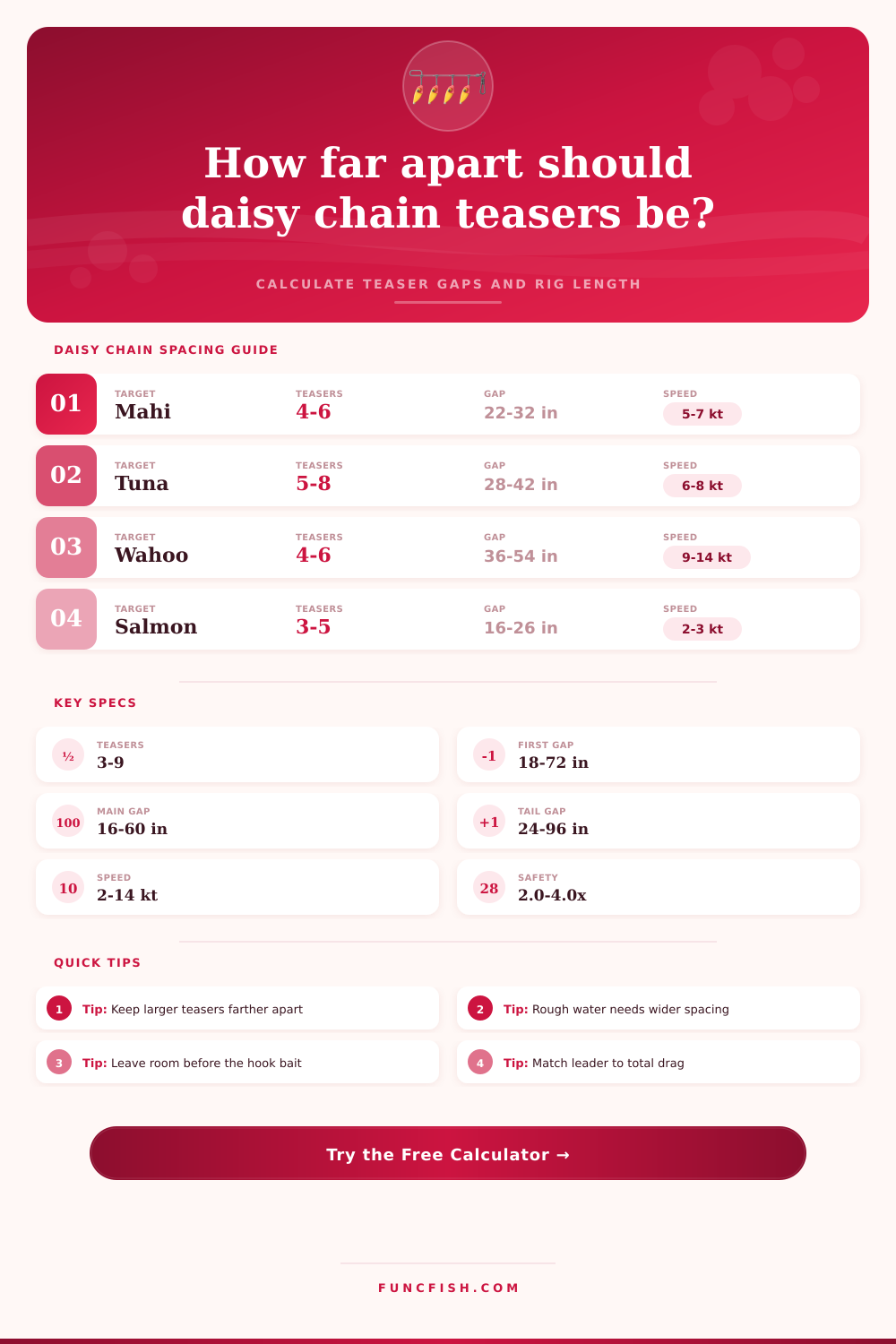
| Mahi mahi | 4 to 6 small squids or feathers | 22 to 32 in / 56 to 81 cm | 5 to 7 kt | 36 to 60 in / 91 to 152 cm |
| Yellowfin or bluefin tuna | 5 to 8 bulb squids | 28 to 42 in / 71 to 107 cm | 6 to 8 kt | 48 to 84 in / 122 to 213 cm |
| Wahoo | 4 to 6 hard or skirted teasers | 36 to 54 in / 91 to 137 cm | 9 to 14 kt | 60 to 96 in / 152 to 244 cm |
| Sailfish | 4 to 7 compact squids | 24 to 38 in / 61 to 97 cm | 5.5 to 7.5 kt | 42 to 72 in / 107 to 183 cm |
| Striped bass | 3 to 5 tubes, spoons, or shads | 18 to 30 in / 46 to 76 cm | 2.5 to 4 kt | 24 to 48 in / 61 to 122 cm |
| Pacific salmon | 3 to 5 hoochies or flash teasers | 16 to 26 in / 41 to 66 cm | 2 to 3 kt | 20 to 42 in / 51 to 107 cm |
🌀 Spacing Adjustment Table
| Condition | Spacing multiplier | Why it matters | Best use |
|---|---|---|---|
| Calm, clear water | 0.96x | Tight pattern stays visible without tangling | Mahi, school tuna, small feathers |
| Light chop | 1.00x | Neutral baseline for most trolling wakes | Mixed offshore chain spreads |
| Rough sea | 1.12x | More distance keeps teasers from colliding | Bird chains, heavy squids, rolling wake |
| Dirty or green water | 1.08x | Wider flash window improves separation | Inshore mackerel, stained coastal water |
🛠 Chain Style and Terminal Gap Guide
| Chain style | Spacing bias | Terminal lure gap | Hardware note |
|---|---|---|---|
| Inline squid or feather chain | Standard center spacing | 1.3x to 1.8x main spacing | Swivel rating should exceed full chain load |
| Bird plus teaser chain | First gap longer than main gap | 1.5x to 2.2x main spacing | Bird adds splash drag and requires heavier clips |
| Staggered drop chain | Use 5% more center spacing | 1.4x to 1.9x main spacing | Keep dropper lengths shorter than clear gap |
| Heavy plugs or hard heads | Use 15% more center spacing | 1.8x to 2.4x main spacing | High drag needs chafe guards and larger swivels |
| Compact light inshore chain | Use 10% less center spacing | 1.2x to 1.6x main spacing | Works with lighter leader when speed is low |
📊 Gear and Species Matching Grid
| Target and spread | Teaser size | Leader class | Recommended material | Spacing priority |
|---|---|---|---|---|
| Mahi around weed lines | 4 to 7 in / 10 to 18 cm | 80 to 150 lb / 36 to 68 kg | Mono or fluoro | Flash density and easy turning |
| Tuna behind boat wash | 6 to 9 in / 15 to 23 cm | 150 to 250 lb / 68 to 113 kg | Hard mono or mono | Clean wake lanes and strong crimps |
| Wahoo at speed | 5 to 8 in / 13 to 20 cm | 175 to 300 lb / 79 to 136 kg | Wire or coated cable | Wide gaps to stop bite-offs and fouling |
| Sailfish pitch bait teaser | 4 to 6 in / 10 to 15 cm | 100 to 200 lb / 45 to 91 kg | Fluoro or mono | Natural rhythm and compact profile |
| Striped bass umbrella-style teaser | 3 to 6 in / 8 to 15 cm | 40 to 100 lb / 18 to 45 kg | Mono or braid | Short spacing at low trolling speed |
| Salmon hoochie chain | 2 to 5 in / 5 to 13 cm | 25 to 60 lb / 11 to 27 kg | Mono or fluoro | Tight cadence behind flashers |
💡 Calculation Tips
Use the calculated spacing as a rigging target, then confirm the chain tracks without tumbling beside the boat before fishing it in the spread.
There are times out there where everything appears to be right but you can’t get bit. Everything seems right in the boat. Speed, spread etc., and you’re staring down on your electronics waiting for something to pop up. One more teaser comes by and swings into the other teaser or they both swing into business bait on the end of line. Before you know it, you have a fish hooked. Then the rig fouls out and you lose the fish.
That’s typicaly a spacing issue and really not bad luck. But instead of winging it and hoping gaps is right for conditions, all you need do is input how many teasers and what speed you want to go and let calculator figure it out.
Why Correct Spacing Matters
What happens with daisy chaining is water resistance multiplies rather than scales linearly. Adding one more bait, a sixth squid in our example to a chain of five, doesn’t simply add one thing to the wake. It adds drag. This pulls all previous knots tighter and force all baits closer to the turbulent wash from your boat. What most anglers consider is how it looks spaced on deck. Six squids laid out equally apart by inches makes for a neat appearance.
What happens when it goes over side at seven knots? The water flow has changed instantly. The teasers up front is pulling hard and creating tension, this shortens the effective distance between next bait. This is where leader material selection come into play. Fluorocarbon doesn’t stretch near as much as nylon does. Under load nylon will stretch some whereas fluorocarbon won’t.
If you’re running a long chain with lots of big teasers and are cranking fast, the gap those baits have underwater may only be half of what they appear on deck. That’s why tool asks you about your backbone type. Then it puts a safety factor onto calculated load. Not only will it tell you how far apart to tie them, it will also tell you what strength hardware you should of using to maintain that tension while fighting a fish. A cheap swivel is a weak link waiting to happen in a high-load chain.
The other requirement that changes is sea state. On glassy water, tight works fine because you know what the wake will be and the teasers follow same line. Add some light chop or even a quartering sea and now those same teasers start hunting laterally and verticaly colliding into one another. Now you’ve got lost bait and tangled line. The adjustment tables has multipliers for rougher conditions because each teaser have room to recover from wave action without hitting its neighbor.
This isn’t making the chain longer for sake of being longer but rather creating independent lanes of motion where each teaser can work their own way through water.
One key variable that lots of folks overlook is speed. If you’re trolling at 12 knots for wahoo, the spacing has got to be dramatically wider different than when trolling at five knots for mahi. The amount of pressure applied to each link grows as square of its speed, so you quadruple the pressure on the whole assembly just by doubling your speed. You can bet that an arrangement that was working for tuna at six knots would foil-out on itself at ten times the speed if you don’t widen gaps accordingly.
In particular, in these high-load situations the distance between the last teaser and the hook bait, aka the terminal gap, should be very wide. If the final gap is too narrow, the hook bait gets pulled back into turbulence created by the teasers. You need to leave the bait in clear water behind them so a fish can find it without being spooked.
Instead of seeing each lure as an individual piece tied to a line, consider them all part of one chain. The water moves between each one and they tug at each other. One slows down a little because of fatigue or a stray piece of debris, it then tugs back on those in front and pushes forward on those behind throwing off the rhythm. Good spacing will absorbs this kind of irregularity, giving the system enough room to correct itself without getting tangled up. You want it to appear as if it is organized from boat but have enough room inside of it to livig with the chaos of actualy being fished.
The spacing is key. Less time tying on knots, more time catching fish. It is a precision tool from chaos that presents bait precisely as desired. Adjust for species, acknowledge the physics of drag and speed and let gaps do their job to keep your spread alive. The only thing to wonder when they follow it cleanly is whether anything bites.