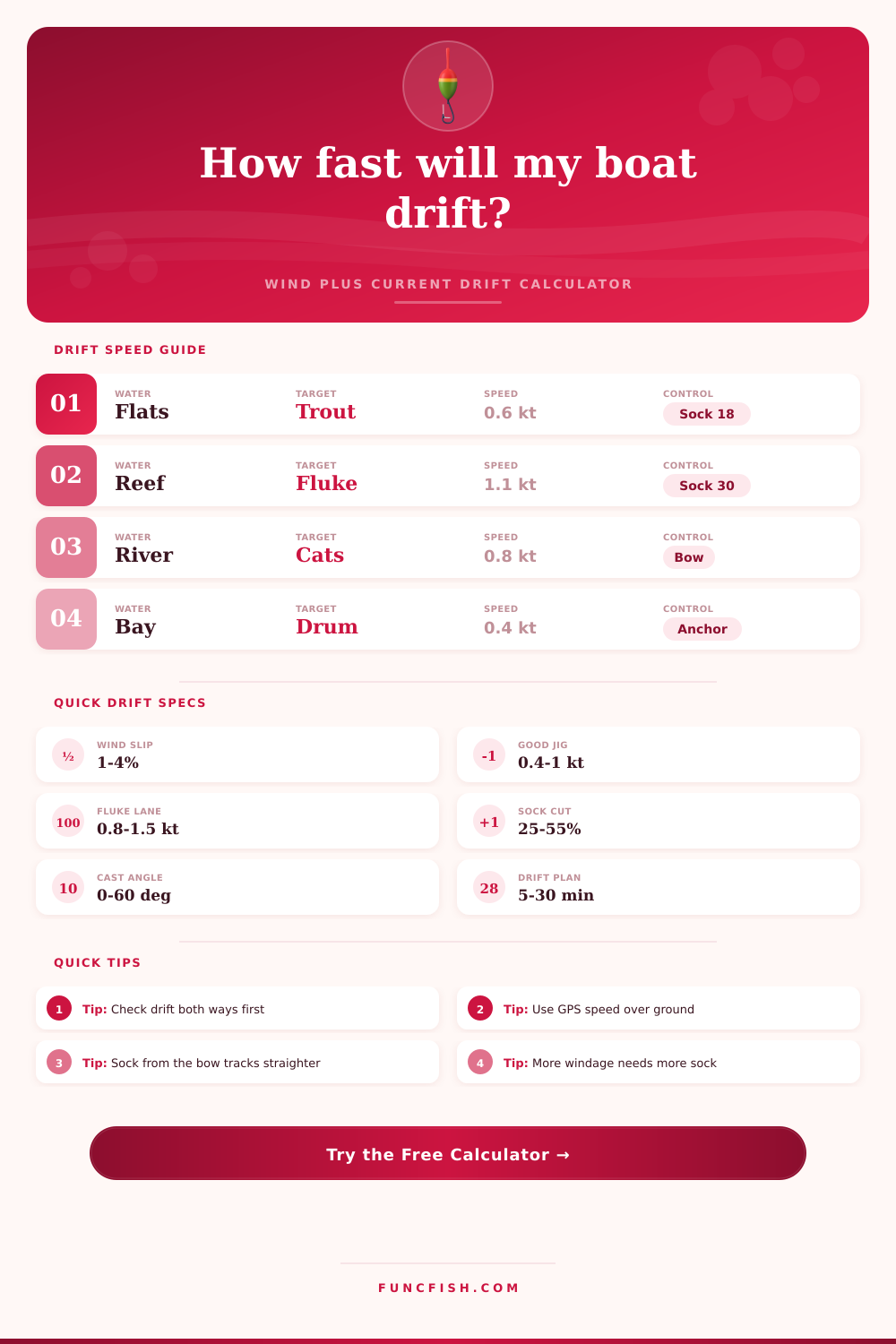
Drift Speed by Wind and Current Calculator
Estimate GPS drift speed, drift bearing, fishing-lane time, and drift distance by combining current, wind slip, boat profile, sea state, and drogue control.
📌Scenario presets
⚙Drift inputs
Wind and current drift forecast
Calculation breakdown
🎣Gear and species drift comparison
Fluke Bucktail
Walleye Jig
Reef Bait
Trout Cork
📊Wind slip reference
| Craft profile | Typical wind slip | Best control | Fishing use |
|---|---|---|---|
| Fishing kayak | 1.2-2.6% of wind speed | Small sock or anchor trolley | Marsh trout, panfish, smallmouth |
| Low bass boat | 1.5-2.8% of wind speed | Bow motor correction | Walleye, bass, crappie lanes |
| Bay boat or skiff | 2.0-3.5% of wind speed | Medium sock off bow cleat | Flats, inlets, drifted bait |
| Center console | 2.4-4.0% of wind speed | Large sock or twin socks | Reef, inlet, nearshore drift |
| Pontoon | 3.2-5.5% of wind speed | Twin socks and bow alignment | Slow bait drifts on lakes |
| Pilot house or cuddy | 3.0-5.0% of wind speed | Sea anchor from bow | Offshore live bait and bottom rigs |
🌊Current and tide reference
| Current type | Speed range | Drift behavior | Common fishing adjustment |
|---|---|---|---|
| Weak lake current | 0.05-0.25 mph / 0.04-0.22 kt | Wind dominates track | Use lighter jigs and longer casts |
| Tidal flat exchange | 0.25-0.70 mph / 0.22-0.61 kt | Clean directional sweep | Line up with potholes or grass edges |
| Inlet or bridge tide | 0.80-2.50 mph / 0.70-2.17 kt | Current dominates boat path | Heavier sinker, shorter drift window |
| River seam | 0.60-2.00 mph / 0.52-1.74 kt | Speed changes across lanes | Start above the target seam |
| Offshore surface push | 0.10-0.60 mph / 0.09-0.52 kt | Combines with swell and wind | Check GPS track before setting lines |
| Dam release flow | 1.00-3.50 mph / 0.87-3.04 kt | Very fast lane turnover | Use chain drag only where safe |
⚓Drift control reference
| Control device | Typical speed reduction | Best attachment | When it helps |
|---|---|---|---|
| No sock | 0-5% | Boat trims naturally | Light wind or active casting |
| Small drift sock | 15-30% | Bow or midship cleat | Kayaks, skiffs, light chop |
| Medium drift sock | 25-45% | Bow cleat with float line | Fluke, walleye, bay drift lanes |
| Large drift sock | 40-60% | Bow bridle | Center consoles and reef drifts |
| Twin socks or sea anchor | 50-70% | Balanced bow bridle | High windage boats offshore |
| Bow-mount correction | 10-45% | Into wind or crosswind | Precise jigging lanes |
🐟Species and presentation speed windows
| Target and rig | Useful drift speed | Depth fit | Gear note |
|---|---|---|---|
| Fluke bucktail or bait rig | 0.8-1.5 kt / 0.9-1.7 mph | 15-80 ft | Increase jig weight as speed rises |
| Walleye vertical jig | 0.4-0.9 kt / 0.5-1.0 mph | 10-45 ft | Keep line angle near vertical |
| Speckled trout cork | 0.3-0.7 kt / 0.3-0.8 mph | 2-8 ft | Cast crosswind to slow the float |
| Catfish bottom drift | 0.5-1.2 kt / 0.6-1.4 mph | 8-40 ft | Use a rig that ticks, not plows |
| Snapper reef bait | 0.6-1.3 kt / 0.7-1.5 mph | 40-160 ft | Shorter leaders reduce sweep |
| Offshore live bait | 0.2-0.8 kt / 0.2-0.9 mph | surface to 120 ft | Match chum and bait track |
💡Drift planning checks
Tip: Measure one short test drift on the GPS before committing to a long pass. Wind slip changes quickly when anglers stand, the bow swings, or chop grabs the hull.
Tip: If your lure keeps sweeping behind the boat, slow the hull first with a sock or bow correction, then add weight only enough to restore bottom contact.
The boat drifts too fast and your jig is still sitting on bottom like a stone. Then you make another cast and by the time the line is tightened, the wind pushes the bow around. It’s all chaos until you realize it’s just math. It is vector math, to be exact. Drift fishing is arithmetic, which calculator will do for you; all you have to worry about is where the fish are located. Knowing the numbers makes difference between a targeted pass and aimless wandering.
The reason is simple. In shallow water, current exerts more force then wind. Current pushes all the water below your hull. Wind only pushes part of boat above surface. Depending on whether you run a high sided center console with a windshield or a low profile bass boat, hull shape affect this variation as shown by reference table. Twenty-mile per hour winds might give you a two percent drift speed for a low boat. You could lose five percent or more if you have a lot of surface area like on a pontoon. That three percent equate to nearly half a knot gain in speed over the bottom. And that can be enough to pull your lure out of strike zone.
How to Control Your Drift Speed
Your main way of steering will be drogue control. Drift socks is more than just rough sea equipment for many anglers. They’re precise presentation tools. A sock that’s too big might take off 60% of your surface speed. A smaller sock can cuts speed by a quarter. You don’t really want to stop drifting because stopping the boat makes fish spooky up close in open water, but you do want to slow down enough and get into same speed window where your lure looks naturaly. Sometimes fluke prefer a slightly faster drift around one knot to keep their vertical jig upright and moving. Shallow ledge walleye typically wants something more in the half-knot range for keeping bait in strike zone longer.
When wind and current don’t line up, it gets tricky. If both push in same direction, their combined speed will increase quickly. Instead of having five minutes at a productive lane, you might go through it in two. If they work against one another, like a powerful outgoing tide meets a stiff headwind… Your boat might barely move forward while churning up the water beneath you. The net result… The angle and relative speed of the two directions combined into a projected track; is what tool calculates. And you won’t have to figure out any trigonometry on the spot since the tool handles that geometry for you, it would of been easier if it was automatic.
Drag is exponentially greater with depth. For example, a float rig fishing two feet deep will drift noticeably faster than heavy bottom bouncer sitting at thirty feet, even if boat speed remain identical. This relationship between speed and depth is what the presentation fit score measures, how much your actual surface speed differ from ideal speed range of your tackle. Low scores indicate you’re either floating too fast above the bottom or dragging too hard along it. Both scenario tend not to get many bites.
A quick test pass is worth a thousand words. Open water conditions change fast, and chop can catch you from behind without you knowing. Run with your engine at least a bit of throttle to check your speed over ground instead of going by what you think you see. When your eyes are busy casting, you’re fatigued and trust me…what you see isn’t always accurate. Dial in the motor correction or increase/decrease sock size until your bait matches actions of your target fish. After that it’s just timing and knowing how much your bait needs to fight the wind and current. You’ll plan out the vector ahead of time and the drift won’t be an accident.