Fireball Rig Bead Count Calculator
Estimate how many floating beads a fireball rig needs to lift bait, hooks, and leader off bottom while preserving enough reserve buoyancy for current, bait soak, and hook count.
📌Fireball rig presets
⚙Bead lift settings
Use the wet bait amount actually hanging from each hook after trimming.
Leader mass is estimated from typical mono or fluoro diameter for this strength.
Fireball rig bead forecast
Calculation breakdown
📊Floating bead lift grid
8 mm Foam
10 mm EVA
12 mm Foam
16 mm Foam
📐Bead size reference table
| Bead option | Diameter | Estimated lift in freshwater | Typical count range | Best fireball use |
|---|---|---|---|---|
| Closed-cell foam micro bead | 6 mm / 0.24 in | 0.10 g / 0.004 oz | 6-18 beads | tiny hooks, worms, finesse bottom rigs |
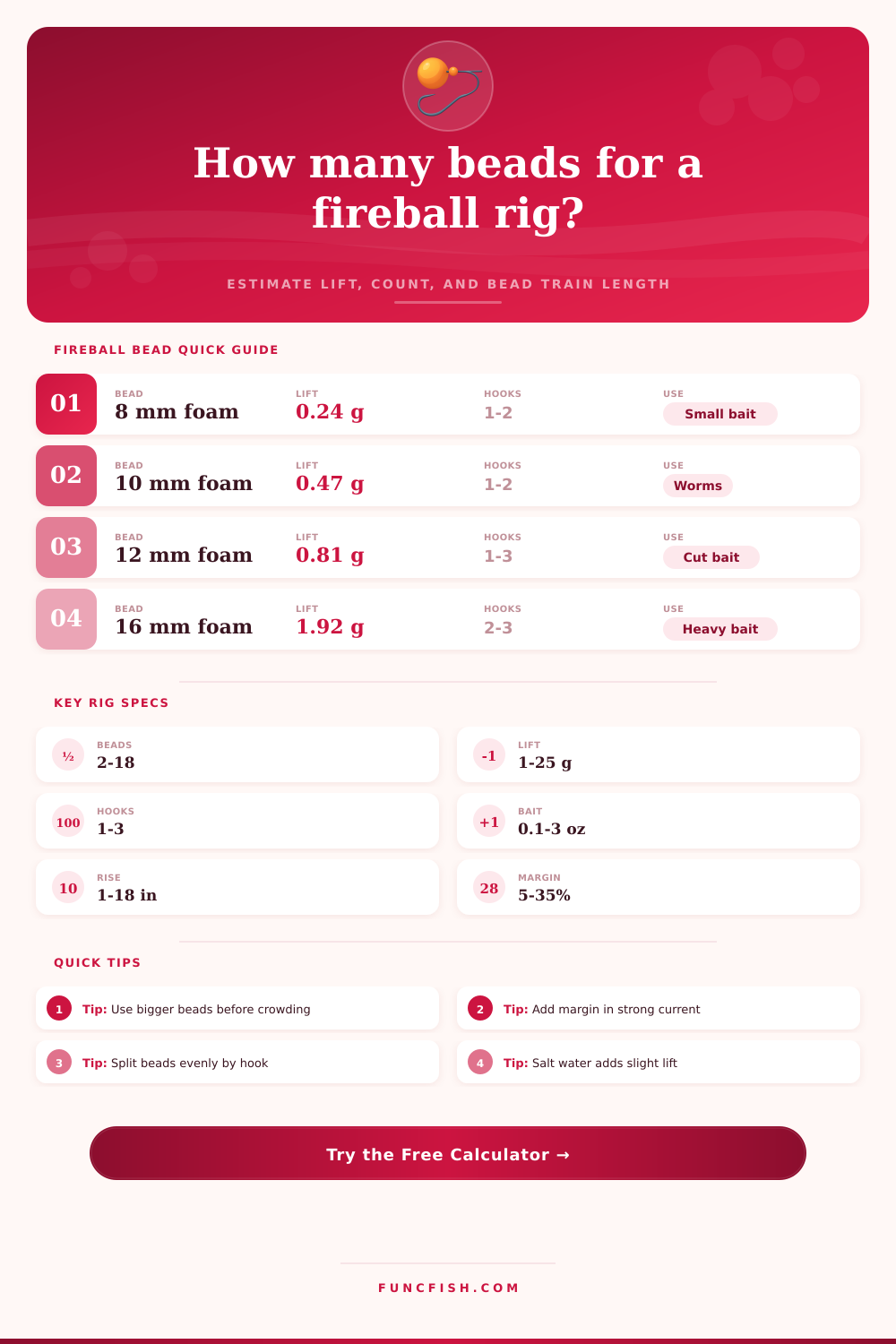
| Closed-cell foam small bead | 8 mm / 0.31 in | 0.23 g / 0.008 oz | 4-14 beads | pompano, croaker, small catfish baits |
| EVA or foam standard bead | 10 mm / 0.39 in | 0.44-0.46 g / 0.016 oz | 3-12 beads | nightcrawlers, shrimp, leeches, dough bait |
| Closed-cell foam large bead | 12 mm / 0.47 in | 0.79 g / 0.028 oz | 2-10 beads | cut bait chunks and standard catfish leaders |
| Foam oversized fireball bead | 14 mm / 0.55 in | 1.25 g / 0.044 oz | 2-8 beads | mullet strips, herring chunks, surf sweep |
| Foam heavy bait bead | 16 mm / 0.63 in | 1.87 g / 0.066 oz | 1-7 beads | heavy river bait and larger circle hooks |
🐟Species and gear comparison grid
| Target | Common fireball bait | Hook range | Leader range | Typical bead approach |
|---|---|---|---|---|
| Channel catfish | cut shad, liver, worms | 1/0-5/0 circle | 20-40 lb / 9-18 kg | 10-12 mm beads, moderate lift |
| Blue catfish | cut shad, skipjack, herring | 5/0-9/0 circle | 40-80 lb / 18-36 kg | 14-18 mm beads or shorter bead train |
| Flathead catfish | live bluegill, shiner, chub | 5/0-9/0 kahle or circle | 40-80 lb / 18-36 kg | large beads with extra reserve |
| Pompano and whiting | sand fleas, shrimp, clam | Size 4-1/0 bait hook | 15-30 lb / 7-14 kg | 6-10 mm beads near each dropper |
| Red drum and striper | mullet, bunker, herring strips | 5/0-9/0 circle | 40-80 lb / 18-36 kg | 12-16 mm beads, surf reserve |
| Walleye and sauger | leeches, crawlers, minnows | Size 4-1/0 live bait hook | 8-15 lb / 4-7 kg | 6-10 mm beads for subtle lift |
⚖Bait load adjustment table
| Bait profile | Apparent sink factor | Drag factor | Bead placement note | Calculator effect |
|---|---|---|---|---|
| Nightcrawler or leech | 0.42 of wet weight | low | small cluster above hook eye | fewer beads, subtle rise |
| Shrimp, clam, sand flea | 0.55 of wet weight | medium | split beads on high-low droppers | normal surf fireball count |
| Cut bait chunk | 0.70 of wet weight | medium-high | cluster beads ahead of bait | higher lift and reserve |
| Soft liver or stink bait | 0.82 of wet weight | medium | use more small beads to avoid tearing | extra load from dense bait |
| Live baitfish | 0.35 of wet weight | high | do not over-float active bait | drag can exceed sink load |
| Dough ball or boilie | 0.88 of wet weight | low-medium | short bead stack above hair or hook | dense bait needs lift margin |
📏Rig layout spacing reference
| Rig layout | Normal hook count | Bead split method | Suggested train cap | When to size up beads |
|---|---|---|---|---|
| Single hook sliding sinker | 1 | all beads above hook | under 4 in / 10 cm | when count passes 8 beads |
| Two hook fireball leader | 2 | half above each hook | under 3 in / 8 cm per hook | when either hook needs 7 beads |
| Santee-style lift leader | 1 | beads near bait or mini float | under 5 in / 13 cm | when current flattens leader |
| Surf high-low fireball | 2 | beads on each dropper arm | under 3.5 in / 9 cm per arm | when sweep rolls bait low |
| Three hook pier rig | 3 | small clusters per dropper | under 2.5 in / 6 cm per arm | when tangles increase |
💡Fireball bead calculation notes
Use reserve buoyancy as the practical check. A rig that calculates to 6.1 beads needs 7 beads, but the reserve tells whether the rounded bead count barely clears the bait load or has enough lift for current and bait softening.
Change bead size before building an oversized train. If one hook needs more than 7 small beads, a larger foam bead usually gives cleaner casting, less leader twist, and a shorter fireball cluster.
First you rig foam beads that get the bait up off the bottom where it’s visible to fish and they can sniff around it, then hit weight. Seems easy enough right? Well, the water wants down and gravity is patient. Balancing buoyancy isnt a guessing game. It is about counteracting the weight of metal hooks, the drag off current, and the sink rate of wet bait, all while maintaining a clean leader. The calculator does the math based on your own tackle, but knowing what goes in will save you time on the water since you won’t have to tie knots back on if lift isnt right.
Few angler realize that bait will load with water and become significanly heavier. Until a night crawler is dunked into lake and filled with water, it’s light as a feather. Then, it pulls the hook down and crawls along on bottom. This explains why bait profile matter, since softer cut shad or chicken livers will soak up a lot of water and increase there weight. They needs more buoyancy compared to stiffer squid or dough balls. So if you don’t take that into account, your rig won’t stay up high enough.
How to Balance Your Fishing Rig
Depending on what material is used the chart below will illustrate the amount of beads needed to keep your rig at best level. Remember your bait is suspended not held so you want it right at the depth fish are feeding on. That’s why current makes all the difference; it puts drag into actual leader line. The goal is just enough lift to rise above the mud in slack water. But if you’re fishing in a moderately flowing surf zone or river, the current sucks down on line and pushes the bait into the bottom. You want ability to counter that pressure with some reserve buoyancy. Otherwise, your rig will flatten out on bottom.
That means a minimum of 20 percent (or even more) as a safety margin to ensure you can present the bait naturaly no matter how fast water is moving. This is where so many folks miss the mark, thinking that lift is static, whereas it’s really dynamic.
The other factor that has a big impact are the size of the hook, since you need to get both the leader line and metal mass of the hook off the bottom. If you’re fishing for red drum or blue catfish, those big hooks with heavy wire will really add up. And a nine zero circle hook weigh a lot more than a small bait hook does. So, the tool factors that in too, using an estimate of how much hardware will be attached to that chosen pattern. Again, a little thing but it makes a difference when each gram add to the overall required amount of lift. The less the fish have to struggle against excess drag, the better the beads can does the job.
The physical presentation and how easily you can cast this rig is also influenced by bead size choice. Too large and the rig are difficult to retrieve due to twisting out the leaders; too small and you have too much rig that will hang up on structure and get twisted out during the retrieve. The bigger beads create lift better then smaller beads (more lift for each inch of bead) so they keeps the cluster tight and streamlined. If you work out your math and find that you need ten beads that are eight millimeters long, try using four that are 16 millimeters instead. You will likely have a rig that tangles less and is easier to manage. It’s a convenience/performance tradeoff that is generally solved with experience, but the numbers can help you realize where the limit is before you reach it.
Getting that right is what fireball fishing is all about, it’s not about rigging so much that your assembly feels bouncy and unstable but just enough to get the bait suspended, to hover, not to float away aggressively off hook. That’s where the calculator comes into play as well because it figures in the load and gives a buffer for real world stuff like water density, current, etc.
So with the count, now go try it in a bucket of water if you can. When you pull on it gently, watch how it acts. Is it sitting too high or sinking too low? Is it sinking too high? Make an adjustment with a single bead at a time. That will give you the right balance of sink/float, making the rig an active trap where the bait stay up and out where you need it most until fish decides otherwise.