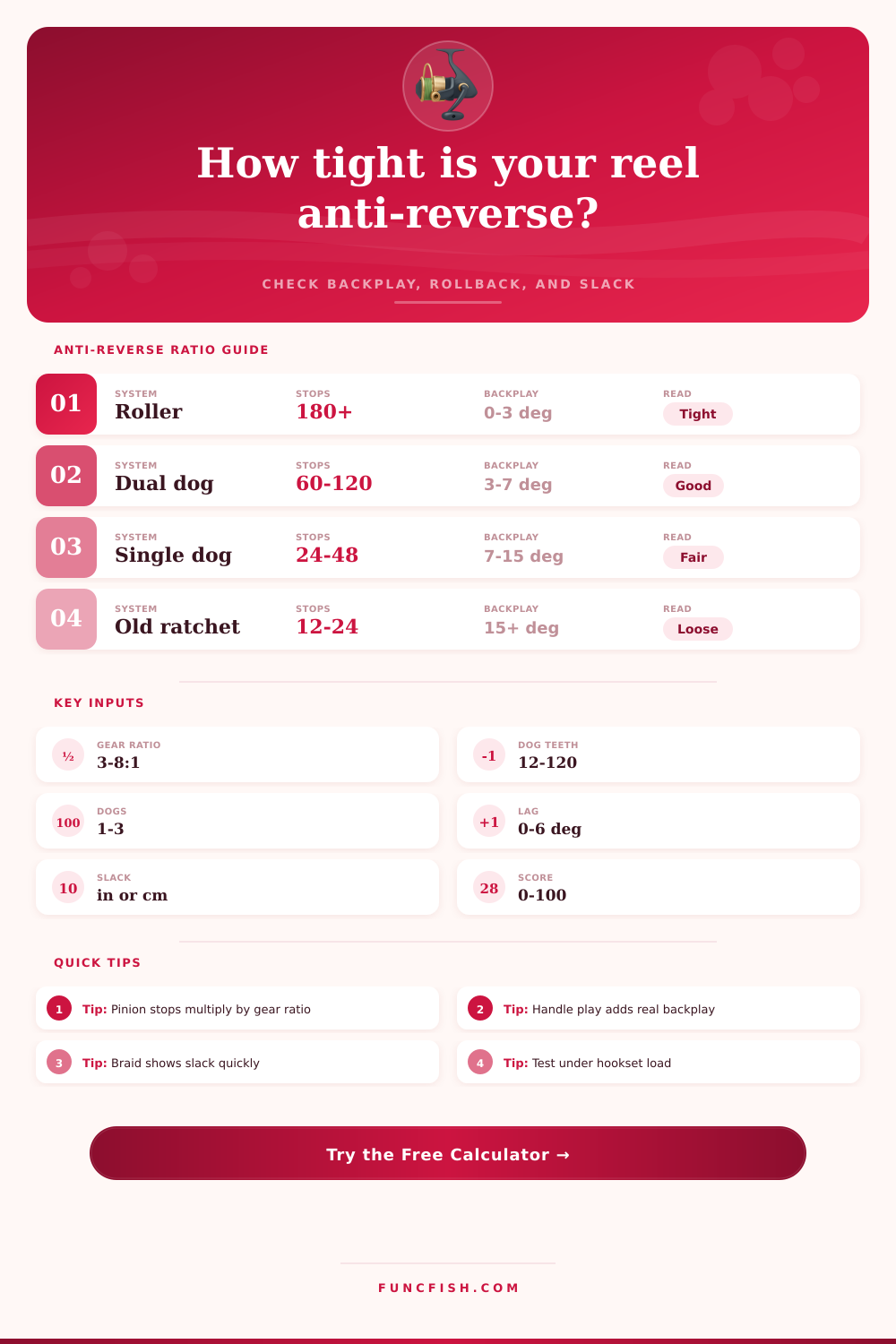
Fishing Reel Anti-Reverse Ratio Calculator
Estimate effective anti-reverse stops per handle turn, handle backplay, rotor or spool rollback, line slack, and hookset stability from reel geometry and load.
📌Scenario presets
⚙Reel and anti-reverse inputs
Anti-reverse ratio forecast
Results update from the reel, stop count, clutch lag, and line retrieval geometry.
Calculation breakdown
🎣Anti-reverse mechanism data
Roller Clutch
Roller + Dog
Dual Dog
Click Pawl
📊Reference tables
| Reel use | Backplay target | Slack target | Usual mechanism | Calculation note |
|---|---|---|---|---|
| Finesse spinning | 0.5–3.0° | Under 0.25 in / 0.6 cm | Roller clutch | Light line exposes even small handle movement. |
| General baitcasting | 2.0–6.0° | Under 0.50 in / 1.3 cm | Dual dog or clutch | Pinion or spool stops multiply through gear ratio. |
| Heavy cover casting | 1.0–4.0° | Under 0.35 in / 0.9 cm | Roller plus dog | Hard hooksets punish free-play and clutch flex. |
| Surf spinning | 1.0–5.0° | Under 0.60 in / 1.5 cm | Roller plus backup dog | Large line pickup magnifies handle backplay. |
| Catfish round reel | 4.0–10.0° | Under 0.80 in / 2.0 cm | Dual or single dog | Mono stretch hides some rollback, but hooks still move. |
| Offshore trolling | 2.0–8.0° | Under 1.00 in / 2.5 cm | Dual dog ratchet | High load needs a high holding margin more than silent feel. |
| Anti-reverse type | Typical effective stops | Backplay feel | Load behavior | Best matching line |
|---|---|---|---|---|
| Instant roller clutch | 180–360 per turn | Nearly locked | Small lag, can slip if contaminated | Braid, fluoro, light mono |
| Roller clutch plus dog | 120–300 per turn | Very tight | Dog carries backup shock load | Surf braid, inshore braid |
| Dual dog ratchet | 48–120 per turn | Short click movement | Strong under heavy drag | Mono, heavy braid, Dacron |
| Single dog ratchet | 18–60 per turn | Noticeable handle knock | Durable but coarse | Mono and bottom rigs |
| Click-pawl fly reel | 12–32 per turn | Large audible steps | Light drag with deliberate feedback | Fly line and backing |
| Input | Imperial example | Metric example | Why it matters | Common measuring mistake |
|---|---|---|---|---|
| Handle length | 2.4 in | 6.1 cm | Converts knob looseness into angular play. | Measuring total handle span instead of center-to-knob. |
| Line retrieve | 30 in/turn | 76 cm/turn | Turns handle backplay into actual slack. | Using catalog retrieve with a half-empty spool. |
| Loaded spool | 1.85 in | 4.70 cm | Checks rollback against real circumference. | Measuring the bare spool instead of loaded line. |
| Stop teeth | 36 teeth | 36 stops | Sets the coarse mechanical anti-reverse step. | Counting clicker teeth that are not anti-reverse teeth. |
| Hookset load | 4 lb | 1.8 kg | Estimates clutch flex and holding margin. | Entering max drag instead of realistic strike load. |
The calculator estimates mechanical backplay and line movement. Actual lockup can vary with lubrication, bearing condition, dog spring tension, handle hardware, and line packed under uneven tension.
💡Practical checks
Backplay measured with an empty reel often understates line slack. Fill level changes retrieve per turn, so check with the spool near its real fishing diameter.
A high stop count can still feel loose if the handle, clutch sleeve, or dog spring has play. Enter free-play at the knob to include that extra movement.
The anti-reverse system is an system that prevents the handle from rotating in the opposite direction of the spool. When a fish pull on the line, the anti-reverse system must lock to prevent the line from spinning backwards. The amount of movement that occur before the anti-reverse locks is called backplay.
Backplay is an important measurement of the function of an anti-reverse system. Backplay can be measured in different ways depending upon the type of fishing that a person performs, and the type of fishing line that they are using. Anti-reverse systems can use a variety of system to lock the handle in place.
Backplay and Anti-Reverse in Fishing Reels
Some anti-reverse systems use a roller clutch, others use a pair of dog, and others use a ratchet system. Each system locks at a different rate, and there is a variety of factors that can contribute to the backplay that is experienced by a fisherman. For instance, the position of the anti-reverse system within the reel gear train can affect the backplay that is exhibited.
The amount of free play in the handle knob also has the potential to contribute to the backplay in the system. Finally, the amount that the clutch will flex under a load will contribute to the backplay of the system. These factors are all separate from the number of stop that a system has; if a person has a system with a high number of stops in their anti-reverse mechanism, they may still experience a loose anti-reverse system if any of these other factor contribute to the backplay.
The calculator use mathematics to calculate the backplay in an anti-reverse system. To calculate the backplay, a person must enter their type of fishing reel, the type of anti-reverse system, and the line type being used into the calculator. The gear ratio for that anti-reverse system can help to calculate the backplay; a higher gear ratio will result in greater multiplication of the movement exhibited at different locations in the drive train.
For example, a stop at the pinion shaft will create more stops at the handle than a stop at the main gear. The type of line that is used will also have an impact on the backplay in the anti-reverse system. For instance, line that is made of braid will allow for less rollback than line that is made of monofilament; braid lines exhibit very little stretch while monofilament lines can stretch to hide the backplay of the anti-reverse system.
Handle length and the looseness of knobs on the handle will also contribute to backplay. For instance, if a person has a knob that is loosely attached to a long handle, the knob will contribute to more backplay than if they have a knob that is loosely attached to a short handle. The angle of the handle movement can also be multiplied through the gear ratio; thus, the gear ratio will help to reveal the amount of line that will slip off of the spool before the anti-reverse system engages.
Additionally, a person can compare the load of the hook to the drag of the reel; if the load of the hook is less than the drag, the clutch will not flex under the load of the hook. Finally, the diameter of the spool and the percentage of the line that fills the spool can change the line movement. For instance, if the line is on a full spool, there will be a larger circumference of the spool than if the spool is half full of line.
Because there is a larger circumference of line that rolls off the spool, the line will move further on a full spool than if the line is on a half-full spool. There are two table within this article that display the target backplay for different types of fishing. For finesse fishing, backplay should be very small due to the low weight of the fish that are hooked.
For surf fishing or trolling fishing, a larger backplay is acceptable because the loads on the lines are greater. These tables also display the different types of loads that are exhibited by different types of anti-reverse mechanisms. These tables allow a person to determine the best type of anti-reverse system for the type of fishing that they perform.
Many people make mistakes when measuring backplay. One of the most common is to perform the measurement when the line on the spool is empty, but to assume that the measurement will be the same when there is line on the spool. Another of the most common mistakes is to enter the maximum drag of the reel instead of the load that is used when setting the hook to the fish.
In addition to the information provided on this page, there are a few other factor that can influence the performance of an anti-reverse system. For instance, the temperature of the water that the fish are in can change the thickness of the lubricant in the system. Dirt or old grease within the clutch can create lag in the system, despite the number of teeth on the clutch components.
Finally, the dog spring on the anti-reverse system may have weakened over time, allowing for the system to exhibit more backplay. For these reasons, many anglers will check the backplay of their anti-reverse systems at the beginning of each fishing season. One of the goals of this information is to ensure that there is zero movement in situations where that type of movement would be detrimental to the angler and the fishery.
In other situations, though, it is desired for there to be some movement; this allows anglers to feel when the anti-reverse system engages. Thus, if the calculations indicate that the backplay is too much for the type of fishing that is to be performed, the angler knows that there is a problem with the handle, the clutch, or the anti-reverse system itself.