Fuel Burn Per Fishing Hour Calculator
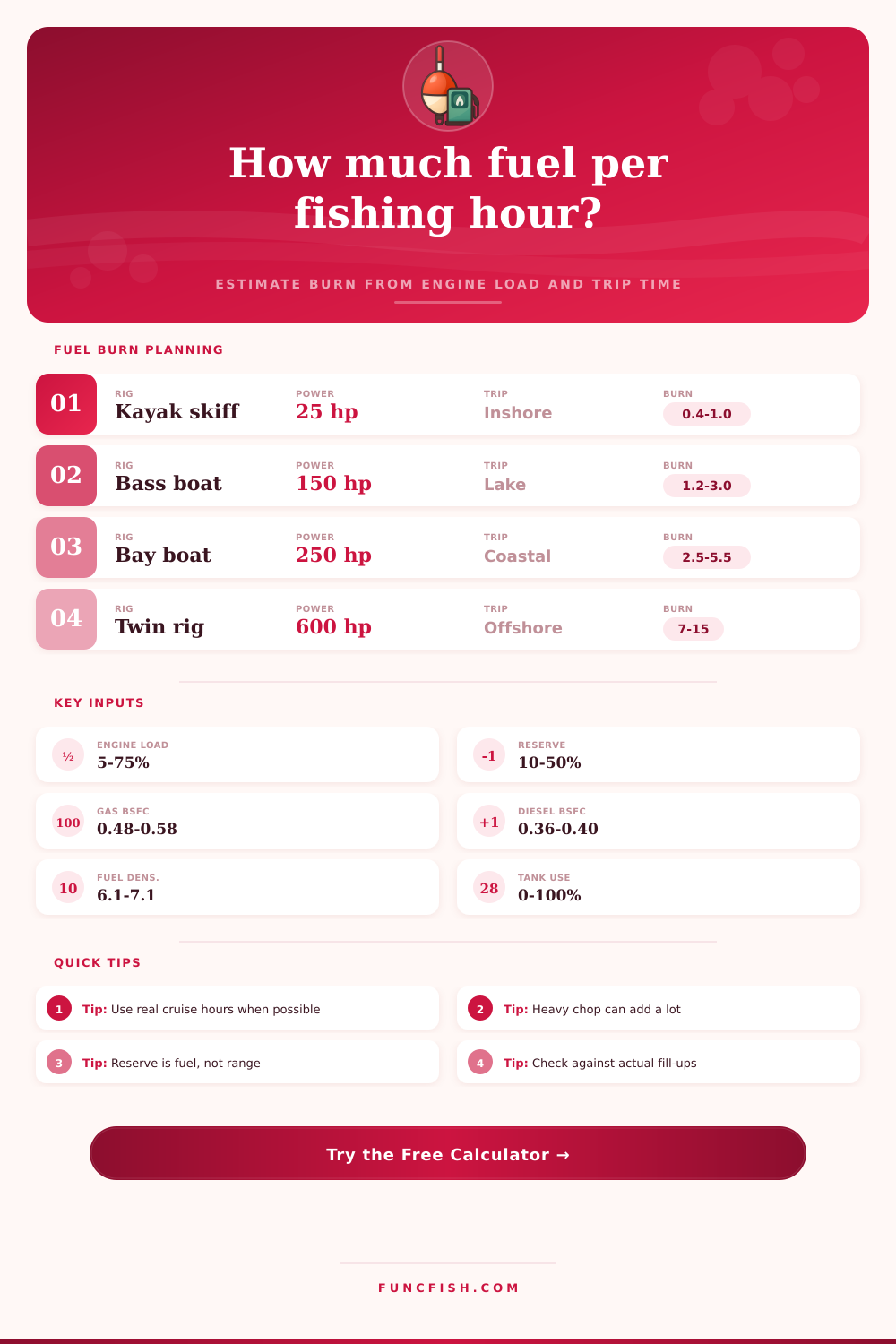
Estimate boat fuel used per active fishing hour from engine power, run time, trolling time, idle time, sea state, current, and reserve fuel.
📌Scenario presets
⚙Fuel burn settings
Fuel burn forecast
Full breakdown
📋Engine and fuel reference grid
Gas 4-stroke
Gas 2-stroke
Diesel inboard
Small kicker
📐Reference tables
| Operating mode | Typical load | Formula role | Use this when |
|---|---|---|---|
| Idle at dock | 1-4% | Idle floor or load burn | Waiting, warming, docking |
| No-wake move | 4-10% | Low load burn | Marinas and channels |
| Slow trolling | 6-15% | Trolling burn | Walleye, trout, salmon |
| Efficient cruise | 35-55% | Main run burn | Most planing hull runs |
| Hard run | 60-80% | Main run burn | Heavy loads or schedule pressure |
| Wide open | 85-100% | High burn warning | Short bursts only |
| Fishing profile | Engine mix | Reserve target | Planning note |
|---|---|---|---|
| Small lake panfish | Idle and short moves | 15-20% | Tank share usually low |
| Bass run and cast | Several cruise legs | 20-30% | Run hours drive the burn |
| Walleye trolling | Troll plus short runs | 25-33% | Low load for many hours |
| River catfish | Current control | 25-40% | Current factor matters |
| Inshore bay trip | Cruise, idle, drift | 30-40% | Chop changes the estimate |
| Offshore run | Long cruise and troll | 33-50% | Use conservative inputs |
| Adjustment | Multiplier | Affects | Use when |
|---|---|---|---|
| Flat water | 1.00 | All modes | Protected water |
| Light chop | 1.06 | Run and troll | Small wind ripple |
| Moderate chop | 1.14 | Run and troll | Trim changes often |
| Rough chop | 1.25 | Run and troll | Bow works hard |
| Heavy seas | 1.38 | Run and troll | Slow, wet, loaded run |
| Strong current | 1.12 | Troll and idle | Holding speed or position |
💡Practical checks
Tip: The formula estimates fuel from brake-specific fuel consumption, engine power, load percentage, fuel density, and time. For a better local number, compare the result with your next fill-up and adjust the load percentages.
Tip: Treat reserve as unavailable fuel. If the tank-use card passes 100 percent with reserve included, reduce distance, reduce load, or add fuel before running the same plan.
To understand the calculator, it is first essential to understand the difference between fishing time and engine running time. Fishing time is the length of time that you are attempting to catch fish. Engine running time, however, is the total time that the boat engine are burning fuel.
Depending on the type of activity that is taking place on the water with the boat, the engine can burn fuel at different rate. For example, when the boat is on a long run to the fishing spot, the engine burns fuel at a highly rate. When on troll or idle, though, the engine burns fuel at a much lower rate.
How to Use the Boat Fuel Calculator
Therefore, you must separate the two types of time to calculate the true cost of one fishing hour. The fuel use calculator requires certain inputs to determine how much fuel will be used on the trip. These include the power of the engine, the split between running, trolling, and idling, and the environmental condition.
One of the most important factor in determining how much fuel is needed is the load percentage of the boat. The higher the load percentage of the boat, the more fuel the engine will use. A boat that is at a forty-eight percent load will use less fuel than a boat that is at a seventy percent load.
Sea state and current will also impact fuel use because chop in the sea or a current will require the boat to put the throttle in a higher number to maintain it’s current speed. Therefore, the boat will burn more fuel in choppy waters than on a flat water. Reserve fuel is another critical input in the fuel use calculator.
This refers to the amount of fuel in the tank that the boat is not to use for its trip. This isnt the same as the range of the boat. The range is the distance that the boat will travel on a tank of fuel.
Reserve fuel, however, is the portion of that tank that will be set aside for emergencies or changes to the trip. This value should of been set to twenty-five or thirty percent. This tells the fuel use calculator that this portion of the tank is already spoken for in the trip estimate.
The calculator will show the number of gallons of fuel that will be required for the trip once the reserve fuel is deducted from the total fuel capacity of the tank. If the number is too high for your fuel tank, you will have to change the trip parameter to allow for this fuel use. The type of engine that the boat uses will also impact fuel use.
For example, a moddern four-stroke engine will burn more fuel than an older two-stroke engine of the same horsepower. Furthermore, diesel inboards will burn fuel differently than gasoline inboards because diesel fuel weigh differently per gallon than gasoline fuel. Additionally, diesel engines will burn fuel more efficiently when maintaining a steady rate of speed.
Each of these variables can be programmed into the calculator to determine how much fuel of each type will be consumed during the trip. Many people tend to make mistakes when using the fuel use calculator. One of the most common is treating every single hour of a trip as if it will use the same amount of fuel.
People may also consider the total time of the trip as the fishing time, ignoring the portion of that time that the boat spend on the high-speed run to the fishing spot and the run back to the dock. Additionally, many people use a single load percentage for the trip instead of adjusting that percentage according to the load of the boat during each segment of the trip. Instead, you should log each segment of the trip and input it into the fuel use calculator.
By comparing the amount of fuel that the calculator determines the boat should use to the actual fuel level of the boat, people can determine if their load estimates for the trip were accurate. The effects of current and tide can be some of the most complex to factor into the fuel use calculator. For example, holding a position against a strong current will use more fuel at idle speeds than it will cruise speeds.
This is because a higher number of throttle setting must be used to fight against the current at slow speeds. Similarly, any extra weight on the boat will change the way that the hull of the boat sit in the water. When the boat sits in a different manner in the water, it will require more power from the engine to maintain its current speed.
The reference tables located on the fuel use calculator page show typical load percentages for different trip modes. These tables show what it means to idle or slowly troll a boat in terms of percentage of the engine’s rated power. These tables also show the effect that sea state and current will have on these load percentages.
These reference tables can be used to determine fuel use for the trip. With a few adjustments to the load percentages according to actual fuel use during the trip, these tables can be used to track fuel use on the boat. Understanding the difference between fishing time and engine time will change the way in which you plan your trips with your boat over time.
By using the fuel use calculator, you will be able to see which portions of the day use the most fuel and which portions use the least. Based off these observations, you will be able to determine whether the long run to the fishing spot is worth the fuel that it consumes, or if a closer fishing spot will save more fuel on the trip. By understanding these differences, you can plan your trips in a way that avoids surprise shortages of fuel on your boat.