
When you start out, the animal is tiny (fits in the palm of your hand), something you can hold in your hand. Then you quickly see that the animal needs some room to grow into! And it doesn’t grow in a straight line. It actualy grows exponentially large. So you find yourself making a mistake common to new crab keepers who got their foot wet by starting out too small because they think the small tank will last them forever. No.
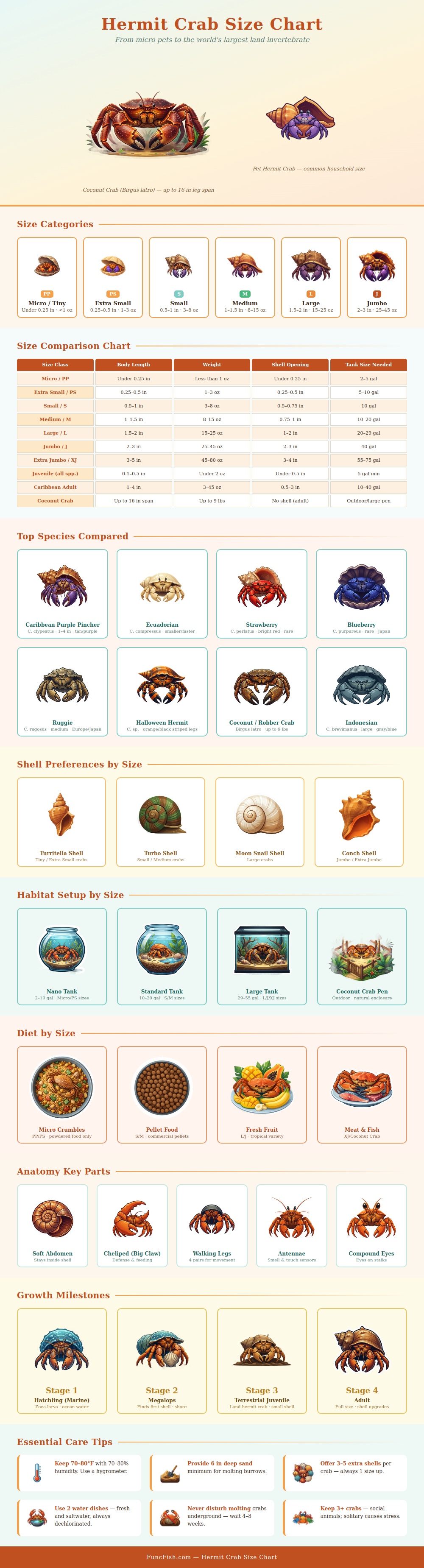
The graph below details the sizes and what each size involve. As you can see, there’s a lot to learn between each size change. This means when you get your first shell, you will know about the growth spurt. You won’t end up having to upgrade under stress.
Why Hermit Crabs Need a Big Tank
Typically, most people starting out will get excited about the little claws right away. The tiny claws, what else? Not the biological facts. One key fact is that hermit crabs must molt their whole exoskeleton to increase size. This means they bury themselves in some form of material (preferably sand) when it’s time to molt. For the duration, they are exposed and therefore need to be kept moist and protected.
The more shallow your set up, the less likely the crab can dig down to protect itself. Typically, a 10 gallon tank is fine for a young crab. However, if the crab grows past one inch, the surface area will limit it. Crabs want to explore, climb, etc., so you require some room for them to wander and climb. Plus, they don’t stay put walking in circles.
When it comes to crab size, both length and weight are important. While a tiny crab may be easily overturned making it hard to turn back, the same goes for an oversized one. Because a large crab is top heavy, he depend on sturdy limbs to navigate his world. In fact, you’ll see that the suggested tank capacity shoots up quite a lot when viewing the size chart’s higher class sizes.
And that’s no coincidence, larger crabs also create greater amounts of waste, so having a bigger body of water helps regulate the humidity, keeping things under control. If there’s inadequate air flow, your little guy will end up dehydrated in no time at all, especially in a big tank where even a small bowl dries up fast.
Another hidden bottleneck is shell availability. Plastic substitutes work fine for tiny crabs (and pieces of broken shell), but they must have smooth openings so the crabs can slip their soft abdomens through without tearing them. For growing crabs, there are also very specific spiral shapes for each size, corresponding to the increasing dimensions of their body. Offer various options, just a little bigger than their existing shell. Don’t attempt to cram one onto them; the crab won’t go if it’s too small because it feels insecure. It’s not about preference.
In terms of size differences, there’s no better illustration then the coconut crab. This is a large crab that will abandon its shell completely when grown (up to nine pounds). Not likely something anyone should of try at home, but it does provide a sense of where crustaceans might go. Even more common species such as strawberry hermits and the purple pincher can grow quite big. The infographic shows this to set realistic expectations from the start.
You don’t want to stuff an elephant into your closet, nor do you want to house a large adult in a nano tank. Diet changes a lot as they get bigger. This is why a micro crab can just sort of scoop things up in powdered form, whereas bigger ones require big chunks of food ranging from protein to fruit. I think trying to feed a baby dust to a jumbo crab is wasteful and irritating to both sides (the crabs don’t want it and the nutrients is processed differently).
The silent killers to any hermit crab keeper are temperature and humidity. Always keep the humidity between 70-80%. This means that if you do not have a way of checking humidity (a hygrometer), then you are guessing at what the air quality is for the crabs that live there day and night.
They do best when kept together in groups of at least 3. It’s one thing being isolated but isolation adds another layer to social dynamics among your herd. Isolation stresses them out which makes them act like they are physically ill.
The size of the aquarium your crabs begin in should match the size of the aquarium you plan to keep them in. It’s always better to have an empty big space and furnish it as desired than a small crowded space and try to stuff living things into it! The bigger the aquarium, the more rewarding your crabs will be as they grow up and entertain you for many years.