Lead Size by Casting Distance Calculator
Estimate a practical sinker or lead size from casting range, rod rating, line drag, rig shape, wind, water hold, and safety margin.
🎯 Quick Fishing Presets
⚙ Casting Setup
Lead Size Recommendation
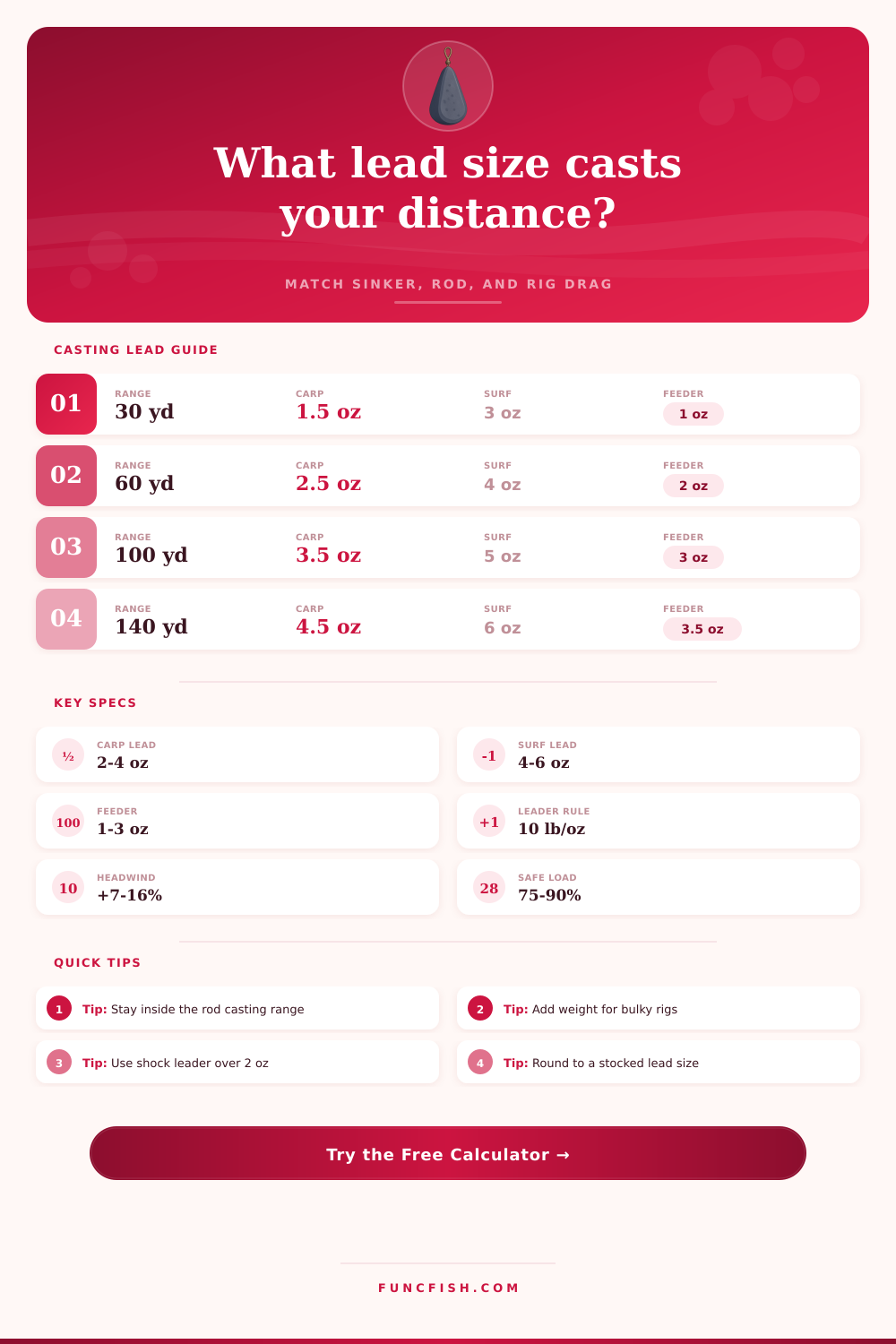
📊 Lead Size Reference Cards
📏 Rod Rating and Casting Range Table
| Rod or Setup | Useful Lead Range | Typical Distance | Notes |
|---|---|---|---|
| Light feeder | 0.5-1.5 oz / 14-43 g | 20-45 yd / 18-41 m | Best for small cages and quiet stillwater casting. |
| Heavy feeder | 1-3.5 oz / 28-99 g | 35-80 yd / 32-73 m | Handles method feeders, river baskets, and compact groundbait loads. |
| 2.75 lb carp rod | 2-3.25 oz / 57-92 g | 55-100 yd / 50-91 m | Comfortable general carp choice when rigs are aerodynamic. |
| 3.25 lb carp rod | 2.5-4 oz / 71-113 g | 70-125 yd / 64-114 m | Common long range rod for clipped-up ledger work. |
| 3.5 lb carp rod | 3-4.5 oz / 85-128 g | 80-140 yd / 73-128 m | Useful for big waters, PVA bags, and stronger headwinds. |
| Surf 4-6 oz rod | 4-6 oz / 113-170 g | 80-160 yd / 73-146 m | Pairs with shock leaders and streamlined sea rigs. |
| Heavy surf rod | 5-8 oz / 142-227 g | 100-190 yd / 91-174 m | For tide, grip leads, and strong beach tackle. |
| Pier or uptide rod | 2-5 oz / 57-142 g | 35-90 yd / 32-82 m | Often sized more by hold than by pure distance. |
🎣 Common Lead Choice by Fishing Scenario
| Scenario | Distance Target | Usual Lead | Adjustment Trigger |
|---|---|---|---|
| Canal feeder | 20-35 yd / 18-32 m | 0.75-1.5 oz | Use less weight if splash and noise matter. |
| Stillwater method feeder | 35-60 yd / 32-55 m | 1.5-3 oz | Loaded feeders behave heavier than plain leads. |
| Carp ledger | 60-100 yd / 55-91 m | 2.5-3.5 oz | Increase for PVA mesh, wind, or soft lead clips. |
| Long range carp | 100-140 yd / 91-128 m | 3.5-4.5 oz | Needs rod loading, thin line, and smooth timing. |
| River barbel | 35-65 yd / 32-59 m | 2-5 oz | Current hold may exceed distance requirement. |
| Beach surf | 80-150 yd / 73-137 m | 4-6 oz | Grip wires and tide usually push size upward. |
| Pier bottom rig | 40-80 yd / 37-73 m | 3-5 oz | Wind, tide, and rig trace length dominate. |
| Kayak inshore | 20-60 yd / 18-55 m | 1.5-4 oz | Size by hold first, then casting comfort. |
🧮 Rig Drag and Water Hold Multipliers
| Factor | Low Drag | Medium Drag | High Drag |
|---|---|---|---|
| Rig shape | Plain lead, compact clip | Method feeder, pulley rig | PVA bag, cage, bulky bait |
| Wind | Tailwind or calm | Crosswind or light headwind | Strong headwind, line bow |
| Main line | Thin braid or tapered setup | Standard mono | Heavy mono or thick fluorocarbon |
| Water hold | Stillwater | Slow tow or steady river | Tide, surf sweep, fast river |
⚠ Practical Calculation Notes
“Just because you think a certain size of lead casts a certain distance, doesn’t mean it always does. Don’t forget about air resistance, line friction and wind pressure. Weight isn’t everything. Your casting distance depend on several factor: your rod’s power, your rig’s drag, and the current conditions.
For instance, if you use a three-ounce lead in calm conditions, it could go a hundred yards. But then if you change out to a bulkier feeder, or the wind picks up, that same three-ounce lead can barely make its way past fifty yards. If you understand this balance, you’ll save yourself a lot of broken rod and missed swims.
Why Weight Is Not Everything for Casting Distance
You input the rig shape, rod rating and desired range of distance. The calculator eliminate guessing at how those three things match up and takes care of the math for you. It doesn’t spit out a number; it spits out whether or not that number will be OK on your equipment.
If it’s a strong headwind, you will need more weight since air resistance go up with speed. So now we want to make up some weight to cut through the air but not so much that the added weight put us outside the curve of our rod’s test. And that right there is where many casts goes wrong before ever getting off the tip.
Then think about the shape of the rig. A simple aerodynamic lead slice through the air effectively and you can get away with lighter weights while achieving same distance. Then add a big PVA bag or a cage feeder packed with groundbait. This results in a parachute effect. To counteract this the tool include drag coefficients in the data you enter. It’s a small thing, but it matters immensely if you’re attempting to put a bait on a specific swim at ninety yards. If you forget to take the bulk of your bait presentation into account you’ll be undershooting each and every time.
To overcome this, the calculator will recommend a heavier lead so that your casting energy doesn’t go toward fighting air resistance, but instead keeps its momentum to help you cast more further. Perhaps the trickiest of all variables is wind. What looks like a gentle side-breeze could become a brake on your cast by causing your line to bow out.
To make sure you cast accurately, the tool adjusts based off both the strength and direction of the wind. When facing strong head winds, increase the weight to gain power and stability. If the weight isn’t sufficient, it’ll cause the line to flutter and blow off to the side. This results in a miss well short of your mark. Tailwinds allow you to achieve greater distance while using less weight. This is helpful when trying to avoid splash noise in shallow water or reducing fatigue on your rod.
The second aspect that complicates things is water hold. Sure, you can throw it out there and hit the swim, but now how do you stay there? You need a constant battle against the river and tide pulling on your line. If you throw too lightly just to make the cast, you’ll get washed off when setting the hook before you even reach it. So the calculator defaults to whichever is greater, hold or distance. That way you don’t end up throwing perfectly then watching your rig wash downstream in mere seconds. Better to be slightly over weighted for the cast and sitting still after landing it.
The last precaution involves rod safety. All rods has a maximum pound-rating, typically measured by the weight in pounds or ounces of line they can safely cast. Do not overload them with forceful overhead casts, or you risk cracking the rod’s blank. The rod weight calculator will give you a safe working range to keep your lead within reasonable loading limits. It recommends using a load between 75-90% of a rod’s max capacity. This gives you some cushion and leaves plenty of leeway for overloading, while also protecting the glass from shock loads when stopping too hard. That extra ten yards may be gained pushing that envelope but more frequently results in a rod repair bill.
There’s no chart memorization involved in choosing the proper lead. There’s an understanding of what the components does together. Experience and physics help the tool give you a starting place, but then it’s up to your cast feel to make it work. Use the suggestion as the beginning point. Make that trial cast. Adjust accordingly.
Maybe you’re not falling short because you need a different size lead. Perhaps it has nothing to do with lead at all. Could be the line lay. Could be the timing. Spend more time fishing and less time tinkering with tackle once you get the basics right. You should of tried this sooner. It works naturaly well.