Mono to Fluoro Diameter Equivalent Calculator
Convert a monofilament setup into a practical fluorocarbon equivalent using diameter, rated test, wet knot strength, cover, water clarity, drag, and spool-capacity math.
📌Scenario presets
⚙Line conversion inputs
Fluorocarbon equivalent results
Calculation breakdown
📊Line profile data grid
Standard Fluoro
Supple Fluoro
Thin Fluoro
Hard Leader
📐Reference tables
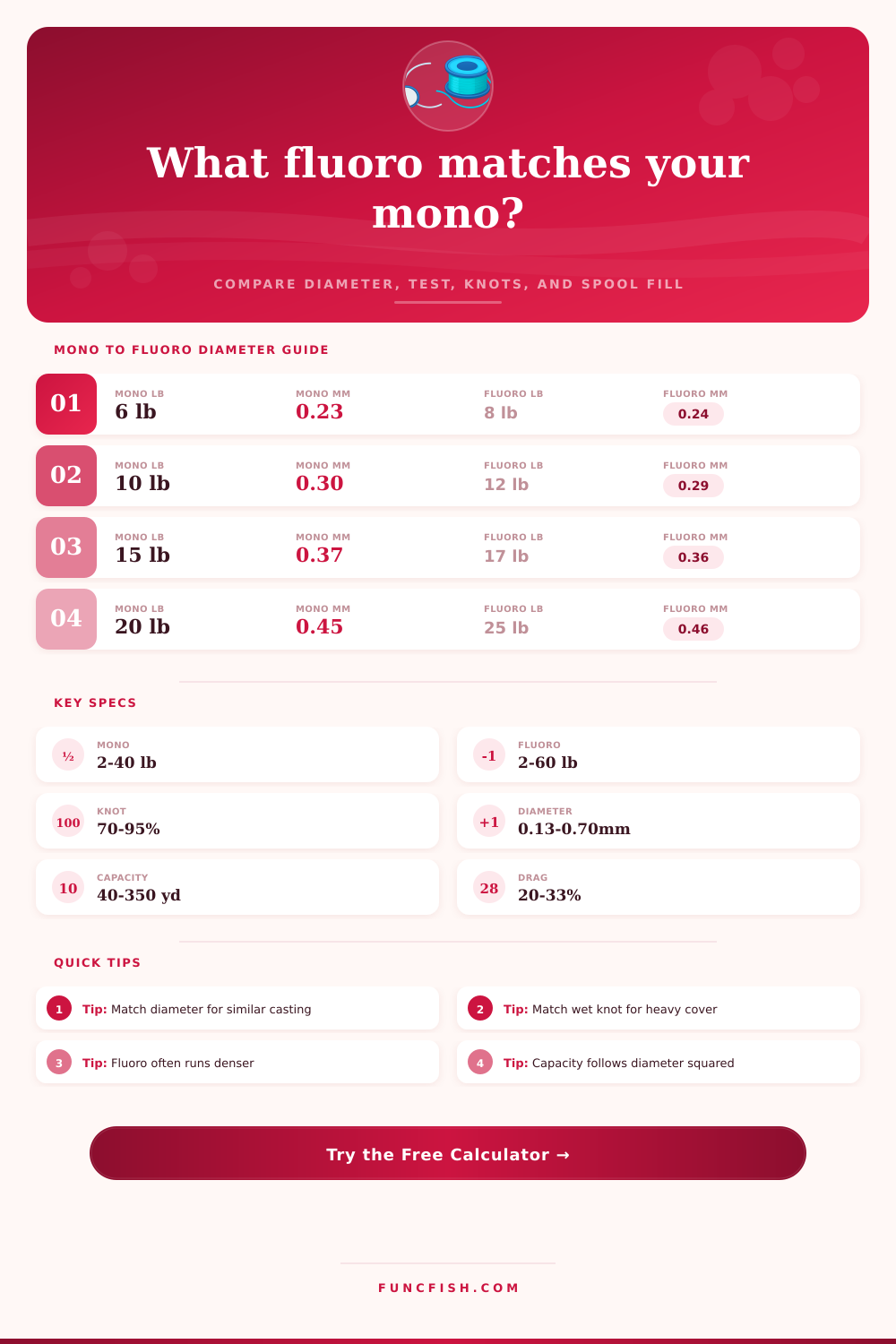
| Rated test | Typical mono dia. | Standard fluoro dia. | Thin fluoro dia. | Handling note |
|---|---|---|---|---|
| 4 lb / 1.8 kg | 0.17 to 0.20 mm | 0.16 to 0.18 mm | 0.15 to 0.17 mm | Ultralight, trout, panfish |
| 6 lb / 2.7 kg | 0.21 to 0.24 mm | 0.20 to 0.22 mm | 0.19 to 0.21 mm | Finesse bass and streams |
| 8 lb / 3.6 kg | 0.25 to 0.28 mm | 0.23 to 0.25 mm | 0.22 to 0.24 mm | Light spinning, clear water |
| 10 lb / 4.5 kg | 0.28 to 0.32 mm | 0.25 to 0.27 mm | 0.24 to 0.26 mm | General bass mainline |
| 12 lb / 5.4 kg | 0.31 to 0.34 mm | 0.28 to 0.31 mm | 0.27 to 0.29 mm | Jigs, crankbaits, walleye |
| 15 lb / 6.8 kg | 0.35 to 0.39 mm | 0.32 to 0.35 mm | 0.30 to 0.33 mm | Cover and heavier casting |
| 20 lb / 9.1 kg | 0.43 to 0.47 mm | 0.39 to 0.42 mm | 0.37 to 0.40 mm | Leaders, surf, cats |
| 30 lb / 13.6 kg | 0.55 to 0.60 mm | 0.50 to 0.54 mm | 0.47 to 0.51 mm | Heavy leader and structure |
| Species or setup | Common mono start | Likely fluoro equivalent | Suggested priority | Drag check |
|---|---|---|---|---|
| Finesse bass | 6 to 8 lb mono | 7 to 10 lb fluoro | Clear-water finesse | 1.5 to 2.5 lb |
| Trout stream | 4 to 6 lb mono | 4 to 7 lb fluoro | Same diameter | 0.8 to 1.8 lb |
| Walleye jigging | 8 to 10 lb mono | 8 to 12 lb fluoro | Drag-balanced | 2.0 to 3.0 lb |
| Inshore snook/redfish | 12 to 17 lb mono | 15 to 25 lb fluoro | Abrasion-weighted | 4.0 to 6.5 lb |
| Catfish bottom rig | 20 to 30 lb mono | 25 to 40 lb fluoro | Same wet knot | 6.0 to 10 lb |
| Surf casting | 15 to 25 lb mono | 17 to 30 lb fluoro | Capacity preserve | 4.0 to 8.0 lb |
| Condition | Diameter adjustment | Why it matters | Good match priority |
|---|---|---|---|
| Open clear water | -4% to 0% | Less visibility and better casting | Clear-water finesse |
| Normal mixed cover | 0% to +3% | Balances strength and handling | Drag-balanced |
| Rock, shell, docks | +5% to +10% | Abrasion margin beats thinness | Abrasion-weighted |
| Wood or heavy grass | +8% to +12% | Shock and sawing resistance | Same wet knot |
| Surf and long casts | -2% to +4% | Capacity and distance still matter | Capacity preserve |
| Comparison point | Monofilament tendency | Fluorocarbon tendency | Calculator treatment |
|---|---|---|---|
| Density | More buoyant | Faster sinking | Scenario changes drag note |
| Stretch | Higher stretch | Lower stretch | Drag card uses chosen percent |
| Wet strength | Can drop after soak | Usually steadier wet | Wet retention factor included |
| Spool memory | Usually softer | Often stiffer | Profile diameter bias included |
| Capacity | Baseline capacity | Changes by diameter squared | Capacity formula uses dia ratio |
💡Calculation tips
Diameter-first conversions: If your goal is similar casting, lure action, and spool fill, match the mono diameter first, then check whether the calculated wet-knot strength still clears your drag setting.
Strength-first conversions: For cover, leaders, and hard-pulling fish, use the same wet-knot option. It may choose a thicker fluoro because the knot, abrasion setting, and water pressure are part of the formula.
Even though a reel may look identical, it will perform differently with fluorocarbon than it did with monofilament. Because fluorocarbon sinks and monofilament stretches, energy transfer is different down the line, effectively changing your casting distance and knot strength. People tend to pick their next spool by pound test only, and that cause them to break knots and make short casts because diameter of the line affects the performance. The formula above do all of this math for you, making it easy to determine proper thickness without guesswork.
The difference between ten pound monofilament and ten pound fluorocarbon is not reflected on marketing labels, they’re not equal. Because fluorocarbon is more dense than nylon, it need to be larger in diameter to have the same strength. When you change over blindly, odds are good you’ve got something heavier on your spool than what you were expecting. That affects your reel’s drag response, so adjust for thickness first before knotting up anything.
Why Fluorocarbon Line Is Different From Monofilament
Durability versus Visibility You should also consider water clarity when choosing a line. You want durability in heavy cover and stained water where abrasions is more of an issue then invisibility (so a larger diameter will do). Conversely, clear water demands the opposite; you need stealth, so match your monofilament’s diameter exactly for better casting distance and lure action. It’s a tricky balance: not too heavy and not too light which is hard to figure out just by thinking about it. But tool does it for you, offering the option of wear-based priority, suggesting a bit heavier line for greater abrasion resistance.
The one place where theory meets a practical problem with fluorocarbon is in knot tying; it is stiff, does not bend well around swivels or hooks and does not form good tight knots easily. Cold weather can also reduce wet knot strength dramatically when compared to dry knot rating. A line that rates out at say 90 percent efficiency may be performing near 70 percent in cold water. The calculator let you account for this by allowing you to plug in what you expect your knot efficiency to be. Meaning if you suspect your knots are getting sloppy you can adjust that number downward. That will adjust the test weight recommendation which help protect against loss of fish from weak knots. Brand names on spools don’t matter as much as knowing how good your knot are.
Another key consideration is spool capacity. Fluorocarbon does not lie on the bail arm like monofilament; it’s different. How much line will go onto the reel before reaching the rotor depends of its diameter. So if you change from a heavy mono to an equal-strength flouro, you’ll likely have less spooled up. That makes sense; a little difference in thickness result in a big swing when it comes to volume. The formula for capacity includes the square of the diameter ratio. This means small differences in thickness cause big changes in volume. These changes can matter when making long casts or fighting big fishs.
The other consideration is that fluorocarbon come in different profiles as well. High-quality, thin, flexible, and stiff leader lines made to cut through cover or feel like mono all change how fish behave. Choosing the proper profile in the inputs helps to ensure that it’s recommending something that works with your style of casting… You don’t want a finesse tippet on a baitcaster or a heavy leader on a spinning reel getting tangled.
It includes reference tables that give you a starting point for common situations like trout stream fishing or offshore trolling. These help you see how changes in diameter affect different species instead of having to look up conversion charts. Because fluorocarbon transmits shock and monofilament absorbs it, you’ll have to calibrate your drags with a new line. Setting the hook too hard and/or snapping your line on the first few strikes can happen if you fail to adjust your drag from mono to fluoro. To counteract the lack of stretch, simply back off your drag just enough that it doesn’t sacrifice hook-holding ability but maintains an unbroken connection. You should of adjusted before.
It’s all about balance; you’re looking for just enough skill to catch ‘em but also enough strength to stick ‘em when they go sideways. Don’t get hung up on one number. Consider the entire system, including spool fill, knot strength, diameter, and water clarity. For these variables, let the tool do the number crunching and rely on your hands to make good casts and tie down tight knots. That’s what makes the switch worth it, the right line goes unnoticed between you and that fish.”