Outboard Gear Ratio Calculator
Estimate prop-shaft rpm, theoretical speed, measured prop slip, and a practical pitch change for fishing boats using your lower-unit ratio, wide-open-throttle rpm, prop pitch, and GPS speed.
📌Fishing boat presets
⚙Ratio and prop inputs
Outboard ratio results
Formula breakdown
🔧Gear ratio data grid
3704 prop rpm at 6000 engine rpm; often paired with tall pitch and light, lifted hulls.
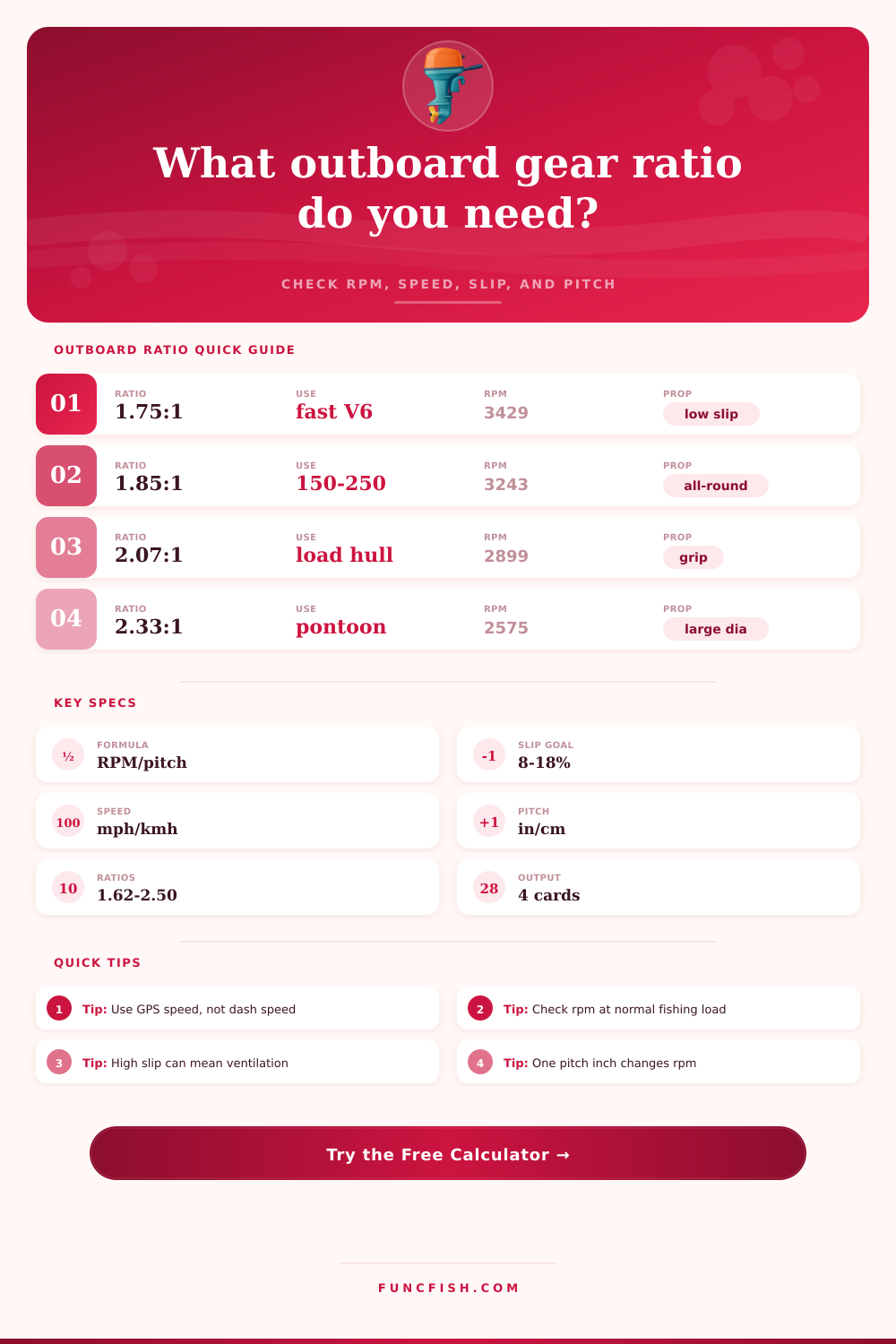
3429 prop rpm at 6000; common on higher horsepower rigs that can turn larger pitch.
3243 prop rpm at 6000; a frequent middle ground for 150 to 250 hp fishing boats.
3000 prop rpm at 6000; gives more propeller leverage for moderate loads.
2899 prop rpm at 6000; useful when diameter, blade area, and holeshot matter.
2791 prop rpm at 6000; often seen where carrying anglers and gear is the priority.
2575 prop rpm at 6000; supports larger diameter and lower pitch propellers.
2400 prop rpm at 6000; common for smaller engines with modest pitch and broad load swings.
🐟Gear and species comparison grid
Low slip, high trim, and taller pitch suit tournament loads once the hull carries on pad.
Moderate ratio and blade area help carry waves, kicker gear, batteries, and livewell weight.
Quick holeshot and shallow-water grip usually matter more than top-end pitch.
Lower gearing and larger diameter help push square deck loads without excessive slip.
Heavy tackle, big trolling motors, and two anglers favor balanced pitch over a speed-only setup.
Current, shallow bars, and stern load reward thrust and slip control at lower speeds.
Downriggers, kicker brackets, and chop make load carrying and rpm range more important.
Twins or big singles need a ratio that keeps heavy fuel and ice within WOT range.
📊Reference tables
| Ratio | Prop rpm at 6000 | Typical fishing use | Propeller tendency |
|---|---|---|---|
| 1.62:1 | 3704 rpm | Light performance bass hull, high horsepower single | Needs more pitch; sensitive to load and engine height |
| 1.75:1 | 3429 rpm | Fast multispecies or large V6 outboard on a lifting hull | Works with medium-tall pitch and low to moderate slip |
| 1.85:1 | 3243 rpm | Broad 150 to 250 hp fishing-boat middle ground | Accepts many three-blade and four-blade prop choices |
| 2.00:1 | 3000 rpm | Midrange rigs, aluminum hulls, and mixed passenger loads | Can turn more blade area with less pitch |
| 2.07:1 | 2899 rpm | Deep-V, bay boat, and heavy fishing-load applications | Good for carrying weight and staying in WOT range |
| 2.15:1 | 2791 rpm | Heavy hulls, work skiffs, and rough-water fishing setups | Often paired with grippy props and modest pitch |
| 2.33:1 | 2575 rpm | Pontoons, high-thrust lower units, and displacement loads | Large diameter and lower pitch are common |
| 2.50:1 | 2400 rpm | Small outboards, tillers, and heavily loaded small boats | Emphasizes thrust over peak speed |
| Measured slip | What it often means | Fishing setup note | Check next |
|---|---|---|---|
| 4-8% | Very efficient, lifted hull, or optimistic pitch/speed data | Common only on clean pad hull runs or light loads | Confirm GPS, tach accuracy, and true prop pitch |
| 8-12% | Efficient planing setup with good prop bite | Good range for many bass, flats, and light bay rigs | Fine tune engine height and trim angle |
| 12-16% | Normal all-round fishing load performance | Typical for deep-V, aluminum, and average crew loads | Match pitch to the upper half of WOT range |
| 16-22% | Heavy load, drag, rough water, or some ventilation | Can be normal for pontoons, rough water, or stern-heavy boats | Try more blade area, lower pitch, or engine-height change |
| Over 22% | Likely mismatch, ventilation, damaged prop, or bad input | Usually too much for a healthy planing fishing setup | Inspect hub, prop, tach, motor height, and bottom growth |
| Pitch change | Approx rpm change | Speed effect | Fishing tradeoff |
|---|---|---|---|
| Minus 2 in | +300 to +400 rpm | Lower theoretical top speed | Better holeshot and heavy-load WOT recovery |
| Minus 1 in | +150 to +200 rpm | Slightly lower top speed | Useful if livewells or rough water pull rpm down |
| No pitch change | Baseline | Baseline | Good if measured rpm is already inside target range |
| Plus 1 in | -150 to -200 rpm | Higher theoretical top speed | Only useful if the motor still reaches WOT range |
| Plus 2 in | -300 to -400 rpm | Much taller setup | Can hurt holeshot, handling, and engine loading when heavy |
| Symptom | Ratio clue | Prop clue | Useful calculator check |
|---|---|---|---|
| Engine over-revs at WOT | Ratio may be lower numerically than load needs | Pitch may be too low or prop is slipping | Compare measured slip and target pitch result |
| Engine cannot reach WOT range | Ratio may be too tall for the boat/load | Pitch may be too high or diameter too large | Use target rpm to estimate lower pitch |
| Strong holeshot but low top speed | Numerically high ratio favors thrust | Low pitch may be giving away top speed | Review speed per 1000 rpm and slip percentage |
| Ventilation in turns | Ratio alone is rarely the cause | Blade area, cup, or engine height may be wrong | High slip plus small diameter points to grip issue |
| Heavy stern load struggles | Numerically higher ratio may help leverage | Four-blade or lower pitch may carry better | Use heavy-load target slip, not light-load slip |
💡Calculation tips
Fishing boats is loaded with an added battery, an ice-filled cooler, and people in the back. Throttle comes open wide and you expect to fly. Hull creeps along, screaming engine at full throttle. GPS says one thing, tachometer another. That’s a prop mismatch and it usually come from confusion over gear ratios.
Outboard gear ratio calculator does all the math for you. It take raw pitch numbers and rpm and spits out information on how that combination performs in your boat. It calculates things like prop slip, theoretical velocity and prop shaft speed.
How to Find the Right Prop for Your Boat
Prop slip is the difference between where the prop should be pushing the boat and where it actualy pushes it. Where it actually pushes the boat. You’re going to lose a little to hull drag, cavitation and water resistance. Normal is a little slip. Too much and you’re not getting any faster, just losing power as noise and heat.
Today’s most common outboard gearing on fishing boats falls within the range of 1.75, 2.07. A lower numerical ratio, like 1.62, allows the propeller to spin faster. That’s good for a light bass boat that plane easily on a pad hull. Ratios above 2.0, like 2.33 and 2.50, produce more torque but less turning speed. You’ll see this on heavy workboats or pontoons that carry more weight then they do speed. The secret: find the right match for how you normaly run and what size boat you have.
Pay attention to actual GPS speeds when adjusting input parameters in the tool compared to wide-open-throttle rpm. Your dash gauges may be inaccurate; GPS sensors aren’t. Increasing the pitch value without changing the gear ratio results in greater theoretical speed. However, it also makes slip more likely as the engine struggle to stay in its best power band. For most four-strokes, that is somewhere around 5000-6000 rpm, which is factory specified range. If you go too far in either direction, you are either at too many rpms with a propeller that is too small, or you are lugging low with one that is too big.
On the page there is also a good reference table that takes certain ratios and matches them with the best application for those ratios. For instance it will help you envision how a low pitch with lots of blade area would be better for a pontoon setup, while high pitch with less blade area would be better in an offshore center console.
Pitch changes of one inch can make a difference of about 150 to 200 rpm. This is enough to take your engine out of or put it into the sweet spot. Expectations should not of the same for a morning run when the boat is light and a day with a heavy load. Don’t forget about the water conditions either. Steep waves and a rough chop will significantly add drag, forcing the prop to work harder just to move forward. By choosing your load condition, the calculator factors this into play, which affect the expected slip percentage. So you aren’t wasting time trying to find a magical efficiency number that isn’t possible in heavy seas. On a stormy day you might be fine with 15 percent slip to keep the hull stable and the engine safe.
For most people, handling and acceleration are far more important than top speed, which many folks obsess about. If I were hunting for fish on shallow flats, a propeller with a lower pitch might help me get on plane faster. On tight turns it lessens the chance of venting. The calculator gives an estimate of that tradeoff as it shows what happens to your targeted rpm with each pitch reduction. You give up a tiny bit of max velocity for safer operation and increased control.
The bottom line is that gear ratios alone aren’t the entire equation. Hull cleanliness, engine height and trim angle all contributes greatly too. But getting the fundamentals correct can save you gas and extend component life. Use it as a benchmark for your existing setup. If rpm readings are outside of range or if there’s excessive slip, then make incremental pitch adjustments and test on a two-way run to account for wind/wake effects. It’s all a balancing act. Numbers is never everything. A sweet setup will have the engine running smoothly, not screaming for more. A boat runs true and requires no ongoing steering correction. It hits plane fast and stays there well.
Begin with the calculator. Then let the water decide. That prop should grip rather than just slip as it pushes your load around the lake in comfortly.