Photoperiod Spawning Trigger Calculator
Estimate whether day length is close enough to trigger spawning behavior, then combine that light cue with temperature, trend, habitat, shade, stability, and artificial light.
🏷Photoperiod labels
📌Spawning trigger presets
⚙Light, water, and habitat inputs
Photoperiod trigger estimate
Calculation breakdown
🧬Species photoperiod grid
Largemouth bass
Walleye
Crappie
Bluegill
📊Photoperiod reference tables
| Species group | Light start | Peak cue | Spawn temperature | Typical response |
|---|---|---|---|---|
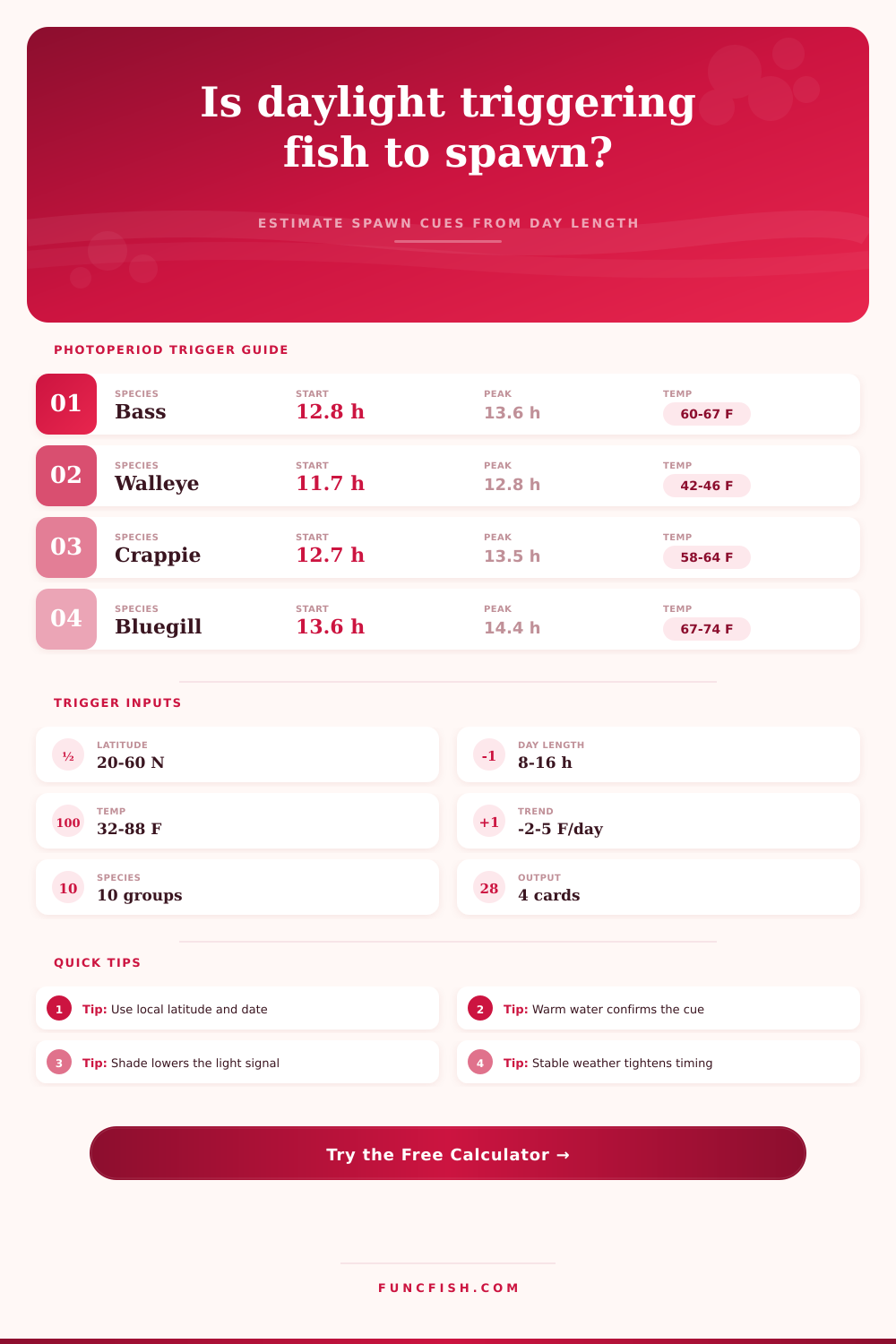
| Largemouth bass | 12.8 hours | 13.6 hours | 60-67°F / 15.6-19.4°C | 4-8 stable days |
| Smallmouth bass | 13.0 hours | 14.0 hours | 55-62°F / 12.8-16.7°C | 5-9 stable days |
| Walleye | 11.7 hours | 12.8 hours | 42-46°F / 5.6-7.8°C | 2-5 stable days |
| Crappie | 12.7 hours | 13.5 hours | 58-64°F / 14.4-17.8°C | 3-7 stable days |
| Bluegill | 13.6 hours | 14.4 hours | 67-74°F / 19.4-23.3°C | 3-6 stable days |
| Channel catfish | 14.0 hours | 14.7 hours | 72-80°F / 22.2-26.7°C | 5-10 stable days |
| Northern pike | 11.4 hours | 12.2 hours | 38-44°F / 3.3-6.7°C | 1-4 stable days |
| Rainbow trout | 11.0 hours | 12.2 hours | 45-52°F / 7.2-11.1°C | 4-9 stable days |
| Common carp | 13.8 hours | 14.8 hours | 68-75°F / 20.0-23.9°C | 4-8 stable days |
| Striped bass | 12.2 hours | 13.2 hours | 58-65°F / 14.4-18.3°C | 2-6 stable days |
| Latitude band | Spring daylight gain | Photoperiod sensitivity | Timing note |
|---|---|---|---|
| 20-30 degrees N | 1.1-1.8 min/day | Gradual cue | Temperature often leads the final trigger |
| 30-40 degrees N | 1.8-2.6 min/day | Balanced cue | Light and warming often align tightly |
| 40-50 degrees N | 2.6-3.7 min/day | Fast cue | Short warm windows can unlock movement |
| 50-60 degrees N | 3.7-5.4 min/day | Very fast cue | Photoperiod can arrive before water warms |
| Modifier | Low value | High value | Calculator effect |
|---|---|---|---|
| Habitat readiness | Poor bottom | Clean cover or gravel | Moves score by -12 to +10 points |
| Water clarity | Muddy or canopy | Clear open water | Changes effective light by -0.35 to +0.10 hour |
| Weather stability | Cold front or flow surge | Stable warming | Changes response timing by about -15% to +22% |
| Night lighting | No artificial glow | Bright shoreline light | Adds light noise and softens the natural cue |
| Moonlight | Dark moon | Full moon | Adds a small night-light adjustment |
| Readiness score | Trigger status | Likely behavior | Calculation priority |
|---|---|---|---|
| 0-39% | Early | Staging or scattered movement | Watch for day length and warming trend |
| 40-59% | Building | Short exploratory moves possible | Track protected shallow temperatures |
| 60-79% | Trigger window | Consistent shallow checks likely | Confirm habitat and stability modifiers |
| 80-100% | Strong trigger | Spawn behavior is biologically supported | Use local observations to validate timing |
💡Calculation tips
Match date to latitude. Photoperiod changes faster in northern waters, so a five-day shift can matter more at 48 degrees north than at 28 degrees north.
Treat light as the trigger, not the whole answer. Most species still need the water temperature band and a stable habitat window before the score should be trusted.
In late March, sun comes up a couple minutes sooner each morning, though you may not realize it til your game plan falls flat. Yep, you got the right bait and the right tackle. But dang, those fish is still deep and inactive.
One key variable are photoperiod, which is the biological clock controlled by day length that tell the fish it’s time to move on from winter. This light cue is the missing variable, and this calculator above can tell you whether that light cue has been triggered. By blending both water temperature and habitat condition with astronomical data, it predict when you’re most likely to see the spawn-like behaviors start. In other words, it takes all that fuzzy stuff about seasonal change and converts it into a measurable window of opportunity.
Why Daylight Matters for Fishing
One thing we can count on is day length, and it’s a silent trigger. In other words, fish don’t need a thermometer to tell them spring is near. As the days gets longer, their internal clock start responding to the increased daylight hours by producing gonadotropin hormones, which will eventually stimulate reproduction.
Species such as northern pike and walleye pick up on the cue early. Even while the days are still twelve or so hours long. On the contrary, a bluegill or largemouth bass will hold out for longer days (sometimes as many as fourteen) to coincide with warmer waters in which they thrive. These is the magic numbers you’ll see in table references on this page, but what does it all mean in real world? It means understanding the timing.
Because a fish’s biological clock is ticking faster up north (it takes more minutes of daylight gain each day compared to say the equator), if you’re fishing a high northern latitude, sun will rise sooner regardless of whether there’s a warming or cooling trend; the light cue accumulates no matter what happens with the weather. While a cold front may stall spawning action, it won’t halt time and the light cue will accumulate anyway.
However, the gatekeeper is always going to be temperature. Though light start the hormonal process, you cannot finish it without warm water. So just because the calculator shows a high readiness score due to day length doesn’t mean the fish is going to slide up onto shallow flats if the water is still forty degrees. That’s where the critical interplay comes into play.
This is why the tool weights the temperature support based off the particular species requirement. For example, largemouth bass need that consistent sixty-degree mark in order to be active whereas walleye can actualy spawn in much cooler water. So that’s why the calculator want to know the current temperature trend. Even a half degree rise a day can indicate stability to the fish. They won’t move up to spawn until they think it has stabilized enough for those eggs and larvae to survive.
The calculations is then fine-tuned by habitat and clarity modifiers. For example, a darker canopy and more stained water allow less light to penetrate. This is like having shorter days for the fish. But clearer water will transmit more of the light, perhaps moving the trigger. By accounting for those environmental conditions, the calculator is more precise than using a calendar day alone. In other words, it’s not just about getting on the clock, but about being ready once your particular body of water is.
Maybe that shallow gravel cove in the back warms quickly while the big flat main lake stay chilly due to its depth and clarity. You’ll be able to dial in your particular water body with the type selection, recognizing that there can be large temperature variation between different bodies. This knowledge shifts your thinking about prespawn fishing.
Now instead of guesswork you have an indicator of when these three factor come together, days getting longer, temperatures stabilizing and habitat ready for fish. So based off what the calculator spits out if its high, you know to concentrate on that shallow cover where they’re probably sitting. Low, well maybe you’ll hang back and go deeper and just wait until that thermal support catches up to daylight.
It turns this unclear game of early spring fishing into a set of things you can see. You stop chasing ghosts and go fishing the biology. At the end of the day this all boils down to being there at the right time. When Mother Nature triggers that biological need, fish won’t negotiate with you or the sun. Knowing what causes the spawn based off daylight gives you a strategic advantage. You’re not simply hoping to get a bite, but instead you’re reading the environment like the fish. The environment tells its own story, and now you have the tools to know how it ends: with the light.