Shotgun Line Distance Calculator
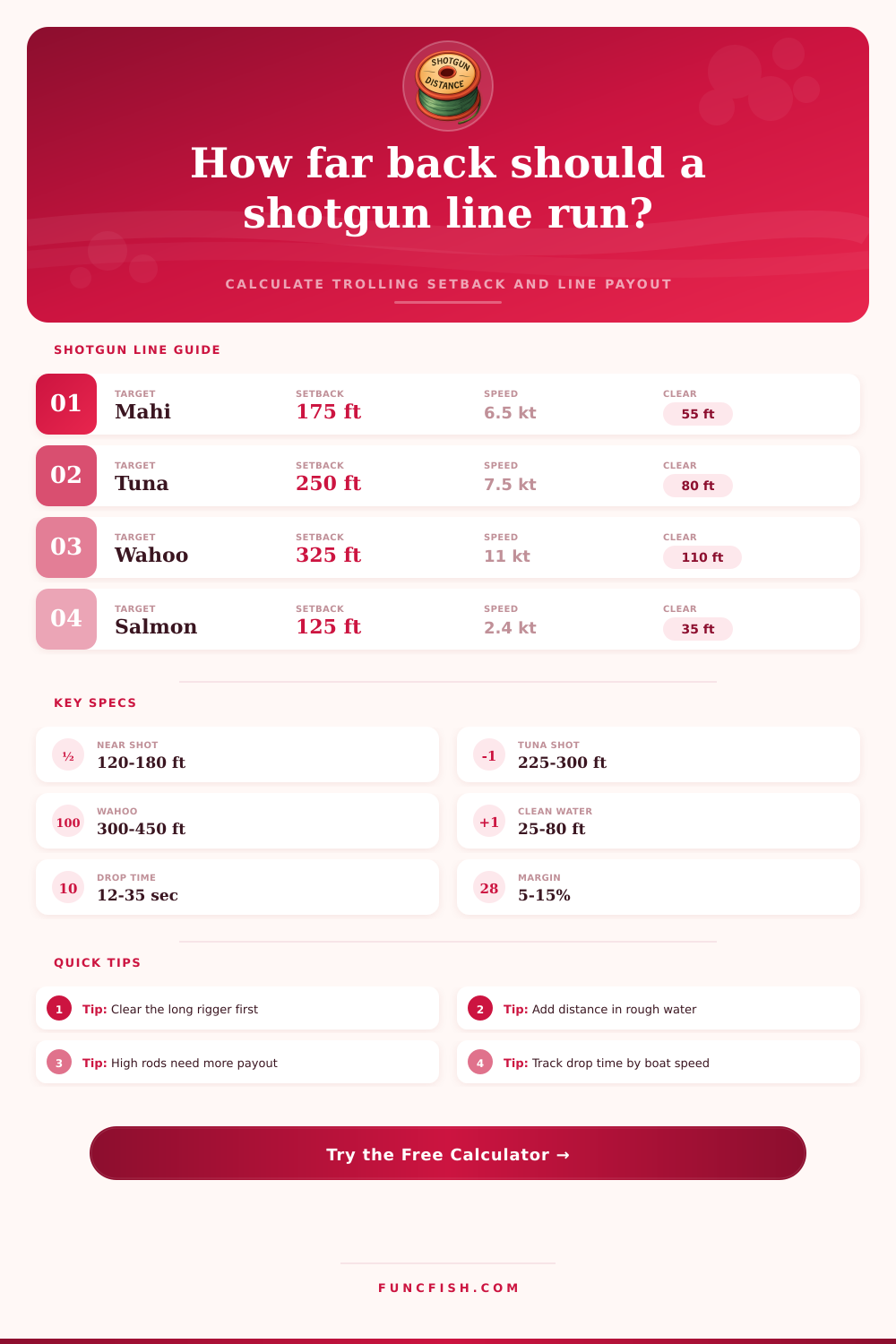
Calculate the far-center trolling setback, true line payout, long-rigger clearance, clean-water buffer, and drop-back timing for a shotgun lure.
🎯 Shotgun Spread Presets
⚙ Shotgun Line Inputs
Shotgun Line Results
Calculation Breakdown
🧰 Line and Lure Data Grid
📊 Shotgun Setback Reference
| Spread type | Common setback | Long-line clearance | Typical speed | Best use |
|---|---|---|---|---|
| Small boat center line | 90-150 ft / 27-46 m | 25-40 ft / 8-12 m | 4-7 kt | Compact inshore spreads and light center lures |
| Offshore tuna shotgun | 220-320 ft / 67-98 m | 60-95 ft / 18-29 m | 6-8.5 kt | Cedar plugs, feathers, and center-rigger baits |
| Billfish long center | 250-400 ft / 76-122 m | 80-130 ft / 24-40 m | 6.5-9 kt | Skirted baits behind teasers and long riggers |
| High-speed wahoo shotgun | 300-500 ft / 91-152 m | 100-180 ft / 30-55 m | 10-15 kt | Bullets, jet heads, high-speed plugs, and wire |
| Coldwater chute spoon | 100-180 ft / 30-55 m | 30-60 ft / 9-18 m | 2-3.2 kt | Salmon, trout, and center chute presentations |
🐟 Species and Spread Comparison
Mahi Mahi
150-225 ftLight feathers, small chains, and birds usually sit just beyond the longest rigger with moderate clearance.
Yellowfin Tuna
225-325 ftCedar plugs and tuna clones fish well in a clean center lane behind prop wash and rigger wash.
Wahoo
325-500 ftFast trolling spreads need longer separation because plugs and jet heads surge hard at speed.
Salmon
100-160 ftChute spoons and plugs work closer because speeds are lower and the wake settles sooner.
📐 Line Material Reference
| Line type | Typical rating | Stretch / sag effect | Shotgun distance note |
|---|---|---|---|
| Nylon mono top shot | 30-80 lb / 14-36 kg | Moderate stretch, forgiving drop-back | Add a normal margin when the lure surges in chop. |
| Braid main line | 50-100 lb / 23-45 kg | Low stretch, small diameter, less water drag | Use rod angle carefully because payout tracks more directly. |
| Wire line | 40-90 lb / 18-41 kg | High sink and direct pull | Best for high-speed or toothy-fish shotgun plugs. |
| Dacron backing | 50-100 lb / 23-45 kg | More drag and belly than braid | Add clearance if a long center line bows in side current. |
🌊 Wake and Sea-State Adjustment Table
| Condition | Clean-water buffer | Clearance multiplier | When to use it |
|---|---|---|---|
| Calm stern wake | 15-25 ft / 5-8 m | 1.00x | Flat water, steady helm, and narrow prop wash. |
| Light chop | 25-35 ft / 8-11 m | 1.08x | Most normal offshore trolling spreads. |
| Moderate chop | 35-55 ft / 11-17 m | 1.18x | Quartering swell or frequent lure-surface blowout. |
| Rough sea | 55-85 ft / 17-26 m | 1.30x | Spread surges and the long rigger sweeps across center. |
| Following sea | 45-75 ft / 14-23 m | 1.24x | Stern lift shortens the spread and the lure catches wake foam. |
🧭 Lure Type Distance Effects
| Lure type | Speed range | Distance adjustment | Spread behavior |
|---|---|---|---|
| Feather or tuna clone | 5.5-8.5 kt | Baseline | Tracks high and tolerates shorter far-center spacing. |
| Cedar plug | 6-9 kt | +10 ft / +3 m | Benefits from clean water and a straight center lane. |
| Diving plug or spoon | 2-12 kt | +20-35 ft / +6-11 m | Wide wobble needs extra separation from long-rigger paths. |
| Daisy chain | 5-8 kt | +35 ft / +11 m | More drag and visual footprint require a larger gap. |
| High-speed jet head | 10-15 kt | +60 ft / +18 m | Fast cycling lures need the longest clean-water lane. |
💡 Shotgun Distance Tips
Measure the spread, not just the reel counter. The calculator separates horizontal setback from actual payout because rod height, rod angle, leader length, lure drag, and line belly all change how much line leaves the reel.
Use clearance as the tangle check. A shotgun line that is only a little farther back than the long rigger can cross during turns. Add margin when seas, lure drag, or speed make the center line surge.
All calculations are spread-planning estimates for line distance and lure placement. Tune final setback by watching lure action, wake lanes, turn behavior, and reel-counter repeatability.
Tangled lines can frustrate even the best offshore anglers. The birds are feeding and you’re making a clean wake. Then you turn the boat or get hit by a swell. Next thing you know, the long rigger is in the middle of lane. The shotgun line drags across next line. Before you know it, all heck breaks loose. It happens fast and ruins fishing for an hour.
In most cases, it’s not bad luck. It’s bad geometry. Most skippers estimate setbacks based off what they’ve seen in the past or how many times they clicked their reels back. Guessing, even if it’s right most of the time, will leave room for error in changing conditions going from flat water to some wind chop.
Why Lines Get Tangled
After entering line lengths and boat speed, the calculator do the math for you. No more looking at angles in your head as you steer around. But understanding how the numbers work will serve you better then simply accepting them as truth.
The one thing that trips most people up is the difference between line payout and horizontal setback. I’ve heard guys say they want their lure three hundred feet behind the transom so they feed out three-hundred feet of line. That doesn’t work. Rod angle isn’t accounted for there. If the rods is set high on the gunwale, the lure will lay much closer to the boat than expected with the same amount of line let out. To account for this, the calculation must be divided by the cosine value of the angle. This is a little nuance, but it is critical if you’re trying to hold a specific amount of space between your lures.
The other key element is the clean water buffer, which is the area directly behind the prop wash where turbulence cause lures to roll on their side and swim erratically. No matter how much money you spend on a shotgun lure, if you put it into the buffer zone, it won’t show right. That’s why the tool asks you to estimate its wake length, allowing it to position the lure well beyond the chaos zone. Now throw it in rough seas and that buffer grows considerably as the prop wash takes longer to settle down. Either you have to manually compensate for this growth or select the sea state via the selector. Regardless of how far out you position the lure in relation to boat, if you don’t compensate for the wake, you’re going to fight with a lure refusing to track straight.
But one detail that definitely affects distance, even if it isn’t obvious at first, is the line material. Braid has virtually no stretch and doesn’t produce as much drag as monofilament while running through the water. So a bait fished with braid will track more directly from rod tip to lure. It also transmits each jerk and surge from the stern right to the lure. Monofilament or fluorocarbon top shots has stretch that will absorb some of that shock so they’re a little more forgiving. But that stretch also causes a belly in the line when slowing down or turning, That belly pulls the bait back toward the boat. This reduces your actual setback and your effective setback, which is exactly what you need most for separation on a turn.
The calculator take those material differences into consideration and adjusts the recommendation to match. You get an estimate of what your drop-back time should of be, as well as the actual payout required to produce it and a recommended setback. The former can easily be forgotten, yet is crucial for putting it all together. This will determine how far from the boat the line should be held out over water before making it fast. This allows the bait to fall back to its target depth and position, instead of pulling up short toward the rigger lines and tangling when the boat speeds up or leans. If you rush and skip this part, the lure will stay too close to the rigger lines, making it inevitable that they tangle.
Lure spread isn’t so much by the numbers as it is controlling 3D space within constantly changing conditions. That’s what the calculator is baselined on. But it’s the eyeballs that confirm it. Pay attention to the middle lure in relation to the wash of the outriggers. Do they look nervous? Is it getting pulled out of its lane and onto the next guy’s route? Add some separation. Does it run straight and steady without any problems? You’re dialed in.
Geometry matter. It makes the lines straight so the fish bite. Where there was once chaos and messiness, there is now a controlled presentation. When the fish hits it, the strike is clean and direct instead of tangled and lost.