Sidearm Cast Distance Calculator
Estimate practical carry distance for sidearm fishing casts from release speed, angle, lure weight, rod loading, line drag, wind, and release height.
📌Scenario presets
⚙Cast and tackle inputs
Sidearm cast estimate
Calculation breakdown
🎣Lure profile data
Compact jig
Spinnerbait
Float rig
Surf plug
📊Release angle reference
| Sidearm angle | Best use | Distance effect | Risk to watch |
|---|---|---|---|
| 6-12 degrees | Dock skipping, mangroves, under branches | Shorter carry but flatter entry | High water slap if the lure is not level |
| 14-20 degrees | Wind punch, bank cover, low target lanes | Strong practical distance with low flight | Headwind cuts range quickly |
| 21-28 degrees | Open sidearm distance with compact lures | Often the best sidearm carry window | More crosswind drift than low casts |
| 30-38 degrees | Float rigs, light trout lures, high banks | More hang time, less line slap | Accuracy drops in wind |
📏Rod load and lure weight guide
| Rod class | Typical lure band | Sidearm behavior | Distance note |
|---|---|---|---|
| Ultralight fast | 1/32-1/8 oz (1-3.5 g) | Loads easily with a smooth wrist roll | Thin line matters more than power |
| Medium fast | 1/4-5/8 oz (7-18 g) | Best all-around bank sidearm profile | Compact 3/8-1/2 oz lures carry well |
| Medium-heavy fast | 3/8-1 oz (11-28 g) | Good for jigs, spoons, spinnerbaits | Overloading hurts release speed |
| Surf moderate | 3/4-3 oz (21-85 g) | Longer arc with slower recovery | Needs extra follow-through clearance |
🌬Wind and line adjustment table
| Condition | Calculator adjustment | Typical range change | What it means |
|---|---|---|---|
| 5 mph tailwind | Positive wind factor | +3% to +7% | Compact lures gain more than bulky lures |
| 5 mph headwind | Negative wind factor | -5% to -12% | Lower the launch angle and reduce lure spin |
| 10 mph crosswind | Drift estimate from hang time | 4-18 ft lateral | High float rigs drift much more than jigs |
| Heavy fluoro or mono | Line drag and guide friction | -6% to -15% | Coil memory can cut sidearm speed |
🐟Gear and species comparison grid
Bass bank cover
55-95 ftMedium or medium-heavy rod, 3/8-1/2 oz jig, 15-30 lb braid or 12-17 lb fluorocarbon.
Trout creek
25-60 ftUltralight or light rod, 1/32-1/8 oz lure, 2-6 lb mono for tight lanes and low branches.
Redfish kayak
60-110 ftMedium fast rod, 1/4-1/2 oz spoon or jig, 10-20 lb braid with short fluorocarbon leader.
Surf striped bass
120-230 ftSurf moderate rod, 3/4-2 oz plug or metal, slick braid and low release into wind lanes.
Walleye jigging
50-100 ftMedium-light rod, 1/8-3/8 oz jig, thin braid or light fluoro for clean sidearm sweeps.
Pike casting
65-125 ftMedium-heavy rod, spinnerbait or spoon, braid plus wire leader with extra friction allowance.
Salmon float
70-150 ftLong moderate-fast rod, float rig, mono or braid main line; hang time increases crosswind drift.
Panfish docks
20-55 ftUltralight rod, small jig or float, 2-4 lb mono; accuracy matters more than raw range.
📝Distance interpretation table
| Result signal | Formula clue | Adjustment | Fishing meaning |
|---|---|---|---|
| Rod load below 65% | Lure is light for the blank | Use more wrist speed or a lighter rod | The lure leaves before the blank stores much energy |
| Rod load above 110% | Lure exceeds ideal band | Use a smoother swing or stronger rod | Tip recovery slows and sidearm accuracy falls |
| Aero efficiency below 70% | Bulky lure, float, or line drag | Lower angle and reduce tumble | The calculated vacuum range is not realistic on water |
| Drift above 10 ft | Crosswind plus long hang time | Aim upwind or flatten the cast | Targets near docks or seams need extra correction |
💡Sidearm calculation tips
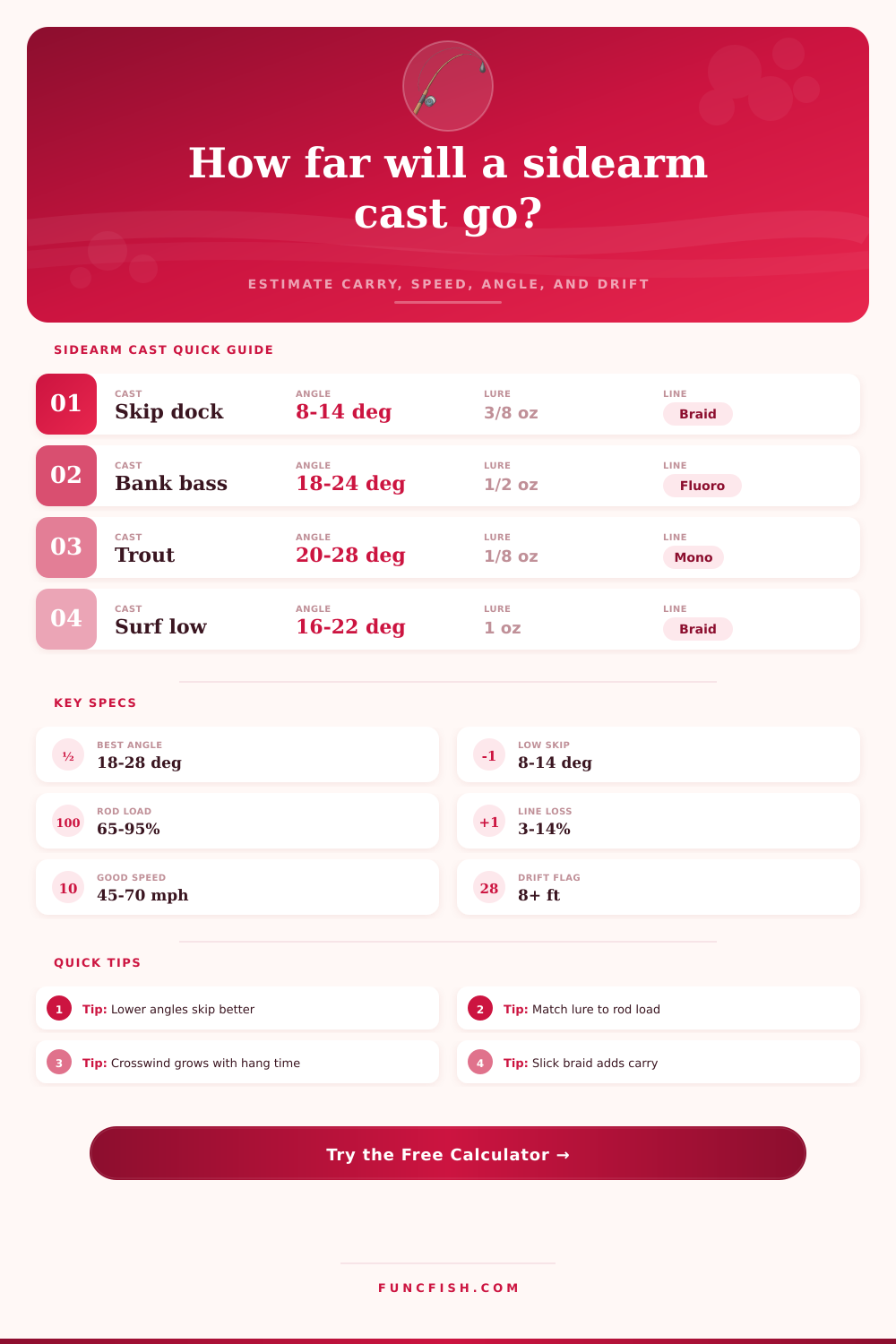
Angle tip: A sidearm release does not need a 45 degree launch to carry well. With real lure drag and a release height above the water, many fishing casts peak in the 18 to 28 degree range.
Load tip: If the lure is far below the rod's comfortable casting band, the calculator reduces effective speed because the blank stores less energy. If it is far above the band, recovery loss also reduces range.
Wind tip: Crosswind drift is based on flight time, not just distance. A light float rig that hangs in the air can miss sideways even when the forward carry looks correct.
Line tip: Slick braid usually keeps sidearm casts cleaner through the guides. Heavy mono, heavy fluoro, and wire leaders add guide friction and air exposure, especially on low casts.
A short cast is not just about straight-up loft; it’s about trajectory control, and sidearm casting alters that cast’s shape. You’re combating physics differntly when you make a cast across windblown flat or low underneath some heavy limbs then you are with an overhead pitch. Plug in your wind conditions and rod specs into the calculator above. Let it do the math for you and save yourself guesswork on conversions and coefficients that typicaly trip folks up.
So what does that mean? Release angle is a compromise between drag and hang time. On an overhead cast, you could shoot for 45 degrees to get maximum range in a vacuum, but a high-angle cast will catch the breeze and slow down quick. That’s why sidearm casts love low, typically in the eighteen to twenty-eight degree window. Spending less time in air means more speed at impact and less side-to-side drift from crosswind. A little tweak, but it makes a big difference if you’re trying to skip underneath a dock ledge or snake through a gap between some mangrove.
Why Sidearm Casting Works Better
The tool does this by accounting for how long your lure actualy is in the air as opposed to simply making an assumption of perfect parabola. That potential distance never materializes if it’s too light or too heavy for that rod. You can’t store much energy with an ultralight rod. A heavy jig won’t bend it enough. On the flip side, putting a tiny panfish lure on a heavy rod mean it will be off the end of the tip before the rod even begins to recover. Both situation lose speed immediately. This mismatch in lure weight versus rod class result in a drop in effective release speed as the lure weight moves further from its ideal band. It’s not all about swinging it harder but rather getting that energy into the line via the rod. The tool will indicate a drop in estimated carry if the cast felt stiff or sluggish; system was out of sync.
Drag: Drag’s an overlooked range killer; we’re often guilty of forgetting about line choice till our accuracy flies out the window. Braid’s slick as snot and glides right through your guides with no friction. Mono or fluorocarbon causes noticeable drag, more so on tight sidearm swings when the line scrape your rod tip or thumb on release. The calculator’s friction allowance include leader thickness, coil memory and guide wear. Six percent doesn’t seem like much, but at top speed that equate to several feet in lost distance.
Wind will also grab thicker leaders, converting a compact trajectory into a drift that sails past close cover. The only thing you don’t get to control about fishing with wings is the wind. And that’s the one you should of planned for. Float rig, Because they hang in the air longer, light float rigs will wander so much more than sinking jig even if they travel the same forward distance. For example: headwinds require lower angles and heavier lures to punch through; tailwinds can help carry bulky baits further then expected. Once you understand these dynamics, you no longer fight the conditions, you use ’em.
But in the end, it’s not so much a matter of brute force as it is efficient casting. A loaded rod, a good release and a trajectory that minimizes air resistance will result in most distance. And when all of these things come together, you’ll throw your lure further without trying harder. So the next time you’re faced with gusty conditions or low hanging branches, remember that less is more. Shallow is better. Match the rod to the lure and let the laws of physics do the rest.