🌙 Solunar Fishing Calculator
Calculate major & minor solunar feeding periods, moon phase activity scores, and optimal fishing windows for your location and date.
| Species | Solunar Sensitivity | Peak Period Type | Optimal Water Temp | Feeding Trigger |
|---|---|---|---|---|
| Largemouth Bass | Very High | Major (Moon overhead) | 65–75°F (18–24°C) | New/Full Moon |
| Smallmouth Bass | High | Major & Minor | 60–70°F (16–21°C) | Quarter Moon |
| Trout (Rainbow) | High | Minor (Dawn/Dusk) | 50–65°F (10–18°C) | New Moon |
| Walleye | Very High | Major (Low Light) | 55–68°F (13–20°C) | Full Moon |
| Catfish | Moderate | Major (Night) | 70–85°F (21–29°C) | Full Moon |
| Crappie | High | Minor (Feeding) | 60–72°F (16–22°C) | New Moon |
| Salmon (Chinook) | High | Major (Tide Sync) | 45–58°F (7–14°C) | New Moon |
| Snook | Very High | Tide + Major Sync | 72–82°F (22–28°C) | Full Moon |
| Tarpon | Very High | Major (Tide Sync) | 75–85°F (24–29°C) | Full Moon |
| Steelhead | Moderate | Major (Morning) | 38–50°F (3–10°C) | New Moon |
| Condition | Activity Modifier | Explanation | Best Response |
|---|---|---|---|
| Barometric Rising (>30.0 inHg) | +15% | Fish move to shallows | Surface / mid-water |
| Barometric Falling (<29.5 inHg) | -20% | Fish go deep, lethargic | Slow deep presentation |
| Stable Pressure (29.7–30.1) | +10% | Normal feeding patterns | Standard technique |
| Wind 0–10 mph (0–16 km/h) | +10% | Calm, good visibility | Any technique |
| Wind 10–20 mph (16–32 km/h) | 0% | Neutral conditions | Leeward bank |
| Wind >20 mph (>32 km/h) | -15% | Disturbed feeding zones | Sheltered areas |
| Clear Water | +5% | Ambush predators active | Natural presentation |
| Murky / Stained Water | -5% | Relies more on vibration | Noisy lures |
| Rising Tide | +20% | Baitfish pushed inshore | Inlets, points |
| Flood Tide | +25% | Maximum inshore feeding | Grass flats, creeks |
| Slack Tide | -10% | Reduced current movement | Wait for tide change |
| Period Type | Duration | Trigger Event | Activity Level | Recommended Action |
|---|---|---|---|---|
| Major Period 1 | 1.5–2 hrs | Moon directly overhead (transit) | ★★★★★ | Fish aggressively |
| Major Period 2 | 1.5–2 hrs | Moon directly underfoot (anti-transit) | ★★★★★ | Fish aggressively |
| Minor Period 1 | 45–60 min | Moonrise | ★★★ | Fish steadily |
| Minor Period 2 | 45–60 min | Moonset | ★★★ | Fish steadily |
| Dawn Overlap | +30 min bonus | Solunar + sunrise conjunction | ★★★★★ | Maximum effort |
| Dusk Overlap | +30 min bonus | Solunar + sunset conjunction | ★★★★★ | Maximum effort |
Solunar Fishing ranks between those causes that pushes fishers to discuss lively or even argue. The main idea is that sun and moon act on fish feeding habits. In 1926, John Alden Knight created it invents the term “solunar” and issued an article about the way sun and moon change the behavior of animals.
According to the theory, fish are most active when the moon stands directly above or below a certain place. The sun also plays a part, although a bit less strongly.
What Is Solunar Fishing
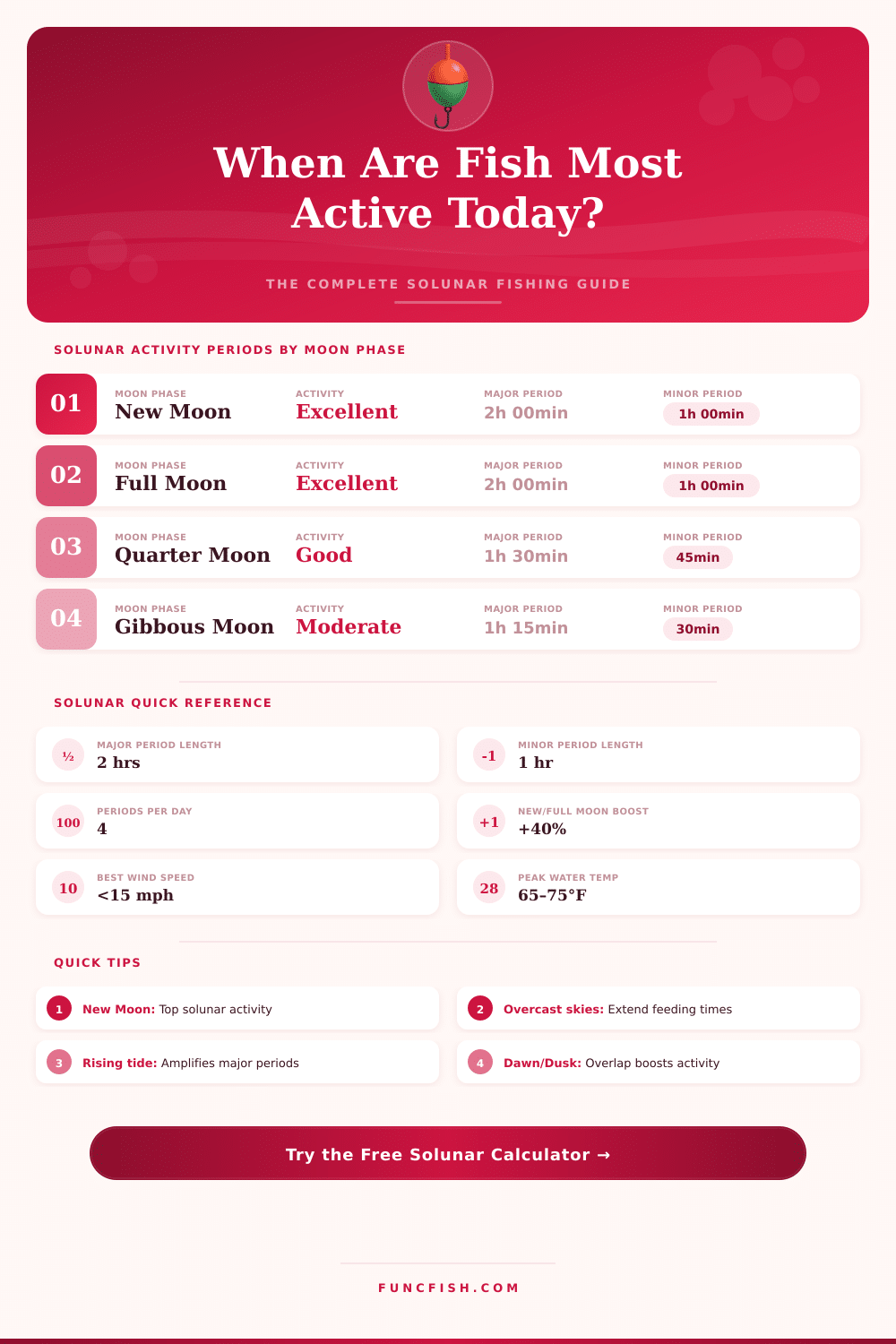
Solunar Fishing tables predict four feeding times daily. Two of them are called major, and the two others minor. Major ones happen during lunar pass above and the opposite pass below, so when the moon is above your head or under your feet.
Those times normally last two hours, but sometimes extend to three. The minor ones match with the rise and descent of teh moon.
Many apps and timetables are based on that idea. Some of them show hourly charts and percentages, to help guess whether a particular day is good for fishing. Others mix Solunar Fishing hours with tidal tables, info about weather, moon phases and times of peak activity for various fish types.
There are free monthly timetables in PDF format, that let you choose your place by land, region, city or zip code. Some resources are made for phones and present Solunar Fishing tables together with tidal hours.
Here is the part wear it gets tricky. Not all accept it. Some fishers call it fish astrology.
Others however insist that it helps. For instance, one fisher used a Solunar Fishing sliding scale that estimated the bite of steelhead trout at 8 from 10 for a certain day, and he caught a nice nine-pound fish right in the predicted bite window.
Many fishers think that other factors weigh more. Water temperature, season, recent weather, air pressure, wind direction and fishing pressure all beat Solunar Fishing predictions for many folks. Water movement because of tides is commonly rated more important than the main Solunar Fishing feeding time.
When a weather front arrives, the Solunar Fishing tables simply go out the window.
The direct effect of moon phases on fish activity has not yet been proved. Solunar Fishing theory holds some sharp observations and clever ideas, but the basic claim about the moon directly affecting creatures needs more proof. Fishing during full moons or new moons can sometimes bring more active fish, but that is not certainly guaranteed.
The idea won many followers in the circles of deep fishing, especially during the last years, although it hasexisted for almost a hundred years.
Tides themselves, that move because of the moon, obviously matter in sea fishing. Here is no real argument.