🎣 Fishing Line Diameter Calculator
Find the exact line diameter for any species, technique, and spool capacity
| Test Strength | Monofilament | Fluorocarbon | Braid / Superline | Wire (SS) |
|---|---|---|---|---|
| 4 lb | 0.007 in / 0.18mm | 0.007 in / 0.18mm | 0.004 in / 0.10mm | — |
| 6 lb | 0.009 in / 0.23mm | 0.009 in / 0.23mm | 0.005 in / 0.13mm | — |
| 8 lb | 0.010 in / 0.25mm | 0.010 in / 0.25mm | 0.006 in / 0.15mm | — |
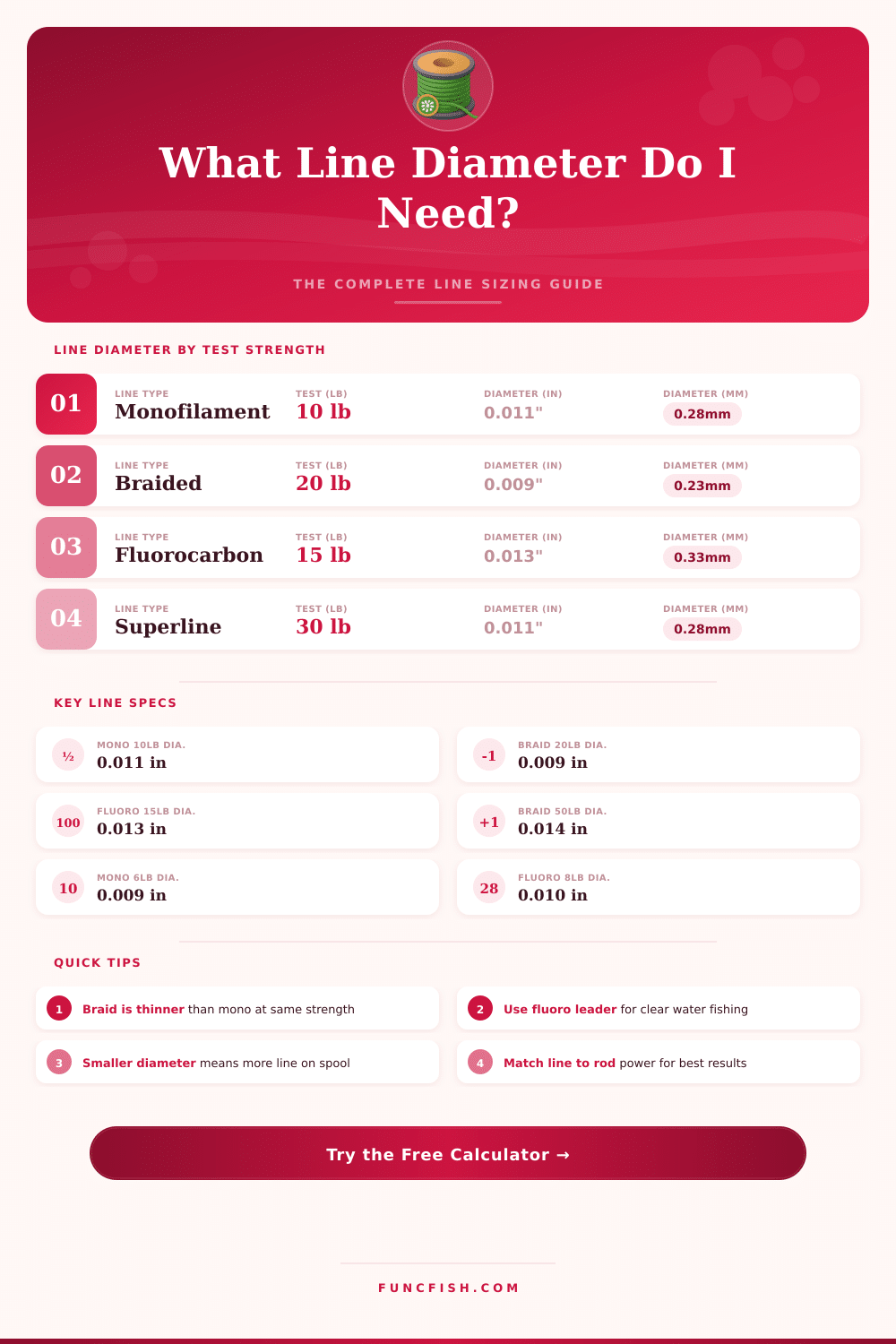
| 10 lb | 0.011 in / 0.28mm | 0.011 in / 0.28mm | 0.007 in / 0.18mm | — |
| 12 lb | 0.013 in / 0.33mm | 0.013 in / 0.33mm | 0.008 in / 0.20mm | — |
| 15 lb | 0.015 in / 0.38mm | 0.014 in / 0.36mm | 0.009 in / 0.23mm | 0.012 in / 0.30mm |
| 20 lb | 0.018 in / 0.46mm | 0.017 in / 0.43mm | 0.010 in / 0.25mm | 0.014 in / 0.36mm |
| 30 lb | 0.022 in / 0.56mm | 0.020 in / 0.51mm | 0.012 in / 0.30mm | 0.018 in / 0.46mm |
| 50 lb | 0.028 in / 0.71mm | 0.026 in / 0.66mm | 0.014 in / 0.36mm | 0.022 in / 0.56mm |
| 80 lb | 0.037 in / 0.94mm | 0.033 in / 0.84mm | 0.018 in / 0.46mm | 0.029 in / 0.74mm |
| 100 lb | 0.043 in / 1.09mm | 0.038 in / 0.97mm | 0.022 in / 0.56mm | 0.033 in / 0.84mm |
| Species | Weight Range | Rec. Test | Best Line |
|---|---|---|---|
| Panfish | 0.1–1 lb | 2–6 lb | Mono / Fluoro |
| Trout (stream) | 0.5–5 lb | 4–8 lb | Fluoro Leader |
| Bass (largemouth) | 1–12 lb | 8–17 lb | Braid / Fluoro |
| Walleye | 1–10 lb | 6–12 lb | Braid + Fluoro |
| Pike / Musky | 5–50 lb | 20–80 lb | Braid + Wire |
| Catfish | 2–100 lb | 20–80 lb | Mono / Braid |
| Redfish | 3–40 lb | 12–30 lb | Braid + Fluoro |
| Striped Bass | 5–80 lb | 20–50 lb | Braid |
| Tuna (offshore) | 20–600 lb | 50–130 lb | Mono / Braid |
| Marlin / Sailfish | 50–1000 lb | 80–130 lb | Mono |
| Property | Mono | Fluoro | Braid |
|---|---|---|---|
| Diameter (10lb) | 0.28mm | 0.28mm | 0.18mm |
| Stretch | 25–30% | 15–20% | <3% |
| Visibility | Medium | Very Low | High |
| Abrasion Res. | Good | Excellent | Moderate |
| Knot Strength | Good | Good | Moderate |
| UV Resistance | Fair | Excellent | Good |
| Water Absorb. | Yes (3–5%) | None | Minimal |
| Spool Fill | Standard | Standard | 3–4x More |
| Tippet Size | Diameter (in) | Diameter (mm) | Breaking Strength | Recommended Fly Sizes |
|---|---|---|---|---|
| 0X | 0.024 in | 0.61mm | 15–18 lb | #2 – #6 |
| 1X | 0.022 in | 0.56mm | 12–15 lb | #4 – #8 |
| 2X | 0.019 in | 0.48mm | 9–11 lb | #6 – #10 |
| 3X | 0.015 in | 0.38mm | 6–8 lb | #10 – #14 |
| 4X | 0.012 in | 0.305mm | 4–6 lb | #12 – #18 |
| 5X | 0.010 in | 0.254mm | 3–5 lb | #16 – #22 |
| 6X | 0.008 in | 0.203mm | 2–3 lb | #18 – #24 |
| 7X | 0.006 in | 0.152mm | 1–2 lb | #22 – #28 |
The diameter of fishing line is something that one does not mention quite a lot, even though it does rank between the most important spots that one must consider during the choice of line. The most easy way to compare various kinds is to observe their real diameter, what helps to ensure that one chooses the right one for the spool.
Here the main problem that confuses many folks. In the American market there are no rules or signs that control the labeling of line diameters of companies. A company can make line and add any weight-test label that it wants.
Why Fishing Line Diameter Is Important
Because of that the 10-pound line of one company could have same diameter as the 12-pound of another. That really helps a brand present his product as more tough than it truly is. Just do the line thicker and label it with a lower weight-test.
One should however check the diameter on the package in the store before buying… This is a wise step.
Braided line is much more thin than mono for same strength. For example, 30-pound braid is much more slim than 30-pound mono. At 20-pound level, the braided line has diameter of around 0.010 inches, while mono reaches 0.016 inches (a difference of 38%).
This small diameter allows that the line slips through water more easily. Braid enjoys popularity between folks that need long spools or high sensitivity to seize bites. Also, it offers very long tension and truly high breaking strength for its diameter.
Fluorocarbon has also more small diameter than mono. It sinks more quickly then mono, what makes it good for reaching rigs more deeply. Besides that, it stretches less, so setting hooks on fish that strikes light can happen more quickly.
Diameters matter not only for comparisons of force. Line with big diameter usually shows more to fishes, what reduces the chance that they grab the rig. When the line is too thick for a small rig, it can block the right motion of it.
That counts also for crawling, pitching or jigging.
PE-ratings form a Japanese method for rating line diameters. On most many spools one finds printed how many metres of a certain PE-line it stores. As a clear guide, the breaking strength is around ten times the PE-rating, so PE 5-line breaks at around 50 pounds at least.
Actually, many lines beat those values in tests.
Braid with 0.07 mm diameter is truly small stuff, used for panfish and small game fish. On the other hand, 4-pound braid could have 0.02 mm, 0.06 mm or even bigger diameter according to the brand. The pound-test relates to breaking strength, not to diameter.
More smart is tochoose line according to diameter than according to assumed test values.